 po polsku
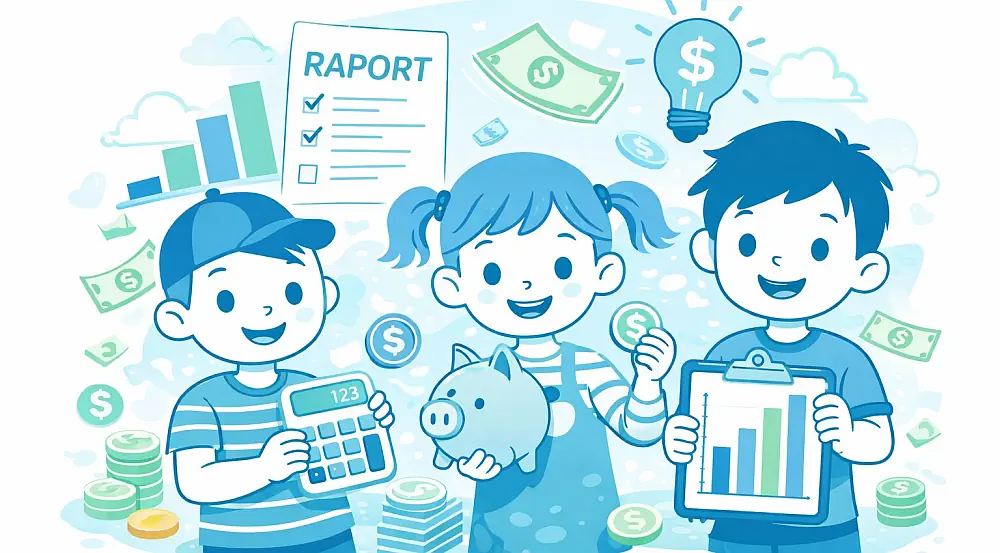 illustration: Ogólnopolski Operator Oświaty Foundation
Money is not a boring theory for children. Over 90 percent of six-year-olds and early elementary school students talk about this subject. Most often at home (79%), during classes with teachers (47%), and also with their peers (19%). These conversations may stem from the fact that even at this stage of life, they have their own money at their disposal.
The evaluation study showed that the vast majority of children who participated in the project (95.5%) declare that they receive money from various sources. Compared to the first Children`s Financial Knowledge Study from 2024, the percentage of students who systematically receive pocket money from their parents has increased (from 33% to 39%). This may indicate more frequent conversations with parents on financial topics and highlighting the need to learn how to manage one`s budget.
Children`s knowledge about finances
The Ogólnopolski Operator Oświaty Foundation, together with KRUK S.A., conducted an Evaluation Study of Children`s Financial Knowledge. It involved students who participated in the project "Learning OOO finances with KRUK S.A"., implemented in ten kindergartens and elementary schools across five voivodeships. The study aimed to answer the question of how a professionally prepared educational path affects the financial awareness and independence of the youngest.
The most interesting conclusions from the study show a clear increase in financial awareness and interest in money-related topics across all age groups. In the most popular topics - saving and prices - the increase in awareness exceeded 20%.
What do you talk about, what do you learn about?
| TOPIC | 2025 | 2026 |
| Saving | 54.8% | 67.3% |
| How much things cost | 39.5% | 48.4% |
| Spending money | 44.8% | 34.0% |
| Borrowing | 21.3% | 31.1% |
| Returning borrowed things and money | 16.44% | 28.7% |
Meanwhile, the mechanism of borrowing and returning borrowed items or money to peers has taken on a completely new meaning. This is a topic of conversation and interest for nearly one in three children:
- 31.1% - borrowing (a year earlier 21.4%, growth dynamic +45%)
- 28.7% - returning (a year earlier 16.4%, growth dynamic +75%)
"Children are already keenly interested in money in kindergarten. It is clearly visible that when they receive reliable knowledge, they are eager to use it and transfer it to everyday situations", assesses Małgorzata Rabenda-Wojas, director of the SPECTO Public Elementary School in Wrocław and author of the lesson scenarios implemented in the project. "Talking about finances is ceasing to be a taboo subject. It is becoming something natural. This is one of the most important achievements of the project".
Relationship and tech. Study about love in the age of likes 👇
"The effects of the project please us for at least two reasons. Firstly, it is clear how much children`s awareness and knowledge of the world of finance has grown. This was the main goal of our project, and we proved that children want and need such knowledge as early as kindergarten", comments Agnieszka Salach, press spokesperson for KRUK S.A. "Secondly, building a sense of financial responsibility and consistency in children regarding borrowing and returning is a great success. As well as the courage to ask for the return of their property. It is here that the improvement in results is record-breaking".
Financial independence
The study also showed how large and important an impact financial education has on children`s independence in the world of money. Children participating in the project not only perform significantly better than in the first edition of the study; they also achieve better results than preschoolers and students of the same age did a year earlier.
- 41.5% of respondents decide on their expenditures independently (a year earlier 26.4%, growth dynamic +57%)
- 38.9% of children receive regular pocket money (a year earlier 32.9%, growth dynamic +18%)
- 73.3% put money in a piggy bank for larger purchases (a year earlier 59.6%, growth dynamic +23%)
- 25.8% are able to ask for the return of a borrowed item or money (a year earlier 16.7%, growth dynamic +54%)
Only one in twenty surveyed children (4.5%) declares that they do not receive money from their parents. In a year, this percentage dropped by one-third. Additionally, only 8% of respondents admit that they cannot do shopping and pay for it independently or together with their parents (a year earlier, 10% of children answered this way).
"It is very important that we managed to combine not only the education of children in this path but also the roles of teachers and parents. The results show that thanks to the children`s involvement in the project, caregivers also actively joined in introducing children to the world of finance", says a pleased Agnieszka Salach. "This is of huge importance because our cyclical Financial Index studies show that it is precisely the attitude and approach of our parents and caregivers that most strongly influence our financial habits in adult life. For 78% of children, parents and caregivers are the most important source of knowledge".
"Parents are increasingly entrusting children with responsibility for small expenses and less frequently imposing their own consumer choices on them. This is a clear change reflected in the growing independence of children", adds Małgorzata Rabenda-Wojas. "Financial education brings the best results when the school and home act together, building responsibility and agency in the child in a consistent way".
How to learn about finances?
The effects of the "Learning OOO finances" educational project show that even one school year can bring real change in children`s financial education. The project is a joint initiative of the Ogólnopolski Operator Oświaty Foundation and the company KRUK S.A. on the occasion of the Year of Economic Education in Poland. It is implemented among preschoolers (5-6 years old) and students in grades 1-3 of elementary schools from twenty institutions in Poland.
It is based on practical lesson scenarios and interactive tools concerning financial issues. Teachers received interesting lesson plans, workshops, and dynamic dexterity games prepared by educators, as well as an educational book about borrowing and returning, written and illustrated by children. Polish educational robots, Photon, help the youngest in learning. Thanks to such a developed educational path, tailored to each age group, children learn:
- what money is and where it comes from,
- how to plan expenses and manage their own budget,
- how important reliability and responsibility are in borrowing and returning borrowed things and money.
Teachers participating in the program emphasize that the level of children`s knowledge after classes grows significantly faster than before the introduction of this project, and students are able to discuss topics that adults previously considered "not for children": about bills, credits, debts, or the necessity of saving.
Meanwhile, the effects of the "Learning OOO finances with KRUK S.A". project showed that early financial education brings real benefits:
- Builds assertiveness. Children learn to care for and ask for their property.
- Shapes an "analyst" attitude. Instead of thoughtless spending, children begin to analyze the value of items and compare prices.
- Strengthens work ethics and the understanding of the link between effort and reward.
- Prepares for adulthood. It teaches risk assessment and responsibility for obligations.
"Many of us still feel that children are too small for conversations about finances and that it is solely an adult matter. Meanwhile, even the youngest children are not only interested in money but actually use it and make decisions. The key, therefore, is how we talk about it", points out Director Małgorzata Rabenda-Wojas. "Education should be engaging, based on examples, but at the same time, from the beginning, it should include risks and consequences. Only then do we build real, responsible financial competencies".
Responsible business
The partnership between KRUK S.A. and the Ogólnopolski Operator Oświaty Foundation is an example of synergy that brings real social benefits. It is proof that well-prepared joint projects allow for moving beyond theory and implementing practical educational mechanisms.
"When creating the assumptions for our joint project, we wanted to fill a certain educational gap. To add elements concerning responsibility, financial consequences, and dealing with difficult situations to the curriculum alongside familiar elements like saving", explains Agnieszka Salach. "The combination of the foundation`s pedagogical experience and our knowledge of financial mechanisms and the world has allowed us to create an educational path that will give children very useful competencies for life".
"Such cooperation allows educational institutions to become a modern source of competencies", emphasizes Anna Wolak, project coordinator at the OOO Foundation. "Our joint project with KRUK S.A. is an excellent example of a well-understood idea of CSR, socially responsible business. Together, we support parents in the upbringing process, laying a solid foundation for the future financial independence of children".
All kindergartens and schools in Poland can use the educational materials from the project "Learning OOO finances with KRUK S.A". The foundation makes them available for free at: https://operator.edu.pl/pl/ooo-finansach/
* CHILDREN`S FINANCIAL KNOWLEDGE STUDY is part of the #OOOfinansach project, implemented jointly by KRUK S.A. and the Ogólnopolski Operator Oświaty Foundation. The second edition (evaluation study) was carried out at the turn of 2025 and 2026. It covered a total of 376 children from 5 kindergartens and 5 elementary schools in 5 voivodeships. Comparative data refers to analogous year groups from the baseline study conducted in the fall of 2024.


COMMERCIAL BREAK

New articles in section
Shaping a company's image in times of legislative changes and crises
artykuł sponsorowany
Effective brand image creation requires the right tools and strategic planning. Do not wait for the moment when you have to go on the defensive. Today, ensure that marketing and image creation work in full synergy.
Jarosław Boberek. When life says "check", he will even stop a train
#pomagam2026
Imagine lying in a hospital after a serious accident. Your terrified loved ones stand around you with tears in their eyes. You, however, start cracking jokes left and right. Sounds like a scene from a movie? For Jarosław Boberek, this was reality. Thanks to this life lesson, today he helps others without hesitation. Quietly, and sometimes even with bravado.
Mateusz Damięcki. From Furioza to saving lives
#pomagam2026
He helps quietly and without unnecessary questions. The famous actor told Paweł Gołębski in the "POSTANAWIAM POMAGAĆ" (I Resolve to Help) podcast about his experiences with charity. It turns out that for the star, asking for support is sometimes harder than the giving itself.
See articles on a similar topic:
How to Register a Company in Madeira and Reduce Tax Expenses
artykuł sponsorowany
How to register a business in Madeira, get tax benefits, and use the island's strategic location for international activities. Madeira offers exceptional economic and tax benefits, making it a prime choice for foreign investors looking to establish a business.
How to teach a preschoolers... to rest? Listen to them!
Małgorzata Cebulska
Does fulfilling dreams have educational value? How much silence fits in 17 square meters? And what impact can a box of mint have on a four-year-old's development? An unusual collaboration between preschoolers and adults brought answers that can and should inspire.
How to Sell Your Luxury Watch Safely and Easily with Expertyco
artykuł sponsorowany
Luxury watches are more than just timepieces; they are symbols of status, craftsmanship, and heritage. Whether you own a Rolex, Patek Philippe, Audemars Piguet, or another prestigious brand, there may come a time when you consider parting with your watch.
Anti-slip soles: what's behind the acronyms SRA, SRB and SRC?
artykuł sponsorowany
Falls on slippery floors are one of the most frequent causes of injuries at work. Especially in Poland, where compliance with BHP standards is mandatory. Anti-slip work shoes with correct labelling can prevent dozens of accidents. But what do the abbreviations SRA, SRB, SRC mean and how not to make a mistake with the choice?