 po polsku
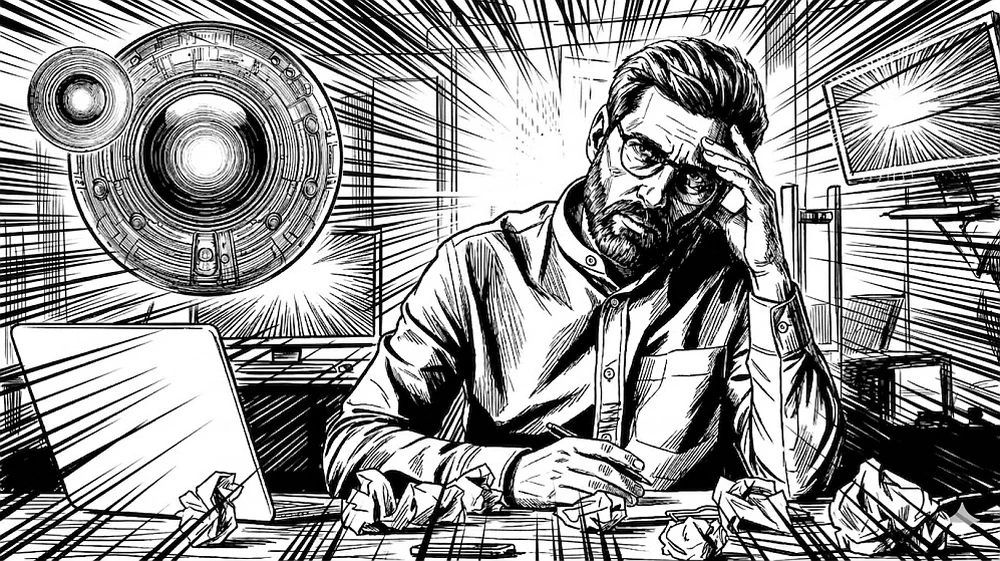 illustration: Gemini
In the film industry, AI tools are already being implemented in editing, subtitle translation, shot searching, virtual production, personalization of the viewer experience, and in experimental projects at the pre- and post-production stages. As in every industry, there is a fear in the film industry that AI may contribute to the replacement of certain job positions with faster and fully automatic solutions that do not require human involvement.
Trade unions and production platforms emphasize that AI is meant to support humans, not replace the author, performer, or rights holder. In what direction all of this will develop, unfortunately, no one knows for sure, and even the best experts are unable to predict exactly what impact the integration of the latest AI technologies will have on the film industry or how artificial intelligence will affect the creativity of film artists.
The greater risk does not concern the "death of art" and creativity as such, but rather the habit of taking shortcuts. Research and official communications show both the productivity benefits and the real danger of over-reliance on the generative properties of AI, especially when the user stops verifying images and ideas. In practice, this means that the future of cinema will depend less on whether algorithms are available and more on whether the industry effectively balances standards aimed at combining the automation of film creation processes with transparency and creative responsibility.
Will AI kill cinema`s creativity? checking how it affects scripts, editing, VFX, and film news
In order not to spread unnecessary panic, which has already taken over the internet, the fairest way to put it is this: artificial intelligence will not destroy the creativity of filmmakers, but it may kill some of their creative habits if it becomes a convenient autopilot. Today, when viewers follow film news on streaming platforms as often as in the cinema, AI is entering the industry not as one big "assistant director," but as a set of specialized tools.
Official materials from Adobe describe functions in Premiere Pro and After Effects that help find a shot faster, extend a clip, or automatically translate subtitles, while Netflix publishes principles for using GenAI in production as "valuable creative aids," provided there is transparency and control. Even the WGA (Writers Guild of America West) sets a hard line: AI is not a screenwriter and cannot be treated as the author of literary material.
This tension is already visible in daily life outside of film. The European Commission reported in February 2025 that over 60% of Europeans view robots and AI at work positively, and over 70% believe they improve productivity. At the same time, 84% of respondents felt that such systems require careful management to protect privacy and transparency. Meanwhile, a 2025 Microsoft Research study showed that generative AI lowers the perceived effort of critical thinking and can reinforce over-reliance on the tool, which weakens independent problem-solving. This is an important lesson for cinema as well: AI can definitely influence the acceleration of production speed, but it can also easily make using "ready-made solutions" a habit.
In graphics, this dispute is even more visible. On one hand, image models are developing rapidly: Adobe is developing Firefly and generative features in Photoshop, and OpenAI released a professional image generation model via API in 2025. On the other hand, pressure is growing to label what has been generated or significantly modified by AI. EU transparency rules provide for the traceability of AI-generated content and the clear labeling of deepfakes, and Adobe is developing Content Credentials—metadata showing who created the material and whether it was generated or edited using AI. In practice, this is a very sensible direction: the mere fact that an image was created with the help of a model does not take away its value, but the recipient should know what they are watching.
In the film industry itself, AI today touches practically the entire work chain. At the scriptwriting stage, it is no longer just about "writing for a human," but about research, organizing versions, mood boards, structural suggestions, or rapid iterations of ideas. The WGA, after the 2023 dispute, won provisions that clearly separate the tool from the author, and Netflix, in its guide for partners, emphasizes that using likeness, personal data, or someone else`s IP requires additional consent and control. This is important because it shows the real state of the market: the industry is not closing the door to AI but is trying to embed it within a framework of responsible production.
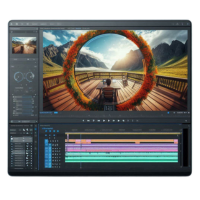
The least controversial and at the same time most practical area is editing and post-production. In the version of Premiere Pro announced on April 2, 2025, Adobe implemented Generative Extend for lengthening shots and audio, Media Intelligence for searching material in massive libraries, and automatic subtitle translation into over 27 languages. These are not "magic movies made without an editor," but solutions that take some of the tedious technical work off the team. And that is exactly the point: AI increasingly takes over time-consuming micro-tasks but does not replace taste, the rhythm of a scene, the feeling for silence, tension, and that one cut that makes a scene work. A tool can generate missing seconds of an image; however, it cannot decide for itself whether a character`s longer gaze strengthens an emotion or kills it.
The situation is similar with special effects and virtual production. NVIDIA now describes AI in film and television as support for the entire workflow: from real-time rendering and AI audio/video effects to data analytics and personalization of the audience experience. The company also shows specific use cases, such as FlixiVerse at Sony Pictures Animation or a 3D scene search tool for ILM. This is good proof that the film industry eagerly uses new technologies when they improve iteration and allow for faster testing of different variants. Creativity does not disappear in such a constellation; it merely shifts from manually "doing everything" toward the automation of tedious processes and choosing the best version from a larger number of possibilities.
However, the most interesting changes are also occurring after the film is finished—in distribution. Netflix officially announced the exploration of generative search for audiences, and its researchers described in 2026 the personalization of artwork using LLM post-training, so that different viewers are shown the most visually attractive representation of the same title. For a viewer who checks film news every day, this means convenience:
- finding "something for themselves" faster,
- more accurately recognizing the mood and theme.
But for creators and publishers, it is also a warning when the algorithm increasingly influences how a film is packaged and to whom it is shown. The risk also grows that a project will be created not for its own artistic language, but for predicted "algorithmic clickability."
And is the industry actually using this yet? Yes—and in very concrete ways.
- On September 18, 2024, Lionsgate announced a partnership with Runway for a model trained on the studio`s own catalog, designed to support filmmakers in pre- and post-production.
- In May 2025, Watch the Skies was described by Flawless as the first feature-length theatrical film to use AI for immersive visual dubbing,
- and in the fall of 2025, the company already reported the debut of this technology in streaming.
These are not, therefore, loose tests in "laboratory conditions," but implementations that touch the real market: studios, distributors, and the finished film reaching the viewer.
The conclusion for now is simple: AI will not kill the creativity of filmmakers if it remains a co-pilot and not the main author. It will only kill it when the industry decides that it is faster and more profitable to automate the creation process and mass-produce, and that a skillful imitation of emotion is enough for the viewer instead of the true, unique exceptionality and depth of human creative thought.
For now, signals from the market say otherwise. Trade unions are fighting for creators` rights, platforms are introducing rules for cautious use, producers are developing transparency tools, and EU regulations are forcing the labeling of synthetic content. All of this together suggests not the end of art, but a new era of film craft in which humans are still responsible for meaning, taste, and creative courage. And that is why the question should not be: "will AI kill creativity?", but: "can creators and studios use AI in a way that does not flatten it?".


COMMERCIAL BREAK
New articles in section Media industry
Information laundering. Russian propaganda returns as news from China
KFi
Russian intelligence agencies use complex tactics to mask the primary source of their harmful narratives. Patrycja Krzyśpiak from NASK details this dangerous process of information laundering in a recent report.
Health disinformation on the internet. Diagnosis from an algorithm
Katarzyna Czechowicz
Health disinformation can cause a cancer patient to see a doctor when it is too late for effective treatment. It can also undermine trust in doctors and public institutions. As a result, people may refuse to cooperate even during a real external threat, experts warn.
Feminatives are not a given. How Polish women talk about their professions
SWPS
Polish women still rarely use female job titles. This comes from the latest report by the Center for Research on Social Relations at SWPS University. Women's professional activity proved to be a significant factor in using feminatives.
See articles on a similar topic:
Media Subscriptions to Replace Advertising. TMT Predictions 2018
BARD
Some publishers already consider attempts to generate revenue from online advertising a waste of time. According to the "TMT Predictions 2018" report by Deloitte, by the end of 2018, half of all adults in developed countries will have at least two online media subscriptions.
Information bubbles. Study of Instagram, Tik Tok and You Tube users
Urszula Kaczorowska
A staggering 96 percent of the time people spend online is spent on anything but consuming information. This, says Professor Magdalena Wojcieszak means ‘we have over-inflated the issue of information bubbles and disinformation.’
New Individual Mass Media (Mass Self Communication)
Grzegorz D. Stunża
In the latest issue of "Le Monde Diplomatique," there’s an article by Manuel Castells titled "Individual Mass Media." The author points out that media, once subjective and often party-affiliated (as with newspapers), only briefly moved away from one-sidedness when under various pressures.
The print media market 2025. Three global trends
Krzysztof Fiedorek
The market value is 359.53 billion dollars, yet the erosion is visible to the naked eye. The decline for newspapers will amount to -2.3 percent. Despite this, print retains strength: it generates 76 percent of subscription revenues and enjoys 82 percent consumer trust. The future of the industry is defined by hybrid strategies and niche specialization.