 po polsku
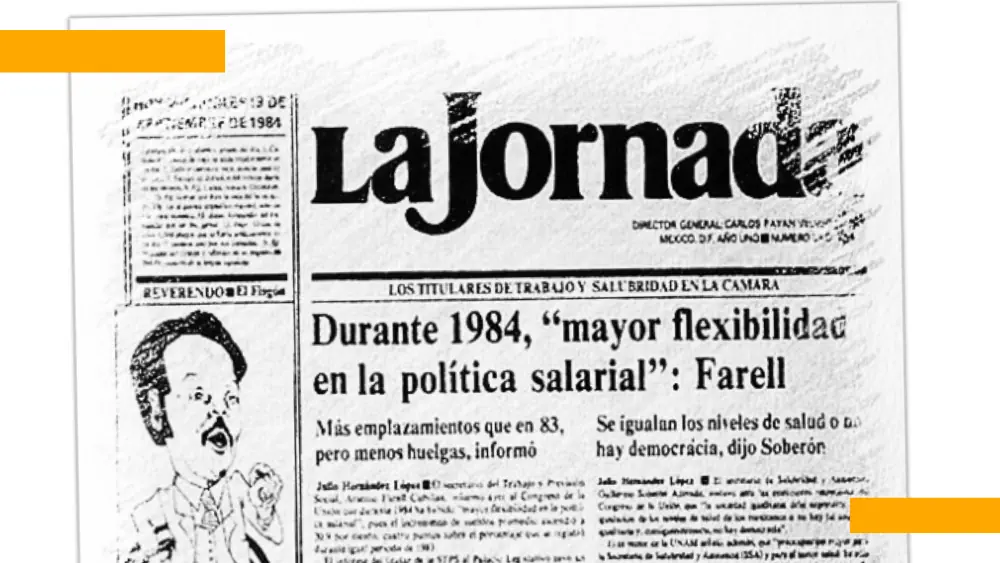 illustration: jornada.com.mx
On the evening of February 29, 1984, in Mexico City, at the Hotel de México, a meeting of people concerned about the country`s welfare took place. The meeting was convened by a group of journalists led by Carlos Payán Velver, who disagreed with the policies of the government and the major national dailies Uno más Uno and Excélsior. The journalists were joined by social activists, scientists, artists, photographers, and even politicians. This multi-professional group made the decision to create a new media outlet providing reliable information.
News of this "went out to the world" in the form of the newspaper`s issue number 0 that very same evening. It was given the name La Jornada (The Day), and it was announced that the daily would be edited by a team of journalists committed to independence and diversity of opinion. Its pages would contain analysis, political information, cultural texts, economic materials, and social articles.
A new day by those and for those who care
However, despite strong motivation and public support, the newspaper would not have appeared without the support of the Mexican artistic elite. An idea is just an idea, and will is just will, but to print a newspaper, money is needed. It turned out that funds were necessary, but not quite as much as expected, because:
- Gabriel García Márquez wrote a report without taking payment;
- Vicente Rojo designed the newspaper without taking payment;
- Juan Sepúlveda rented the editorial office a building at Balderas 68 without taking payment;
- Alberto Bitar made his printing press available without taking payment;
- Manuel Barbachano Ponce dedicated the premiere of the film "Frida", which he produced, to the editorial office;
- housewives, farmers, small business owners, students, human rights defenders, and even the homeless became shareholders of the newspaper (it was enough to pay 20 dollars for this purpose).
Thus was born a new day, the daily La Jornada, whose first issue appeared on September 19, 1984. The group working on this first historic issue included:
- Carmen Lira Saade,
- Carlos Payán Velver,
- Humberto Musacchio,
- Miguel Ángel Granados Chapa,
- Gabriel García Márquez,
- Vicente Rojo.
This was just the core team, as there were many more co-creators. Everyone who cared about the freedom of the press added their brick. Carlos Payán Velver became the director of the newly formed company, Humberto Musacchio his deputy, and Gilberto Meza took charge of the editorial office. In their first collective editorial, they wrote: ...La Jornada appears while Mexican society is still struggling with one of the worst crises in its history and the devastation that this crisis has caused... discouragement and cynicism, that is, the fatalistic acceptance of the fact that as long as the crisis lasts, attempts to repair injustices and shortcomings are pointless...
The money lasted for a week
Vicente Rojo, who was the newspaper`s designer, also took care of the newly created publication`s logo. - I wanted to present an image of the world showing the passage of the day, from morning to night - he said in an interview for the Cervantes Virtual Center. And so, next to the director`s name, just below the title, nested a half sun and a half moon as a whole. They shine to this day.
Although the first issue, which had 32 pages and 4 columns, was a tabloid - though not necessarily of low standards - and was warmly received by readers, the finances only lasted for one week of printing. However, the determination of the journalists, who set themselves the goal of publishing a daily essential for the political, social, and cultural development of the country and providing a voice and platform for social groups that lacked one... brought success and visible results.
This was even more significant because from its early days, the newspaper faced government opposition, which made its activities very difficult. The main problem was the paper supply, which was controlled by the authorities. However, thanks to the support of readers, after a year, this problem was also solved.
The newspaper set clear objectives for itself: honesty, truth, and faithful reporting of national events, which was not at all obvious for other media. Although the beginnings were modest and somewhat unappealing, and opponents called La Jornada the "Nothing-Better" parish bulletin, after a few months, a circulation of 30,000 copies was reached, which was a very good result.
Political humor and caricatures
From month to month, not only the professionalism but also the aesthetics of the publication improved. In addition to interesting texts and a wide range of topics, readers enjoyed the caricatures and political humor for which La Jornada quickly became famous. For years, the main protagonist was the government and its ministers, but current affairs also frequently fell under the judgment of the caricaturists. The leading cartoonists of the daily`s early years included:
- Rafael Barajas Durán (El Fisgón)
- Antonio Helguera Martínez (Helguera)
- Bulmaro Castellanos Loza (Magú)
- Trino Camacho Orozco (Trino)
- Gonzalo Rocha (Rocha)
What was important to everyone was that these were native artists, and although not all were on staff, they tied their fates to the daily for years and decades. Carlos Payán, who was the director but also ran a column of satirical essays called Rayuela, placed great importance on press photography. He sought out the best photographers (Pedro Valtierra, Marco Antonio Cruz), and this department in the newspaper was led by Fabrizio León Diez.
On September 18, 1985, the entire team loudly celebrated their first year of existence. They survived despite the obstacles the government threw under their pens, and they did not suspect that the next day, September 19, they would have to pass their first very important test in journalism.
Always there where something important is happening
At 7:20 AM, as the first issues of the daily were leaving the printing house, the nation`s capital experienced an earthquake measuring 8.1 on the Richter scale. It lasted only 2 minutes, but the destruction was immense. Journalists, reporters, photographers, and even administrative staff, despite a sleepless night, took to the streets - not just for work, but primarily to help. For the following days, the pages of the newspaper featured a record of the tragedy and the heroism of Mexico City`s residents. The newspaper did not just inform; it posted appeals for blood donations, emergency announcements, and information updates. Letters from readers expressing their opinions and comments were printed.
The daily`s audience believed in and trusted their journalists. Two years later, during a student strike, the editors did not fail either. They reported on the situation at the university in real time and were among the few media outlets present at the march on February 9, which resulted in a large panoramic photo and the article La manifestación más grande desde 1968 (The largest demonstration since 1968) on February 10, 1987.
By some strange coincidence, for several years in a row, Mexico`s tragedies occurred on the newspaper`s anniversary. It was the same in 1988, when on September 19, Hurricane Gilbert passed through the state of Nuevo León, destroying everything in its path, and the main headline in the newspaper read: 90 fatalities, 30,000 affected, 200,000 missing. How could one celebrate?
The prestige of La Jornada grows
By the end of the 1980s, La Jornada had consolidated its position in the Mexican media market. Its circulation and reach grew. Alongside names like Elena Poniatowska or Miguel Ángel Granados Chapa, who wrote mainly about politics, new names appeared. The young wanted to learn from their older colleagues. And there was plenty to learn from: Carlos Monsiváis (reporter), Victor Roura (head of the cultural section), Luis González de Alba (column Science in the Streets), or Cristina Pacheco (column Mar de Historias) are just a few names associated with the daily in those years. Some were on staff, and others were just contributors, but everyone wanted to have a text in the pages of La Jornada.
This raised the prestige of the journalist and the rank of the newspaper. They wrote honestly and openly, hiding nothing. The fall of dictatorships (Chile), wars (Somalia, Persian Gulf), elections, and epidemics like AIDS were the main topics of the newspaper`s first decade. The daily did not have its own correspondents, so it relied on information from international agencies, leaving readers the opportunity for opinion and comment. Circulation grew.
But Mexicans did not live by politics alone. A large number of letters to the editor concerned culture. Due to such great interest in this area of life, as early as September 23, 1984, the supplement La Jornada Semanal was created, which became an independent publication starting June 18, 1989. The newspaper`s appearance also improved, as the management invested in a new rotary printing press, and computers appeared in the editorial office.
The uprising in Chiapas
The daily entered the 1990s with a steady step. Spacious, well-composed, with high-quality photos and professionally written texts. Open to the world and the reader. It also had in its set supplements such as La Jornada de Oriente (1991) or the aforementioned cultural supplement. Each department had its own editor-in-chief (head), and everything was invariably managed by Carlos Payán Velver.
In January 1994, the editorial office again faced a great challenge. Readers reported an uprising of indigenous people in Chiapas. Journalists Rosa Rojas and Blanche Petrich set out for that region immediately. The conflict became a global topic, and La Jornada reported on events in real time, siding with the rebels. A debate raged in the newspaper about the conflict and the government`s reaction, and journalists called on society to demand an end to this war.
When the insurgents` manifesto appeared in the newspaper (in full), various types of threats fell upon the editorial office, including death threats and accusations. But the journalists did not give up, and thanks to the newspaper, the news went out to the world. They were not even stopped by the assassination of presidential candidate Luis Donaldo Colosio. This had the opposite effect, and investigative journalists came to the fore, revealing corruption and massive bank embezzlements. Information flowed in a wide river, and when the newspaper gained internet access in 1995, it became even easier to reach recipients. On February 5, the website www.lajornada.unam.mx was launched. In the same year, the newspaper`s digital archive was also started.
Uncomfortable topics in the newspaper`s pages
A year later, changes occurred at the daily. Carlos Payán Velver handed over the reins of the company and the editorial office to Carmen Lira Saade. Saade was a journalist in the nineties with thirty years of experience. She took part in the creation of La Jornada and served as deputy director for information. In 1986, she went to the USA as a correspondent. She returned in 1991 and for the next 5 years was Payán`s deputy. She was a supporter of Fidel Castro and everything happening in Cuba. The effect of this was visible in the pages of the Mexican daily.
She also took care of the native surroundings. On November 14, 1998, the regional edition of the newspaper La Jornada San Luis began. It was the second independent publication after La Jornada de Oriente, which was initially a supplement and has served as a daily since 1994. Currently, the newspaper is available as independent units in 10 regions of Mexico.
In La Jornada, besides more photos, new and not always comfortable topics began to appear. Ruy Pérez Tamayo, a pathologist and immunologist, popularized fields of medicine; Gabriela Rodríguez provided sexual education; Merry MacMasters took on the difficult topic of feminism; and Arnoldo Kraus and Hernán González G. discussed euthanasia. Readers were educated in the fields of economics, archaeology, psychology, and even bullfighting. Care was taken for education and the country`s history.
As Saade herself had been a correspondent for the newspaper (USA), she also took care of that side of information. Increasingly, La Jornada journalists reported directly from various countries, such as Cuba, Germany, France, or Russia. Cooperation developed with newspapers from other countries, whose correspondents` reports were featured in the daily. Robert Fisk and Patrick Cockburn from "The Independent" reported on what was happening in the Middle East, and David Brooks reported on the tragedy of September 11, 2001, in New York and Washington.
La Jornada has enemies too
Despite the sympathy of many readers, the newspaper had and has fierce enemies. Its main opponent was, of course, the government, for whom the journalists did not make life easy. Corruption and irregularities did not stop in the new century; on the contrary, they intensified. Similarly, student protests did not stop. From the first months of 2000, things were heated in the pages of La Jornada.
The daily itself kept its appearance, although a group of graphic designers continued to work on its ever-improving image. New printing machines and computers in the office improved the technical state, but unfortunately, readers still had to wait for color. There were color photos in the supplements, but the basic issues of the newspaper were still black and white, though technically sound.
The first color photo on the front page appeared on June 14, 2004. It was a report by Maria Luisa Severiano from a meeting of Pumas UNAM players with fans after the conclusion of the Mexican Football Championship. Since then, color appeared in La Jornada more and more often.
What was (and is) a curiosity in the newspaper was that the head of the editorial office, commonly called the editor-in-chief, was the general director. In this case, Carmen Lira. The daily was and is an association where decisions are made collectively. Each department has its superior, and the director oversees everything.
The identity of La Jornada
In 2004, the 20th anniversary of the daily was celebrated. On this occasion, Carmen Lira said: ...It is necessary above all for the newspaper to have its own identity. "La Jornada" has built a clear and recognizable identity. (...) This identity is recognized and chosen every morning by readers when they buy the newspaper, and I believe it constitutes the true foundation of pluralism (...) Like any self-respecting press organ, our newspaper has its own editorial line. And talking about an editorial line means talking about a worldview, a vision of society and the nation, and a specific political stance.
The first decade of the new century passed in the editorial office focused on economic and social changes, the war with cartels, and citizen migration. This was documented by journalists such as Karina Avilés, Alfredo Méndez, or Julio Hernández López, but by this time, the editorial staff numbered several dozen full-time journalists. The newspaper had 14 different sections (Política, Economía, Cultura, Deportes), departments like Opinión, or thematic columns like Dinero (money) or Astillero (shipyard, but also a surname).
The daily was transparent, with high-quality large photos, clear navigation, extensive articles, and a left-wing editorial line. The one-sentence essay, Rayuela (from the first issue), and the mandatory logo still existed. The daily even had its foreign stars, like the American Noam Chomsky or the Uruguayan writer Eduardo Galeano, who had been printing their texts in La Jornada for years.
Advertising without excess and a test in journalism
The daily began the second decade of the new era by launching a free application for iPhone and iPad and by opening its accounts on social forums. Although there were no media market studies, in 2010, it was estimated that for a circulation of 35,000-40,000 copies, the newspaper had nearly 280,000 readers in the capital alone and about 180,000 online visits. A satisfying result.
In addition to factual and clear content, readers appreciated that there were no intrusive advertisements in La Jornada. Those that were published were passed through a selection sieve, professionally developed in terms of graphics and content. There was no classifieds, gossip, or sensation section. The principle that the front and back pages looked the same visually was also faithfully observed. Both had a large headline, one clear photo, navigation, the logo, and the Rayuela essay.
Through the decade of 2010-2020, many pieces of content shocking to society appeared across 48 pages. These included the elections in 2012 and 2018, as well as mass kidnappings, drug wars, and protests.
In 2014, La Jornada once again faced a difficult test in journalism. In September, during student protests against educational reform (Yo Soy 132), 43 students went missing. As independent journalistic investigations showed, Mexican authorities and armed forces were involved in this disappearance. La Jornada journalists commented on events in real time, conducted their own investigation, and launched a debate in the pages of the daily.
Blows fall on the editorial office
Unfortunately, 2014 was not a happy year within the newspaper itself either. Trouble began after the 2012 elections when the editorial office came out in favor of the newly elected, right-wing president Peña Nieto. This turn did not please readers, especially since government advertisements also began to appear in the daily. Accusations were made of falsifying photos (September 2011) and of strong political engagement (analysis May 2012), and internet users disliked the use of government money.
Circulation began to fall. Two years later, a bombshell exploded: La Jornada has gone bankrupt! Manager Jorge Martínez Jiménez embezzled 25 million pesos! Although the newspaper did not officially confirm this sensation, the information went to tax authorities, and employees were informed that either their salaries would be cut by 24% or the newspaper would have to be closed. The company had to manage somehow, as the newspaper continued to be printed.
The spring of 2017 brought another blow. On March 23, La Jornada investigative journalist Miroslava Breach Velducea was shot dead, and in May, the daily`s correspondent Javier Valdez Cárdenas was killed. The journalists wrote about drug cartels and their connections with the government. These were not the only victims of this war. According to statistics from Reporters Without Borders, between 2006 and 2018, 102 journalists died in Mexico, and 14 disappeared without a trace.
La Jornada`s popularity bar jumped a bit after the 2018 elections. The newspaper then took a neutral position. It did not negate, praise, or accuse - it described and informed, leaving opinions and comments to the readers.
Four decades of independence
Two years later, another test of life and journalism arrived - the COVID-19 pandemic. A special section was immediately launched in the daily, providing real-time updates on the situation in the country and the world, giving the number of cases, and encouraging vaccinations. The situation in the provinces was reported, and the authorities` attitude toward the situation was commented upon. Over time, in addition to dry facts, reports and articles about problems related to the pandemic began to appear: queues at aid centers, lack of access to tests, or lack of care for the poorest. La Jornada educated and supported its readers.
There were protests during this time. They were related to the pandemic, starting in Jalisco with the fatal beating of a man for not wearing a mask. The protests turned into riots and lasted five days (June 4-9, 2021).
There was no shortage of hot political topics (2021 legislative elections), social topics (Operation Mongoose Azteca against cartels, 2022), or even horror (an attack on a prison in Ciudad Juárez, 19 prisoners died). Nature also did not spare Mexico. In February 2021, 14 people died as a result of a snowstorm, and in October 2023, Hurricane Lidia hit the west coast of Mexico. All this could be read in La Jornada.
Despite difficulties and setbacks, the daily`s 40th birthday was celebrated in September 2024. The editorial office summarized these four decades as a historic record of daily news in politics, history, economics, and culture, and furthermore:
- the daily was a harbinger of the rebirth of independent media;
- it took part in the historic events of the country;
- from its early days, it established a bond with readers;
- it fulfills the mission set in its early days;
- it takes an active part in the democratic life of the country;
- it is a participant in political, social, and cultural debates;
- it remembers those who have passed and continues to fulfill their principles and dreams.
Nothing more to add... may it continue this way.
Timeline of La Jornada:
- 1984, February 29 - issue zero of La Jornada
- 1984, September 19 - first issue of the daily
- 1984, September 23 - first (cultural) supplement La Jornada Semanal
- 1985, September 19 - earthquake as an important test in journalism
- 1989, June 18 - La Jornada Semanal becomes an independent publication
- 1991 - first regional edition of the daily, La Jornada de Oriente as a supplement, an independent publication since 1994
- 1994, January - an uprising of Mexico`s indigenous population broke out. The newspaper sided with the rebels
- 1995 - the newspaper`s digital archive was launched
- 1995, February 5 - start of the website www.lajornada.unam.mx
- 1998, November 14 - the regional edition La Jornada San Luis starts
- 2004, June 14 - first color photo on the front page
- 2010 - application for iPhone and iPad
- 2010 - first social media accounts
- 2012 - the left-wing newspaper supported a right-wing president
- 2014 - threat of the daily`s closure (millions of pesos were embezzled)
- 2017, March 23 - investigative journalist Miroslava Breach Velducea was shot dead
- 2017, May 15 - correspondent Javier Valdez Cárdenas died as a result of an assassination
- 2020-2022 - the newspaper in the trenches of COVID-19
- 2024, September - solemn celebration of the 40th anniversary
sources:
- https://www.jornada.com.mx/pagina/quienes-somos
- https://web.archive.org/web/20060406181451/http://www.pulso.org/Espanol/Nuevos/transparencia%20prensa020809.html
- https://fr.wikipedia.org/wiki/La_Jornada
- https://www.jornada.com.mx/
- https://web.archive.org/web/20121129064631/http://aniversario.jornada.com.mx/
- https://www.proceso.com.mx/nacional/2021/8/17/televisa-tv-azteca-la-jornada-concentran-286-de-la-publicidad-oficial-270028.html
- https://agenciainformativaudem.com/2022/06/29/carmen-lira-saade/
- https://www.lajornadamaya.mx/opinion/236882/cuatro-decadas-de-la-jornada
- https://www.lajornadamaya.mx/opinion/236882/cuatro-decadas-de-la-jornada
- https://www.facebook.com/photo.php?fbid=1051639726971087&id=100063752070542&set=a.526410302827368
- https://www.jornada.com.mx/2016/02/28/cultura/a07n1cul
- https://www.jornada.com.mx/2009/04/06/politica/015n1pol
- https://www.pressreader.com/newspapers/n/la-jornada/issues?srsltid=AfmBOorXRaxulQpBkttdCwdqpzgli-2bCR3edcE39u4lBA9nAoKYt5Zt&page=411
- https://en.granma.cu/cuba/2024-09-20/la-jornada-the-flagship-newspaper-of-the-latin-american-left-turns-40-years-old
- https://www.lajornadamorelos.mx/editorial/40-anos-de-ser-parte-y-motor/
- https://aristeguinoticias.com/1909/mexico/la-jornada-30-anos-de-hacer-periodismo-critico/
- https://ensada.over-blog.es/article-periodico-jornada-mexico-caracteristicas-historia-ideologia-85948927.html
- https://mtpnoticias.com/nacion-y-mundo/nacional/la-jornada-impresa/
- https://www.revlat.com/single-post/2018/12/20/fotoperiodismo-mexicano-portadas-y-contraportadas-del-diario-la-jornada-una-forma-de-hist
- https://www.jornada.com.mx/1998/11/15/presento.html
- https://web.archive.org/web/20020406010210/http://www.jornada.unam.mx/1999/sep99/990920/sup-periodismo.html
- https://links.org.au/mexicos-leftist-la-jornada-25-years-rabble-rousing?utm_source=chatgpt.com
- https://cpj.org/es/2017/05/asesinan-a-javier-valdez-cardenas-periodista-mexic/?utm_source=chatgpt.com
- https://polemon.mx/quiebra-tecnica-en-la-jornada/?utm_source=chatgpt.com
- https://etheses.whiterose.ac.uk/id/eprint/2846/1/Change_and_continuity_in_Mexican_Journalism_The_case_of_Morelia_Ruben_Gonzalez.pdf?utm_source=chatgpt.com


COMMERCIAL BREAK

New articles in section History of the media
Havas. The history of the world's first news agency
Małgorzata Dwornik
The idea of two bankrupt Frenchmen in 1835 turned out to be brilliant: use information as a commodity. Along with translators, messengers, and correspondents, they hired a flock of carrier pigeons. These birds carried news from London to Paris in a single day. The product of L'Bureau Havas quickly became popular far beyond Europe.
România Liberă. 150 years of history of the Romanian press
Małgorzata Dwornik
On May 14, 1877, Romania officially declared independence from the Ottoman Empire, and just one day later, the newspaper România Liberă (Free Romania) appeared on the Bucharest market. Its founder, first director, and journalist was Dimitrie August Laurian, strongly supported by Professor Ştefan Mihăilescu.
El Mercurio de Valparaiso from Chile. The oldest Spanish language newspaper in the world
Małgorzata Dwornik
The first issue started a revolution in South America. It survived 200 years of turbulent history: headquarters fires, editorial office looting, economic crises, and dictatorship. Today, El Mercurio de Valparaiso holds a unique status in the Chilean media market. And the title of a UNESCO World Heritage site.
See articles on a similar topic:
It all began with a one-letter typo. The story of Oprah Winfrey
KFi
One misplaced letter on her birth certificate turned Orpah into Oprah, and one charismatic hour each afternoon turned a local talk show into a cultural super-power. Here’s the story of a girl in potato-sack pants claimed the throne of TV and talk-shows.
La Stampa. The history of the oldest newspaper in Italy
Małgorzata Dwornik
It was founded in Turin as Gazzetta Piemontese. Over more than 150 years, it built its position as an iconic title not only in the Italian press market. It survived attacks from fascists, terrorists, and even Muammar Gaddafi. Even in the era of the internet, it continues to perform exceptionally well.
Fredrik Carl Mülertz Størmer. Story of the first paparazzo in the world
Małgorzata Dwornik
The combination of fascination and shyness gave birth to the profession of taking hidden photos, a practice now used by paparazzi. The pioneer of this was a Norwegian scientist, a brilliant mathematician, and astrophysicist who combined Nikola Tesla's techniques with military spy technology. He confessed to this only at age 70. Here is the story of Professor Fredrik Størmer, the world's first paparazzo.
Ràdio Andorra. The Legend of the Station That Greeted in Three Languages
Małgorzata Dwornik
From its inception, the station broadcasting from the tiny Principality of Andorra in the Pyrenees was a thorn in the side - first to the Germans, then the French, and the Spanish. The conflict over Ràdio Andorra even led to the border being closed to... sheep. After four decades of struggle, the station, known across Europe and the USA, fell silent. But was it forever?