 po polsku
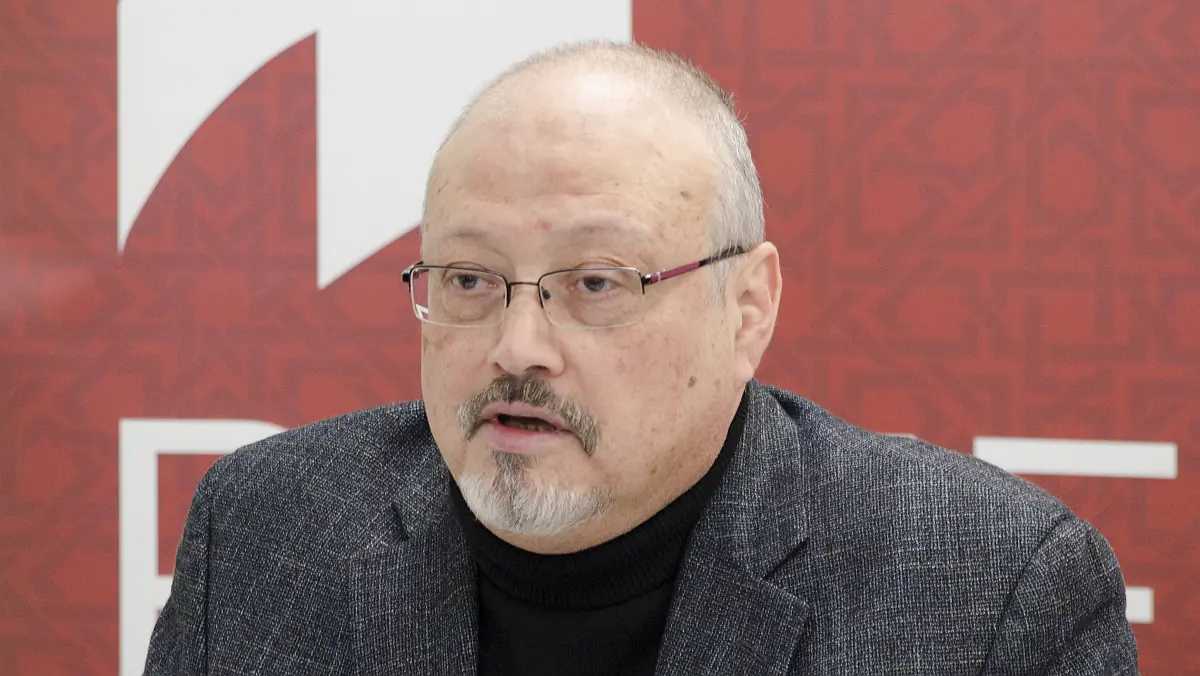 fot. April Brady • CC BY 2.0 • Wikimedia
At the turn of the 1950s and 60s, Saudi Arabia was already overflowing with oil wealth. Although this resource brought economic development and international prestige, the policy of the rulers consisted of "splurging" money, a carefree life, and very generous gestures towards themselves. This led to massive budget deficits, foreign debts, and consequently – a decrease in the standard of living for the average Saudi. The royal family was divided, which also did not help in creating a positive image of the rulers.
In such times, in 1958, Jamal Ahmad Hamza Khashoggi was born into a family with Turkish roots. He was born on October 13 in Medina, one of the oldest and most important cities in Islamic culture and history. Young Jamal`s family belonged to the elite befriended by the royal family. Raised in prosperity, the boy received his primary and secondary education in his home country but went to the USA for university.
There, in 1982, at Indiana State University, he received a bachelor`s degree in business administration, after which he returned home. For a year, he worked as a bookstore manager, and in 1984, he took a job at the English-language daily Saudi Gazette and the Arab-Saudi newspaper Okaz as a reporter. For two years, he wrote about current affairs, sympathized with the Muslim Brotherhood, and although he was a believer, he never joined its ranks, and after a few years, he changed his political orientation. Years later, he recalled that he was... too Islamist for secular liberals, but too liberal for traditional, conservative Wahhabis.
First interview with bin Laden
In 1986, he moved to the English-language daily Arab News, and in the following years (1987-1990), he began collaborating with other newspapers and magazines such as Asharq Al-Awsat, Al Majalla, and Al Muslimoon. He became a correspondent in Sudan, Kuwait, Afghanistan, and across the Middle East. It was for Al Majalla in May 1988 that he conducted his first interview with Osama bin Laden as the leader of the winning side in the war with the USSR. The extensive and flattering text for Islamists, along with photos, appeared on May 4 in the 430th issue of the daily, while its author, an opponent of communism and a sympathizer of the Brotherhood, moved to Kuwait and enrolled in the university there.
He never hid his acquaintance with Osama. They knew each other, and it was bin Laden who invited him to Pakistan, where Al-Qaeda was being formed. In his first report for Arab News, he recalls the event like this:
"I interviewed Osama. [He was] a mild, enthusiastic young man who did not say much and did not raise his voice during the conversation. [We talked] about the situation of the Mujahideen and what [bin Laden] was doing to help them. I did not know him well enough to judge him or expect anything else from him. His behavior at that time did not leave the impression that he would become who he became."
They met several more times, but their paths diverged. Over time, Khashoggi came to consider bin Laden a terrorist, which excluded him from the journalist`s circle of acquaintances and placed him in opposition to his own views.
Risky topics. Uncomfortable questions
In 1991, Jamal was appointed editor-in-chief of Al Madina, where he spent the next eight years. However, he was not an editor who wrote from behind a desk. He simultaneously became a correspondent for his own newspaper. Even then, he was considered an expert on the Middle East. His articles were printed by popular newspapers in Arab countries, his opinions were cited by dailies worldwide, and his first reports as editor-in-chief came from the Persian Gulf and the military operations taking place there (First Gulf War, 1990-1991). At the same time, he established cooperation with the Saudi Intelligence Agency through Prince Turki bin Faisal, becoming an advisor to the royal family for several years.
For eight years, he wrote not only about foreign affairs but also about the troubles of his own country. The Iraqi missile attack in February 1991 on the barracks of American soldiers stationed in Dhahran, the bombing in Riyadh in front of the OPM-SANG headquarters on November 13, 1995, or the great fire in Mecca on April 15, 1997, are just a fraction of what Saudi Arabia and Khashoggi himself were living through. Sympathizing with US policy, he spoke more and more often about terrorism and social injustice. He criticized the lack of reforms, the weaknesses of various institutions, and problems with education, touching on the relationship between Saudi Arabia and Islamic politics—all topics balancing on the edge of safety: could one speak about this or not?
In 1999, Khashoggi left Al Madina and moved to the Arab News daily, where he became deputy editor-in-chief. He remained in this position until 2003. It was here that he experienced the attacks of September 11, 2001, which he called an attack on tolerance, coexistence, and Islam itself, openly labeling Osama bin Laden a terrorist. He presented his views and concerns in the October 11, 2001 issue in the article "Afghanistan and Pakistan: Time to close old chapters", and two months later supported American policy in the article "Marines prepare prison camp for Al-Qaeda" (December 16, 2001, Arab News).
52 days of freedom and a professional ban
For four years, he focused mainly on Afghanistan, security, and terrorism. In this context, he conducted many interviews with politicians from various countries, which sometimes resulted in rather sharp articles. However, he was never accused of even the slightest fanaticism, but rather treated as a journalist who obtains and presents facts and concrete sources. He was considered an objective journalist, which is perhaps why in 2003 he was offered the leadership of the young daily Al Watan (Saudi Arabia), but the authorities miscalculated. Khashoggi criticized the influence of religious authority on the country`s politics. He wrote:
"At the moment, I don`t believe we need to create an Islamic state. I think an Islamic state would be a burden, it might collapse, and people would be very disappointed. It might shake our faith in faith if we insisted on creating an Islamic state… The Quran emphasizes that imposing religion on others is forbidden… There is no compulsion in religion. It is a matter of choice."
As a result, he was fired after 52 days and, to top it off, was banned from practicing journalism. Since he could not find work on his native soil, he first went to London and then to Washington. He served as a media advisor to Turki al-Faisal, who held the post of Saudi Ambassador, and since the men knew each other...
Jamal returned to Al Watan in 2007 when his professional ban was lifted, and this time he remained in the editor-in-chief`s chair for three years. The newspaper`s board set three conditions for Khashoggi:
- He must stay in the position of editor-in-chief for longer than two months (as a joke).
- He must ensure the newspaper does not lose its quality or its spirit.
- He himself must not overstep his bounds.
Journalism as a mission? Less and less so
Regarding his return to the daily and the profession, he said in an April 25, 2007 interview for Al-Awsat:
"They chose me because they need a professional journalist. They saw in me the experience that would allow me to successfully manage a prosperous newspaper."
In the same interview, he presented his plans for running the paper and, along the way, defined his attitude towards journalism:
"I am no longer convinced of the old concept that journalism is a mission. Now I believe that a newspaper is a public service, like water and electricity. This is where the idea of a mission came from, which includes preaching, advising, enlightening, and educating. More precisely, it provides the reader with information, both political and economic, and even those that may seem less important, like restaurant reviews, but are of interest to the customer [reader]."
He admitted that working in diplomacy taught him a different perspective on the ruling sphere, and he indeed used those experiences, though he did not avoid difficult topics. As promised, he did not overstep his bounds, but he did not remain silent either. The newspaper touched on significant issues:
- Women in the Islamic world.
- Is the Mutawwa (Committee for the Promotion of Virtue and the Prevention of Vice) needed by society?
- What influence do Islamic scholars have on the country`s politics?
- The death penalty.
Despite his best efforts, he left the Al Watan editorial office in May 2010. The official version was: "...he resigned to focus on his personal projects," but unofficially it was known that it was over an article by Ibrahim al-Almaee that criticized Salafism (a movement of Islamic revival), and Jamal`s resignation (or dismissal) took place three days later. He himself said in an interview for Al Arabiya News on May 16, 2010:
"There is no successful editor-in-chief who would willingly resign, but special circumstances prompted me to take this step… The newspaper was very successful and did not encounter any problems or pressures, but for anyone who works in journalism, there are successes and mistakes… Unfortunately, some remember only the mistakes and forget the successes. I covered the reforms taking place in the kingdom, and this type of coverage will continue, and the newspaper will remain the same."
Al-Arab. 24 hours of impartial news television
Khashoggi was not unemployed for long, as in June Prince Al-Waleed bin Talal appointed him head of the newly created 24-hour news channel Al-Arab. Preparations to launch the channel took 5 years. During this time, Jamal formed a team, wrote projects, and signed partnership agreements (Bloomberg). In 2013, he published two books: "The Occupation of the Saudi Market" (about foreign business taking over the Saudi market) and "The Arab Spring in the Times of the Muslim Brotherhood" (a collection of modified articles from the beginning of the Arab Spring).

In addition, he wrote articles for various websites and appeared as an expert and Middle East commentator for Saudi and international channels such as MBC, BBC, Al Jazeera, and Dubai TV. Simultaneously, from June 2012 to September 2016, he wrote columns for the Al Arabiya news channel.
On February 1, 2015, the Al-Arab station began broadcasting from Manama, Bahrain. Khashoggi had a team of 280 people across 30 countries, including 20 correspondents in Saudi Arabia.
"The launch of Al-Arab is a response to a real need for an independent and impartial channel," Jamal said at the station`s inauguration.
The channel`s first topics were:
- the deprivation of citizenship of 72 people,
- the murder of a Japanese hostage,
- political chaos in Yemen,
- the wave of violence in Egypt.
The station, intended to compete with Al Jazeera and Al Arabiya, operated for only 24 hours before the channel was closed. According to the Bahrain Information Affairs Authority, "it was decided to suspend the operations of Al-Arab because the channel did not obtain the necessary permits," but the newspaper Akhbar Al-Khalij revealed that "the broadcasting ban relates to the fact that the channel`s managers were not neutral and that they should not discuss anything that could have a negative impact on the union of Gulf countries and its political orientation." Thus, Jamal Khashoggi broke his own record for being a boss.
Criticism of Trump and a publishing ban
For the next two years, he wrote as a freelance journalist. In December 2016, British media reported that Saudi authorities had issued a ban on Jamal Khashoggi publishing or appearing on television "for criticizing the newly elected US President Donald Trump." Jamal confirmed this on his blog and added that he was banned from using Twitter and ordered to remove his article from Al-Hayat.
Khashoggi increasingly felt the authorities` animosity toward him, so in the summer of 2017, he left the country and emigrated to the USA. He settled in McLean, Virginia, and became an official journalist for the Washington Post (October 2017). He also wrote for Middle East Eye. He was well known for his views, so they were eager to collaborate with him. At the American daily, he ran the Global Opinions column in both print and digital versions. His first article appeared on September 18, 2017, titled: "Saudi Arabia wasn`t always this repressive. Now it’s unbearable." In it, he admitted that he left the country, like several others, because he feared for his life. In his subsequent texts, he heavily attacked his country, exposing not only its poor foreign policy but also its domestic policy:
- "Saudi Arabia’s crown prince wants to `crush extremists.` But he’s punishing the wrong people" (October 31, 2017).
- "Saudi Arabia’s crown prince is acting like Putin" (November 5, 2017).
- "What Saudi Arabia could learn from South Korea about fighting corruption" (January 8, 2018).
- "By blaming 1979 for Saudi Arabia’s problems, the crown prince is peddling revisionist history" (April 3, 2018).
- "Saudi women can finally drive. But the crown prince must do much more" (June 25, 2018).
- "The Saudi crown prince must restore dignity to his country — by ending the cruel war in Yemen" (September 11, 2018).
These are just some of Jamal`s weekly columns.
Premeditated murder
On October 4, 2018, there was only a white space in the Global Opinions column. Jamal Khashoggi had vanished without a trace. On October 2, he entered the Saudi Arabian consulate in Istanbul and never came out. The first reports of the journalist`s disappearance were released by Reuters later that same day. Mutual accusations lasted for several days. The Turks claimed that the Saudi government had issued a death sentence for the journalist; the Saudis denied it. On October 11, the Washington Post was the first to report its employee`s death and that there was evidence in the form of video and audio tapes.
An investigation was launched. On October 25, the Attorney General of Saudi Arabia officially admitted that Jamal Khashoggi was dead and his murder was premeditated. The world blamed the Saudi Crown Prince, Mohammed bin Salman, whom Jamal had relentlessly attacked and accused of the country`s failures. The Prince naturally denied it, but on June 19, 2019, the UN published a report in which investigators confirmed there was credible evidence that bin Salman was responsible for the journalist`s death.
The Jamal Khashoggi case remains controversial and subject to conflicting opinions today. In December 2019, Saudi Arabia sentenced five potential killers of the journalist to death, but his children forgave them six months later (in May 2020), which in Saudi law means commuting the sentence to prison. In subsequent years, new facts came to light, and on February 26, 2021, a declassified US intelligence report was published regarding bin Salman`s involvement in Jamal`s murder. Meanwhile, the Prince became his country`s Prime Minister in 2022.
DAWN and the digital library. Without censorship
Months before his death, Khashoggi announced the creation of an organization working to defend rights in the Arab world – Democracy for the Arab World Now (DAWN). For obvious reasons, the work was suspended. On September 27, 2020, DAWN launched with doubled strength, and Jamal is officially its founder and patron.
It's NOT king anymore. Study about video in social media 👇
Although his articles are banned in Saudi Arabia, the Reporters Without Borders foundation established The Uncensored Library in 2020 – a digital library bypassing censorship, where one can read Jamal`s texts from his Arab career. On June 15, 2022, the street in Washington where the Saudi Arabian embassy is located was renamed Khashoggi Way. Two documentary films dedicated to Jamal`s memory have also been produced.
Jamal Khashoggi made his mark in the history of journalism – not only Arab but global. The whole contemporary world learned of his tragic death. On October 16, 2018, two weeks after his death, the Washington Post published Jamal`s last article: "What the Arab world needs most is free expression", and in it:
"Absolute power is a mistake, regardless of how much the country is in danger and needs rescue. We Arabs had bad experiences with seemingly sincere, patriotic leaders who too quickly transform into dictators. It is from such leaders that our suffering, hardships, failures, and civil wars largely stem."
And that is perhaps the problem of the whole world.
Biography of Jamal Khashoggi:
- 1958, October 13 - Jamal Khashoggi was born
- 1982 - graduated from university in the USA
- 1983-1984 - worked as a bookstore manager
- 1984-1986 - worked as a reporter for Saudi Gazette and Okaz
- 1986 - beginning of cooperation with Arab News
- 1987-1990 - became a correspondent in Afghanistan for several Arab newspapers
- 1988, May 4 - first interview with Osama bin Laden
- 1991 - became editor-in-chief of Al Madina
- 1999 - full-time job as a journalist at Arab News (deputy editor-in-chief)
- 2003 - tenure as editor-in-chief of Al Watan lasted only 52 days
- 2003-2007 - held the position of media advisor to the Saudi Ambassador in London and Washington
- 2007, April - became editor-in-chief of Al Watan again
- 2010, May - left Al Watan
- 2010, June - appointed director of Al-Arab news channel
- 2012-2016 - columns written for Al Arabiya
- 2013 - two books by Khashoggi were published: The Occupation of the Saudi Market and The Arab Spring in the Times of the Muslim Brotherhood
- 2015, February 1 - first broadcast on Al-Arab (closed after 24 hours)
- 2015-2017 - worked as a freelance journalist
- 2017 - founded Democracy for the Arab World Now (DAWN), which officially began its activities on September 27, 2020
- 2017, August - emigrated permanently to the USA
- 2017, October - began working for the Washington Post
- 2018, October 2 - Khashoggi entered the Saudi Arabian consulate in Istanbul and disappeared
- 2018, October 11 - Washington Post released the official news of Jamal Khashoggi`s death
Sources:
- https://jamalkhashoggi.com/index.php/about-me/
- https://edition.cnn.com/world/middleeast/jamal-khashoggi-fast-facts
- https://www.magnitskyawards.com/bios/jamal-khashoggi/
- https://www.guillaume-dasquie.fr/secret-jamal-khashoggi/
- https://edition.cnn.com/2018/10/22/opinions/khashoggi-was-journalist-not-jihadist-bergen/index.html
- https://www.theguardian.com/world/2018/oct/19/jamal-khashoggi-obituary
- https://en.wikipedia.org/wiki/Jamal_Khashoggi
- https://archive.ph/20130616121018/http://www.aawsat.net/2007/04/article55262916
- https://archive-forum.aljazeera.net/speakers/jamal-khashoggi
- https://www.bloomberg.com/news/articles/2018-10-17/khashoggi-s-name-runs-through-middle-east-history?embedded-checkout=true
- https://archive.ph/20130616121018/http://www.aawsat.net/2007/04/article55262916
- https://web.archive.org/web/20171019215534/https://www.alarabiya.net/articles/2010/05/16/108790.html
- https://jamalkhashoggi.com/
- https://www.deutschlandfunkkultur.de/aus-den-feuilletons-die-helden-der-freiheit-muessen-100.html
- https://www.20minutes.fr/monde/1530551-20150201-chaine-alarab-prince-saoudien-al-walid-commence-emettre
- https://www.bbc.com/news/world-middle-east-45923217
- https://www.washingtonpost.com/people/jamal-khashoggi/
- https://www.aljazeera.com/news/2019/10/2/jamal-khashoggi-case-a-timeline-of-events-surrounding-his-murder
- https://www.liberation.fr/planete/2018/10/05/qui-est-jamal-khashoggi-journaliste-saoudien-disparu-a-istanbul_1683264/
- https://www.magnitskyawards.com/bios/jamal-khashoggi/
- https://abcnews.go.com/International/timeline-disappearance-journalist-jamal-khashoggi/story?id=58505659
- https://www.washingtonpost.com/news/global-opinions/wp/2018/10/06/read-jamal-khashoggis-columns-for-the-washington-post/


COMMERCIAL BREAK
New articles in section History of the media
Havas. The history of the world's first news agency
Małgorzata Dwornik
The idea of two bankrupt Frenchmen in 1835 turned out to be brilliant: use information as a commodity. Along with translators, messengers, and correspondents, they hired a flock of carrier pigeons. These birds carried news from London to Paris in a single day. The product of L'Bureau Havas quickly became popular far beyond Europe.
România Liberă. 150 years of history of the Romanian press
Małgorzata Dwornik
On May 14, 1877, Romania officially declared independence from the Ottoman Empire, and just one day later, the newspaper România Liberă (Free Romania) appeared on the Bucharest market. Its founder, first director, and journalist was Dimitrie August Laurian, strongly supported by Professor Ştefan Mihăilescu.
El Mercurio de Valparaiso from Chile. The oldest Spanish language newspaper in the world
Małgorzata Dwornik
The first issue started a revolution in South America. It survived 200 years of turbulent history: headquarters fires, editorial office looting, economic crises, and dictatorship. Today, El Mercurio de Valparaiso holds a unique status in the Chilean media market. And the title of a UNESCO World Heritage site.
See articles on a similar topic:
The History of Radio Broadcasting
Agnieszka Osińska
Radio emerged almost simultaneously with film at the dawn of the 20th century, as the growth of the press pushed culture past the so-called second threshold of mass distribution. Alexander Popov and Guglielmo Marconi are considered its pioneers, though only Marconi succeeded in patenting the invention.
MONCAME. The news agency from Mongolia transmitted in Morse code
Małgorzata Dwornik
The first telegraphic dispatch from March 18, 1921, was published only by the Soviet Pravda. The first country to recognize it as an official source of information was South Africa in 1922. The hallmark of the Mongolian news agency MONTA, now MONCAME, was transmitting dispatches in Morse code.
The History of Television
BARD
In 1875, Ernest von Siemens constructed the first photocell. Two years later, Julian Ochorowicz, a Polish psychologist, developed the theoretical foundations of monochromatic television. In 1924, Scotsman John Baird transmitted an image over a distance. In Poland, we waited until 1952 for the first broadcast.
Bravo. History of a sixty-year-old magazine for the youth
Małgorzata Dwornik
The idea of creating a newspaper for the "crazy kids" of the 1950s and 60s turned out to be a bullseye. Music and film stars, important topics and taboo-breaking pieces that flirted with scandal - that was the recipe for success. Circulations in the millions are now a thing of the past, but BRAVO still manages to reach teenagers. It’s building its presence on social media.