 po polsku
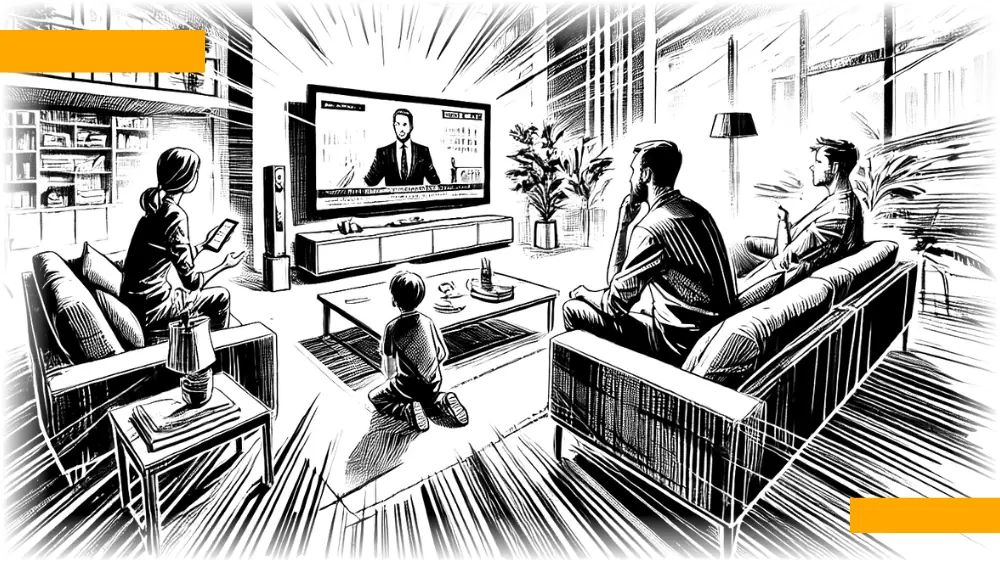 illustration: DALL-E
1,060 Polish women and men participating in the SW Research study commissioned by the MEGOGO platform declared which devices they use most often to watch video content.
The smartphone was indicated in first place by 73.9% of respondents. 68.6% preferred the TV, while more than every second respondent (50.8%) chose a desktop computer or laptop. Less popular were: tablets - 17.1%, gaming consoles / VR - 5.9%, and projectors - 4.3%. The question was multiple-choice, so respondents could select several answers, indicating their most preferred devices.
Declarations are one thing – hard data says another
MEGOGO`s own data differs from the earlier declarations of respondents in the study conducted by SW Research.
More than one in three (34.58%) people using the MEGOGO streaming service, which offers online TV and access to an SVOD catalog, used it on a Smart TV. Adding to this TVs with Android TV (10.15%) and tvOS (0.19%), a total of 44.92% of users watched content on MEGOGO on their television sets.
| Device | Percentage share |
|---|---|
| Smart TV | 34.58% |
| Computer or laptop | 23.50% |
| Android mobile | 17.31% |
| Android TV | 10.15% |
| Mobile websites | 8.37% |
| iOS mobile | 5.03% |
| Tablet | 0.74% |
| tvOS | 0.19% |
| VR | 0.00% |
Smartphones were used for this purpose by more than every fifth person (22.48%), which consisted of traffic from mobile devices with Android (17.31%), iOS mobile (5.03%), and smartphones with other operating systems (0.14%). Additionally, including users of mobile websites who might, for example, watch content on a smartphone but did not use the app (8.37%), we get a total of 30.85%.
A computer or laptop was also chosen for this purpose by nearly every third user (23.50%). In contrast, tablets accounted for 0.74%. VR users should be viewed as a statistical error in this context.
- Such significant differences between the declarations of respondents participating in the SW Research study and MEGOGO`s hard data may result from several issues. The research methodology, which allowed for multiple choices, plays a key role. Respondents indicated their most preferred devices. Another important issue is the understanding of the question in the SW Research study, where we asked about video content in general – not just that watched on streaming platforms, but also on YouTube or other services - comments Artur Pacuła, CEO of MEGOGO in Poland.
This is how the habits of Poles regarding video content will change
The study by SW Research and MEGOGO also concludes that only 1 in 100 surveyed Poles (1.2%) "watches more television or has seen no changes in video content consumption compared to 10 years ago." This was one of the answers to the question: "How have your content viewing habits changed over the last 10 years?". Among the most popular answers was: "we watch less television," indicated by 51.5%. Second place: "we spend more time on YouTube" - 42.2% of indications. Right behind: "we watch more on streaming services" - 41%. The option "we mainly use mobile applications" was chosen by 18.8% of respondents.
To the question: "How will your main habits regarding watching content online change? What do you expect?"
- 36.7% of respondents answered that "nothing will change"
- 34.1% believe they "will watch more content online"
- 11.5% of respondents declare they "will watch less content on the internet"
- and 17.7% "have no opinion."
Do you trust AI-created news? You might have NO CHOICE 👇
Regarding the consumption of television content:
- 41.1% believe they "will watch less traditional TV"
- "Nothing will change" for 33.7% of respondents.
- 14.3% will watch more television content.
- Meanwhile, 10.8% of respondents have no opinion on this topic.
YouTube builds habits
The growth of YouTube sets the direction for trends in the video industry. A vast amount of content is created on social media services, which users often prefer – frequently at the expense of television. Another driver of change is, of course, the development of new technologies, including TVs, smartphones, or new applications that facilitate content consumption, as well as telecommunications networks. This translates into cheaper and easier access to mobile Internet.
About the SW Research study
The "Viewing Audiovisual Content" study was conducted from August 29 to September 8, 2025, by the SW RESEARCH agency using the online interview method (CAWI) on the SW Panel internet panel, commissioned by MEGOGO on the occasion of a planned partnership with YouTube Premium. As part of the study, 1,060 surveys were conducted with Poles aged 18-65. The research questionnaire was prepared by MEGOGO.


COMMERCIAL BREAK
New articles in section Media industry
Information laundering. Russian propaganda returns as news from China
KFi
Russian intelligence agencies use complex tactics to mask the primary source of their harmful narratives. Patrycja Krzyśpiak from NASK details this dangerous process of information laundering in a recent report.
Health disinformation on the internet. Diagnosis from an algorithm
Katarzyna Czechowicz
Health disinformation can cause a cancer patient to see a doctor when it is too late for effective treatment. It can also undermine trust in doctors and public institutions. As a result, people may refuse to cooperate even during a real external threat, experts warn.
Feminatives are not a given. How Polish women talk about their professions
SWPS
Polish women still rarely use female job titles. This comes from the latest report by the Center for Research on Social Relations at SWPS University. Women's professional activity proved to be a significant factor in using feminatives.
See articles on a similar topic:
Yellow Badge. Jan Bluz's documentary on political prisoners in Belarus
BARD
Imagine writing three posts on a social networking site. For a few clicks on a keyboard, you get three years in a penal colony. Sounds like a grim joke? For political prisoners in Belarus, this is the reality that Jan Bluz shows in the documentary "Yellow Badge", produced with the support of the Pulitzer Center.
Read digital newspapers and magazines in PDF, EPUB and MOBI [LINK]
AUTOPROMOCJA Reporterzy.info
The most popular daily, weekly, biweekly and monthly magazines in electronic PDF, EPUB and MOBI formats. For reading on a computer, smartphone and e-reader. The latest issues, archive issues and subscriptions are just a few clicks away. Visit our Reporterzy.info Store
Review of media from around the world. See what they are buzzing about [LINK]
AUTOPROMOCJA Reporterzy.info
What is the media buzzing about? A review of the headlines of the most important newspapers and websites. Events of the day, country, world, media market, economy, sport, foreign media, and even gossip and curiosities. In real time and 24 hours a day. We invite you!
Video content in Poland. What and how we watch
Paweł Sobczak
Video content is watched remotely, but streaming services are mainly enjoyed in the comfort of home. This is how the consumption of audiovisual content by Poles in 2025 can be summarized. This is the result of an analysis of a study conducted by SW Research and data from the company MEGOGO.