 po polsku
 source: https://dimma.fo/
Records regarding the Faroe Islands appeared in the sixth century. However, Norwegians and Danes settled there in the ninth century, naming the islands Føroyar. The territory belonged to different nations until 1536 when it officially joined Denmark.
Residents maintained their identity and Faroese language through the years. The nineteenth century brought a strong national consciousness. A parliament began operating in 1852 while the economy started growing. Faroese people promoted their culture and history despite having more sheep than humans.
Outdated news? Time for the Dawn
No regional press existed on the islands during the late nineteenth century. Ships delivered Danish titles, but the process took long and news became outdated. Most people were illiterate at that time. However, an enlightened group decided to change this situation.
First, the Løgmansprent printing house opened in Tórshavn in July 1877. The pilot issue of the first Faroese newspaper, Færø Amtstidendes, appeared on December 8. Venceslaus Ulricus Hammershaimb and Lütje Lützen were among the 111 shareholders.
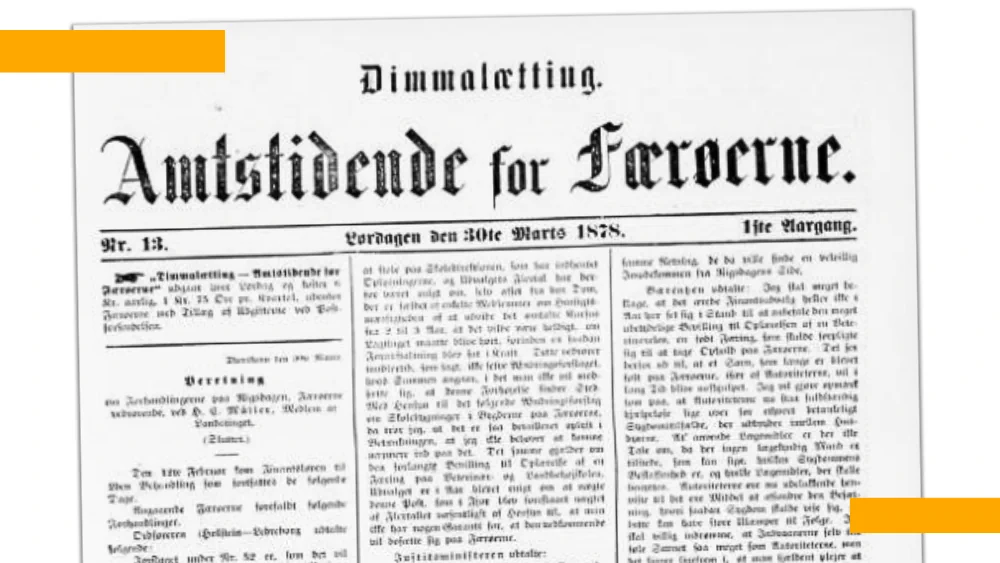
Venceslaus Hammershaimb was a priest and expert on the Faroese language. He did not work directly in the editorial office. However, he created the Faroese name Dimmalætting for the first official issue on January 5, 1878.
The name combines the words for darkness and thinning or leaving. It literally means the darkness decreases or the day breaks, signifying dawn. In later years, people simply called the newspaper Dimmi.
First literary publication
The first issue named Dimmalætting. Amtstidende for Færøerne had four pages and three columns. It featured sections for advertisements and used the Danish language except for the title. Editor Lütje Lützen presented the goals of the paper in his first article:
- The publication will be the official organ for the Faroe Islands.
- It will publish official notices and announcements.
- It will provide news and articles beneficial to the residents.
- It will deliver news from abroad.
- It will publish materials of social and economic importance to the Faroese.
- The paper will accept reasonable suggestions from private individuals to develop public life.
- It will fulfill educational and social functions.
The front page included the start of a serialized novel translated from English. This was the first literary publication in Faroese press history. The second page featured a poem by Louise Aschen. The foreign section reported on an assassination attempt in Turin, while local news covered worker meetings and hunting. Dimmalætting was a weekly paper published every Saturday with a circulation of 300 copies.
Lützen worked as a clerk in the Danish administration. He managed page layouts and advertisements. He served until the end of 1879. Oliver Petræus Effersøe, a teacher and politician, took over the editorial office in 1880.
The new editor served in both the Faroese and Danish parliaments. Political news came from primary sources while his teaching experience helped develop content. The publication gained followers quickly within the small community. Editors worked on the paper part-time while maintaining their primary jobs as officials or teachers.
National consciousness is born
Changes finally occurred in 1918. However, the weekly paper fulfilled its role as an information provider.
Seven editors led the newspaper over the next two decades. Some served only one year. The successors of Effersøe included teachers, officials, poets, and activists:
- Louis Bergh (1882 - 1885), teacher and social activist
- H. C. Petersen (1885 - 1886), official
- Rasmus C. Effersøe (1886 - 1889), poet and activist
- Jakub Johansen (1889 - 1892), activist
- Oliver Petraeus Effersøe (1892 - 1893)
- Emil Bruun (1893 - 1894), printer and publisher
- Enok Daniel Baerentsen (1894 - 1900), official
Most editors were native Faroese. National consciousness and the revival of the Faroese language grew during this period. The Effersøe brothers played a large role in the national movement. Danish authorities supervised the office and prevented complete independence.
The Jólafundurin Christmas meeting in 1888 marked the official start of the national movement. A resolution was adopted and a stamp was issued. Editor Rasmus Effersøe reported everything in Dimmalætting. The office moved to Erlings Jalsgøta the following year.
Competition on the horizon
A competing publication in the Faroese language appeared in 1890. The press scene in the Faroe Islands began to change.
Søren E. Müller introduced Dimmalætting into the new century. He was an official and politician rather than a journalist. Christian Heilskov followed him briefly before Rasmus Effersøe returned. Significant changes occurred during the tenure of Oluf Skaalum from 1905 to 1918.
In 1906, parliament members founded the first party called Sambandsflokkurin. Skaalum participated in these actions. Dimmalætting became the official press organ of the party. The editors supported close ties with Denmark and maintained Danish as the official language. This caused dissatisfaction among other politicians who formed an opposition party. A war between parties regarding the Faroese language began. New media titles appeared on the market using the native language.
Skaalum resisted for four years but yielded in 1910. Dimmalætting started printing texts in Faroese. The publication remained bilingual until 1947. An additional Wednesday edition started in 1911.
The author signing as X
The newspaper changed its content and form during the first decade of the century. It featured three columns and sections for parliament, foreign news, and reader letters. An author using the pseudonym X wrote political articles. Serialized novels and cultural events remained part of the paper. The first graphics appeared in the advertising section and the paper reached Denmark.
War arrived in Europe during the second decade, but Denmark remained neutral. The Spanish flu reached the islands and caused destruction. Dimmalætting covered these topics while focusing on the language struggle. Oluf Skaalum resigned in 1918 after thirteen years. He protested the equal status of both languages in schools and churches.
Poul Niclasen became the first full-time editor-in-chief for the next eighteen years. He started at the newspaper as a fourteen-year-old in the printing house. He trained in various Danish printing houses and wrote articles. He returned to the Faroe Islands in 1914 for union and parliamentary work. He founded the magazine Dugvan in 1916.
The flourishing of Dimmalætting
Niclasen declared himself editor-in-chief when Skaalum resigned. He later became the manager and accountant of the printing house. He dedicated himself entirely to the editorial office and held no other positions. Managing two newspapers and their distribution allowed his media positions to flourish. He served as a member of parliament and used his experience to improve the editorial work.
- He expanded the machinery to include illustrations and photos in 1921.
- He changed the basic font to a clearer version.
- He wrote the name Dimmalætting in large letters.
- He expanded the information department.
- He introduced advertisements on the front page.
- The number of regular pages increased to six in 1920.
- He promoted Scandinavian literature and native poetry.
- He changed the format to broadsheet in 1921.
- The number of columns increased to five.
- Circulation reached 2,000 copies by 1936.
Dimmalætting and Niclasen supported the Union Party but maintained personal opinions. New parties were born and elections occurred every four years. The global crisis affected the economy and local governments grew stronger.
The editor did not forget native culture. Book and theater reviews became common topics. Articles discussed the first motorcycle on the islands in 1922 and the first car in May. Niclasen conducted interviews and collaborated with famous writers for book reviews. He started a children`s corner in 1930 featuring puzzles and stories in two languages.
Taking control
A photo column appeared on the back page in August 1932. It showed national and world events using photos from international press agencies.
Niclasen decided to focus on politics in 1936. Georg Lindenskov Samuelsen took over the newspaper in April. The Faroese media market featured many newspapers and journals by the 1930s. Every new party wanted its own organ. Dimmalætting had many shareholders which threatened internal stability. Georg Lindenskov began buying individual shares to prevent conflicts. He controlled 51 percent of the shares by 1936.
Samuelsen started working at the printing house at age fourteen. He observed the production process and the work of editor Niclasen. He came from a family of lawyers and politicians but chose writing and printing. He was twenty-six years old when he took over the office. He managed the entire publishing house for forty-five years until his retirement in 1981.
Samuelsen organized the newspaper according to his own vision. Changes became visible when he acquired the printing house two years later.
- Sections received specific headings for parliament and world news.
- Fonts were diversified.
- A radio program appeared.
- Much space was dedicated to health.
- Economic matters were discussed with tables and charts.
- Religion became a more frequent topic.
The newspaper appeared twice a week with high-quality photos. Samuelsen managed the editorial office alone and performed excellently.
British friendly occupation
Fascism and another war arrived in Europe at the end of the 1930s. Dimmalætting reported on European events for nearly a year. It focused on Scandinavia and Finland defending against the USSR invasion. Germany annexed Denmark but the British occupied the Faroe Islands during Operation Valentine.
Dimmalætting published a description of the situation and its consequences on April 13, 1940. Both sides promised cooperation and asked for life to continue normally. This friendly occupation brought many benefits to the islands. The country made its own decisions while Denmark was under German control. The national flag was recognized and parliament gained broad autonomy.
Samuelsen wrote positively about the British and focused on German defeats. Cartoon humor appeared during the war period using newspapers delivered to the English. The first political humor appeared in March 1941 from the Daily Mirror. It showed Axis leaders at the door of Hitler. Satirical drawings with comments appeared in every issue from that time forward.
Global crisis, paper shortage, and fire
The newspaper performed well through the war years despite various troubles. Samuelsen wrote about parliamentary boycotts and lost Faroese boats. He also covered football matches and foreign trade profits.
A global economic crisis reached the archipelago in 1944. This meant a lack of paper for newspapers. Dimmalætting apologized for not delivering some issues. Several changes were introduced to handle the shortage. Photo printing was limited and the number of pages was reduced. Some issues did not appear at all.
A fire broke out in the printing house on July 2. The fire destroyed paper supplies, machines, and the editorial office. However, the next issue appeared on July 8. The office moved to a temporary location while another printing house helped with production. Machines were eventually repaired in military barracks. The headquarters was rebuilt and Dimmalætting returned to its old address in 1946.
Dimmalætting in Faroese
The war ended and the British left the islands. Georg Samuelsen became a correspondent for the oldest Danish daily paper. This cooperation proved very fruitful for the Faroese newspaper. Samuelsen received first-hand news from Denmark regularly.
The paper returned to six pages in 1946. It dedicated much space to Danish affairs and Faroese autonomy. Samuelsen informed readers about new printing machines in April to improve quality and speed.
The editor introduced the Dimmalætting Bulletin in May. It published news from Copenhagen regarding political and economic talks. The newspaper announced it would switch entirely to the Faroese language at the end of the year.
This change followed a parliamentary order. From January 1, 1947, Faroese was to be used in all offices, schools, and courts. Danish remained for contacts with Danish authorities. All official documents had to be translated into Faroese as the primary language for public communication.
First Faroese comic
Dimmalætting began a new phase of activity in its seventieth year. Every issue was printed in the native language starting in 1847. The printing house received a modern press and a new employee. Eiden Müller appeared in the editorial credits as the first editor.
Müller started his relationship with the paper by working in the printing house. He was a talented writer. The publishing house sent him to a Danish daily for an internship. He returned after a year to work with the editor-in-chief. Managing the office became easier with director Peter Ferdinand Christiansen. The team collaborated for several decades.
the first comic strip appeared in Dimmalætting on January 3, 1948. It was created by a Danish illustrator associated with Politiken.
The Samuelsen-Müller duo performed excellently as the newspaper flourished. They changed the title font and page layout in 1949. Islanders began calling the paper Dimmi, which remains common today.
Dimmi reported on the autonomy act and the formation of the first government in 1948. It covered the entry into NATO in 1949 and the growing importance of the Faroese language. Readers received the first crossword puzzle as a Christmas gift in 1948. A column featuring news from various islands in verse form appeared shortly after.
Newspaper published on typewriters
The 1950s were relatively peaceful years. Denmark and the islands did not engage in the Cold War. Dimmi focused on domestic affairs and national transformations. More attention was paid to women and fashion topics. Book reviews appeared and two comic strips were presented to readers in 1951.
The newspaper had a unique look in May 1951. It was written on a typewriter due to a general strike in Tórshavn. Technical workers and laborers paralyzed the city demanding higher wages. Printers joined the strike later. Müller and Samuelsen typed the texts so the paper could appear on time. The paper reached a circulation of 5,300 copies by the end of the year.
Advertisements were concentrated on the middle pages in 1952. The first page featured foreign news while the last page covered national news. The paper usually had four pages and grew more professional. The technical condition improved and the network of correspondents expanded. Readers provided much of the information used in the paper.
The editorial office still had only two editors. They were supported by printers who developed journalistic talents. A cultural weekend section started in 1957 to introduce the history of other nations. Faroese people visiting other countries provided these accounts. A section about important historical events also appeared.
The stable 1960s
Space flights and scientific interest defined the next decade. Dimmi editors used reports from Danish and Norwegian newspapers. Readers waited for news from both sides of the ocean.
The newspaper was clear and full of high-quality photos by the 1960s. It was organized into political, local, cultural, and entertainment departments.
More sports information and scientific columns appeared. Reader letters provided opinions and comments. Photographer Kalmar Lindenskov began working with Faroese newspapers in 1968. He spent over four decades at Dimmalætting. Arni Dahl began writing about sports in 1966 while he was a student. A professional sports column launched in 1971 with Dahl as the main editor.
Dimmi three times a week
Dimmi began appearing three times a week in October 1966. It was published on Tuesdays, Thursdays, and Saturdays. The newspaper switched to offset printing in April 1970. Dimmalætting had its own photographer and collaborated with the Associated Press.
The circulation reached 9,000 copies in the early 1970s. Benny Samuelsen joined his uncle George in 1970. Benny started his career in the printing house to gain experience. He was destined to be the successor.
Regular columns for sports and cinema launched in 1971. Satirical features and a global music top ten list became popular. Discussions about the Bible and current island affairs were presented through dialogues.
Authors used pseudonyms or initials for their signatures. Peter F. Christiansen wrote postcards from Copenhagen in Danish. Reports from parliament and cultural matters used single-letter signatures. Beate, the daughter of George Samuelsen, helped her father in the editorial office. Verse comments continued to appear while only one name was listed in the official credits.
Farewell to the Danish subtitle
Dimmi appeared for the last time with its Danish subtitle in January 1978. The subsequent issue used only the name Dimmalætting. This was a jubilee issue celebrating one hundred years of the newspaper. It featured sixteen pages of memories and old texts. The editorial team consisted of four people including Georg, Benny, Peter, and Beate.
Five employees shared the Samuelsen name and were all related. The small team announced a new era. They aimed to work better for the Faroese community and use their own voice. They planned to become a daily newspaper.
Dimmalætting entered the next decade with modern equipment. New machines stood in the printing house and the first computer appeared in the office. The layout used large headings and clear spacing.
Benny Samuelsen took over the newspaper from his uncle in 1981. He led the editorial office until 1995. These were relatively stable years for the paper despite national challenges. The country faced economic crises and a struggle for independence from Denmark.
Advertisements exceeded the space
Great revolutions did not occur within the newspaper. Only the editorial office received a new headquarters. The office moved to the Halsi district in 1985 while the printing house remained on Hoyviksvegur. A new font style was introduced and the page count increased to fourteen. This change resulted from the high number of advertisements that funded the paper.
The world chronicle section appeared at the start of the eighties. Johannes Haraldsen edited the piece while a chess corner also launched. The editorial team expanded in August 1985 with new journalists. Hilmar Jan Hansen took over the sports section while Snorri Brend joined as a fresh media studies graduate.
Benny Samuelsen welcomed interns and journalism students during those years. These students supported the office and learned the profession from older colleagues.
The journalistic community on the Faroe Islands became very aware of its mission by the late eighties. Newspapers began to free themselves from party control. They wanted to be independent. Pressure for this state was so great that Benny Samuelsen retired early in 1995. Beate L. Samuelsen took over the office in September. Georg L. Petersen joined her as co-editor. Beate managed the editions while Georg focused on news content.
Beate joined the paper in 1967. She was the only woman on the islands with a journalism degree at that time. Petersen brought a fresh perspective to the old publication. This combination of youth and experience worked well. The editors declared the paper would become an independent title.
Every single day Dimmalætting
The publication became a daily newspaper one year later. It appeared five times a week from Tuesday to Saturday. The paper featured between sixteen and thirty-six pages depending on the day.
The Samuelsen-Petersen duo transformed Dimmalætting into a professional product:
- The subtitle Independent and Reliable was added.
- Articles became shorter but contained more substance.
- The layout became clear with wider margins and spacing.
- Sections and columns organized the content thematically.
- The paper used well-framed photographs.
- Page numbering and navigation improved.
- The format switched to Nordic tabloid.
- An internet website launched in January 1998.
- The paper received its own logo.
Dimmalætting entered the year 2000 in glory. The paper merged its printing operations with another title in May. Color appeared in advertisements and headings that July. Soon the entire newspaper featured full color.
Stopping the decline
Changes occurred in the editorial office on January 1, 2002. The leadership passed to Ingi Samuelsen. This cousin of Beate was a professional journalist who studied in Denmark. He practiced at the paper before returning home in 2000. The board gave him one task: reduce the budget deficit from recent years.
The task was difficult because circulation had dropped since 1998. The number fell from thirteen thousand to ten thousand by the end of the decade. This trend happened globally as Dimmalætting launched a modern website.
Ingi Samuelsen led the office for seven years. The publication changed its editing days and returned to the tabloid format during this time. Printing mergers continued as the old paper joined another company.
Samuelsen failed to bring back readers because the internet won. Circulation dropped to eight thousand copies by 2005. Ingi resigned in 2007 after facing criticism for his writing style and views on minority groups.
The first step toward failure
Arni Gregersen replaced him in April. The fifty-six-year-old journalist became both editor and general manager with financial responsibility. He was the first leader in seventy-one years not related to the Samuelsen family. He began organizing the company immediately. Circulation continued to fall and the paper lost money.
The board and Gregersen decided to buy two other newspapers in 2008. This move proved to be a major mistake. The expense ruined the entire publishing house. Selling the printing plants and the office building in 2009 did not help. An investment company bought the newspaper in 2010. The Samuelsen family ceased to be owners after seventy-four years.
The new owner could not fix the financial troubles. Circulation dropped to seventy-five hundred copies in 2011. A lawyer invested in the daily and paid its debts, but the debt returned. The decision to liquidate the paper came in mid-2013. Dimmalætting ceased to exist on September 13.
Dimmi disappears from the market
Arni Gregersen opened a new media company the same day and took the remaining assets. He wanted the name, but it legally belonged to another investor. The case went to court and limited the editor`s plans.
The oldest newspaper disappeared and journalists found new work. However, four journalists did not accept the end of the publication. They believed the history of the islands should not be lost. These men included:
- Sveinn Trondarson
- Leif Ladal
- Emil L. Jacobsen
- Georg L. Petersen
They brought Dimmalætting back to life in October 2014 with external support.
The new team decided to create a weekend edition. They believed the market was too small for a daily paper with a large staff. Sveinur Trondarson became the editor-in-chief.
The announcement stated the paper would remain independent of political or religious interests. A website returned along with the printed weekly. A board of the four founders managed the company.
Dimmalætting. Reactivation
The first issue after the return symbolically linked to the 2013 predecessor. It used full color with navigation for entertainment and health topics. A graphic featured caricatures of the men who revived the title. Readers were happy to see the return. A small circulation of three thousand copies satisfied the core supporters.
Planned changes occurred one year later. Trondarson remained general manager while Georg L. Petersen became editor-in-chief. Petersen had previous experience managing the office. Another family member joined the board to handle advertising.
Petersen led the office until 2019. He worked with significant authors for both the weekly and the digital paper. Collaboration with a graphic artist provided humor for readers. The office focused on national news and practical sections like tourism and cooking. Circulation stayed at three thousand copies. The board decided to print the paper in Denmark in 2018 to save money. The local printing house owner criticized this move.
Leif Ladal briefly managed the paper before Emil Lisberg Jacobsen took over in 2019. The weekly featured up to sixty-four pages and a monthly industry insert. Digital subscribers increased while the staff evolved. Former editors and politicians often contributed to the writing.
Tradition continues for 148 years
From March 2020 Sveinur Trondarson returned as editor. He improved the website which began to operate independently. The front page of the printed paper changed to a simple design with one large photo. Trondarson managed the weekly through the challenges of the pandemic.
Financial troubles returned when the parliament limited media funding. The company sought support from various organizations. The Danish government offered help but required the paper to be bilingual. Dimmalætting began printing in Danish again in April 2020.
Trondarson resigned in 2022 during a crisis. Staff left the company and manager Jonhard Hammer took control. Only a few employees remained to handle sales and marketing.
Dimmalætting and another paper joined forces in 2023 to share resources. The editorial offices remained independent. The manager explained that the loss of media support and high costs forced the move. Both printed and digital versions stayed on the market.
The situation improved by April. New journalists took over the editorial duties.
Today this old newspaper still exists. Jonhard Hammer serves as manager and editor. The staff is very small but it has survived. It still reports on daily life in the Faroe Islands and supports its readers. The printed version is now a monthly publication, but it remains active.
Dimmalætting timeline:
- 1877, July - The first printing house and publishing company are founded.
- 1877, December 8 - The pilot issue of the first Faroese newspaper appears.
- 1878, January 5 - The first official issue of Dimmalætting is published in Danish.
- 1888, December - A meeting starts national changes and new newspaper methods.
- 1889 - The editorial office moves for the first time.
- 1890 - A second competing newspaper appears.
- 1906 - The paper becomes the official organ of the first political party.
- 1910 - The publication becomes bilingual in Danish and Faroese.
- 1911 - An additional edition starts on Wednesdays.
- 1918 - Poul Niclasen becomes the first full-time editor-in-chief.
- 1921 - The printing house expands and the first photos appear.
- 1921 - The name is written in large letters and the format changes.
- 1930 - A children`s department is created.
- 1936, April - George L. Samuelsen becomes the first owner.
- 1941, March 29 - The first political cartoon humor appears.
- 1944, July 2 - A fire destroys the printing house and office.
- 1946, May - The rebuilt and modern printing house starts operating.
- 1946, December 30 - The paper switches to the Faroese language.
- 1948, January 3 - The first picture story appears.
- 1948, December 24 - The first crossword puzzle is published.
- 1951, March 28 - The first comic strips appear.
- 1951, May - A strike forces the paper into a two-page typewritten form.
- 1966, October 4 - The paper appears three times per week.
- 1970, April 18 - The newspaper switches to offset printing.
- 1978, January 3 - The Danish subtitle appears for the last time.
- 1978, January 5 - The paper celebrates one hundred years.
- 1985 - The company moves to a new headquarters.
- 1995 - Dimmalætting stops being a party organ.
- 1996, September 3 - The publication becomes a daily newspaper.
- 1998 - The first website is launched.
- 2000, May - Colors appear on the pages for the first time.
- 2004 - Publication days change to Monday through Friday.
- 2005 - The paper returns to the tabloid format.
- 2008 - The company buys two other titles, leading to financial decline.
- 2009-2010 - The company sells its assets.
- 2010 - A new investment firm becomes the owner.
- 2013, September 13 - The last issue appears before bankruptcy.
- 2014, October 10 - The paper is reactivated as a weekly.
- 2017 - A special industry insert is added.
- 2018 - Printing of the weekly moves to Denmark.
- 2020, April - The paper becomes bilingual again.
- 2023, January 1 - The paper merges with another title and becomes a monthly.
Sources:
- https://in.fo/news-detail/dimma-125-r
- https://web.archive.org/web/20160901233937/http://dimma.fo/information/history/
- https://lex.dk/Dimmal%C3%A6tting
- https://en.wikipedia.org/wiki/Dimmal%C3%A6tting
- https://dimma.fo/
- https://web.archive.org/web/20140911001958/http://aktuelt.fo/dimmalaetting+kemur+ut+aftur.html
- https://da.wikipedia.org/wiki/Oliver_Petr%C3%A6us_Effers%C3%B8e
- https://jn.fo/dimmalaetting-aftur-a-gotuni%281%29
- https://kvf.fo/netvarp/uv/2013/12/12/dimmaltting
- https://www.hvannrok.fo/2013/09/18/8344/
- https://www.hvannrok.fo/2014/10/11/ummaeli-kaerkomna-dimmalaetting-stod-royndina-men/
- https://docs.google.com/document/d/1tMM-4OTv4tPLhYcpyUoFGFWQ_Ng4zSPKuwTLQyy5DsA/edit?tab=t.0
- https://foroyaprent.fo/um-okkum/soga/dimmalaetting-arkprent/
- https://in.fo/news-detail/dimma-125-r
- https://dagur.fo/dimmalaetting-sokir-eftir-bladstjora
- http://sosialurin.fo/news-detail/morgin-ver-ur-dimmal-tting-125-r
- https://www.in.fo/news-detail/til-minnis-um-gomlu-dimmu
- https://kvf.fo/ljod/sending/megminnist?sid=24562&page=42
- http://sosialurin.fo/news-detail/ingi-kr-ggj-vi-rey-u-t-lini
- https://www.in.fo/news-detail/rni-gregersen-ongar-vi-merkingar
- https://web.archive.org/web/20141228025136/http://journalisten.dk/faeroeernes-aeldste-avis-konkurs
- https://www.in.fo/news-detail/dimma-aftur-a-goetuna
- https://kvf.fo/netvarp/uv/2022/12/29/dimmaltting-og-sosialurin-leggja-virksemi-saman?utm_source=chatgpt.com
- https://jn.fo/dimmalaetting-aftur-a-gotuni%281%29


COMMERCIAL BREAK

New articles in section History of the media
Havas. The history of the world's first news agency
Małgorzata Dwornik
The idea of two bankrupt Frenchmen in 1835 turned out to be brilliant: use information as a commodity. Along with translators, messengers, and correspondents, they hired a flock of carrier pigeons. These birds carried news from London to Paris in a single day. The product of L'Bureau Havas quickly became popular far beyond Europe.
România Liberă. 150 years of history of the Romanian press
Małgorzata Dwornik
On May 14, 1877, Romania officially declared independence from the Ottoman Empire, and just one day later, the newspaper România Liberă (Free Romania) appeared on the Bucharest market. Its founder, first director, and journalist was Dimitrie August Laurian, strongly supported by Professor Ştefan Mihăilescu.
El Mercurio de Valparaiso from Chile. The oldest Spanish language newspaper in the world
Małgorzata Dwornik
The first issue started a revolution in South America. It survived 200 years of turbulent history: headquarters fires, editorial office looting, economic crises, and dictatorship. Today, El Mercurio de Valparaiso holds a unique status in the Chilean media market. And the title of a UNESCO World Heritage site.
See articles on a similar topic:
History of Die Welt. A newspaper with a dream of German unity
Małgorzata Dwornik
On April 2, 1946, in Hamburg - or rather, among its ruins - the first German newspaper under the patronage of the British military authorities appeared. For years, the Die Welt editorial team proved that a strong, nationwide paper could be published outside the capital. When they finally relocated there, they blazed new trails - this time in the digital world.
The Press in Historical Perspective
Agnieszka Osińska
Researchers trace the prehistory of modern press back to ancient times when primitive forms of mass communication began to emerge.
Ràdio Andorra. The Legend of the Station That Greeted in Three Languages
Małgorzata Dwornik
From its inception, the station broadcasting from the tiny Principality of Andorra in the Pyrenees was a thorn in the side - first to the Germans, then the French, and the Spanish. The conflict over Ràdio Andorra even led to the border being closed to... sheep. After four decades of struggle, the station, known across Europe and the USA, fell silent. But was it forever?
History of WSB Radio. The listener has no radio receiver? No problem!
Małgorzata Dwornik
The first transmitter had only 100 watts of power, and ice was used to cool the batteries. On March 15, 1922, the first radio station in Georgia began broadcasting. The station was assigned the call letters WSB, which the founders transformed into the motto: Welcome South, Brother! This marked the start of one of the most important radio stations in the USA.