 po polsku
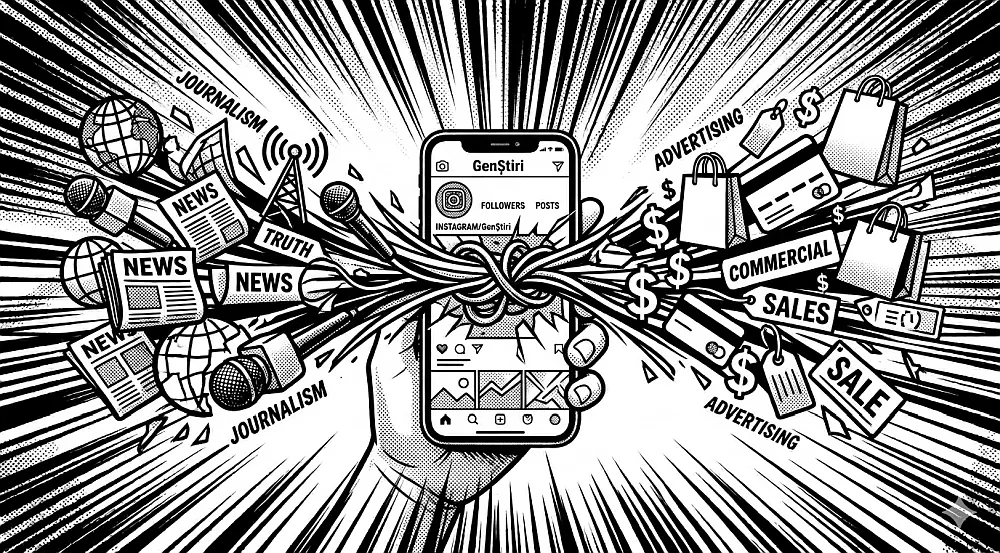 illustration: Gemini AI
Media social media serves as the main information channel for young people. Publishers face a huge challenge: how to earn money from published content while maintaining independence and credibility in the eyes of the recipients. This problem becomes increasingly visible in the era of widespread smartphone usage.
Romanian researchers Eduard-Claudiu Gross from University Lucian Blaga Sibiu and Andreea Stancea from the National University of Political Studies and Public Administration in Bucharest analyzed this phenomenon in their latest study. The scientists published detailed results of their work in the report Sponsored content in the context of short-format SM journalism in Humanities and Social Sciences Communications from the Nature portfolio.
They examined the Romanian Gen.Stiri profile on Instagram, which has long directed its news toward the so-called generation Z. The research team analyzed a collection of two hundred and twenty posts from the period between March 2023 and July 2024. One hundred and forty materials in this compilation were sponsored content, while eighty posts were of a purely editorial nature.
Journalistic style loses to sales goals
Editorial posts much more often maintain journalistic standards compared to materials paid for by advertisers. Eduard-Claudiu Gross and Andreea Stancea checked the strict compliance of posts with the so-called inverted pyramid principle. This basic rule of the craft dictates that the most important facts should be provided at the very beginning of the text, leaving less important details for the very end of the article.
The researchers discovered with surprise that non-sponsored posts adhere to this rule in 87.5% of cases, while advertising content meets this standard in only 61.9%. Brands very often force editorial offices to change the safe content layout and introduce aggressive promotional offers instead of reliable information in the first sentences.
The table below illustrates the compliance of various types of posts with journalistic principles.
| Post category | Compliance with journalistic style | Visual format |
| Non-sponsored | 87.5 percent | Carousels and single photos |
| Sponsored | 61.9 percent | Main video reels and graphics |
| Education (non-sponsored) | 92.0 percent | Minimalist graphics |
| Banking (sponsored) | 20.0 percent | Strongly promotional message |
These results constitute indisputable proof that brands firmly prioritize the language of persuasion over reliable information for the reader. Available statistics illustrate this phenomenon using a very specific example of calls to action. The analysis proves with numbers that editorial posts devoid of commercial slogans meet journalistic requirements in over ninety-five percent of cases. When a publisher adds an advertising command to swipe the screen up, the journalistic correctness rate drops dramatically to zero.
Imagine a text in a newspaper that, instead of explaining the reason for a strike in the first sentence, shouts at the reader about a great sale on footwear. This is exactly how aggressive sponsored posts on Instagram work.
Excessive advertising discourages readers
Another important aspect of the analysis concerns the frequency of publishing materials by specific companies. In the report from the Humanities and Social Sciences Communications journal, the scientists divided corporations into three separate research groups. Eduard-Claudiu Gross and Andreea Stancea called them sporadic, returning, and highly active brands.
Highly active entities, for example Penny Market with forty-two posts and Samsung with fifteen entries, generate extremely unstable engagement. The authors defined this mechanism as the phenomenon of missed shots, where a huge number of posts does not guarantee gaining real interest from young people. A significant portion of these mass messages simply lands in a vacuum.
60% of digital creators do not verify information before publishing 👇
On the other hand, enterprises that publish their offers with moderate frequency achieve much more lasting emotional results. In an extensive study from Humanities and Social Sciences Communications, Eduard-Claudiu Gross and Andreea Stancea prove that companies such as BRD or Orange, which posted nine and seven posts respectively on the platform, build much stronger relationships with recipients. Young readers are much more willing to enter into constructive interaction with brands that remind about themselves less often but provide exceptionally thought-out and socially valuable content. This shows clearly that an aggressive sales policy brings an effect completely opposite to the intended one.
The list of factors determining the success of a campaign with moderate frequency includes the following elements.
- Strict connection of the commercial topic with real problems of generation Z.
- Conscious avoidance of intrusive product reminders in a dozen posts a month.
- Focusing the message on educating the recipient and real help in solving daily difficulties.
- Successive building of long-term trust instead of organizing loud sale events.
We observe a surprising mechanism in which allocating huge financial resources to a massive campaign generates smaller image profits than well-planned and economical communication. Internet recipients suffer from enormous fatigue due to the excess of constant incentives to spend money. Our human mind develops a natural defense barrier against information devoid of educational value. This phenomenon strongly resembles ignoring intrusive leaflets handed to us by random people on a busy city street.
True engagement is born from trust
The type of reader reaction to internet materials depends almost exclusively on whether a specific post was financed by an external advertiser. The publication in Humanities and Social Sciences Communications accurately describes the striking differences in the daily behavior of readers.
Eduard-Claudiu Gross and Andreea Stancea clearly note in their text that reliable editorial content provokes internet users to write a huge number of multi-threaded comments. Regular and non-sponsored reports evoke a wide palette of real emotions in young people. Authentic materials generate a sense of human solidarity, wake up a sincere smile, and sometimes even provoke justified indignation at the injustice surrounding us.
In the case of paid texts, the situation looks completely different. Sponsored graphics and colorful films induce young users almost exclusively to reflexive and completely passive tapping on the smartphone screen in order to leave a symbolic like.
The following comparison presents in detail numerous discrepancies in the behavior of internet users.
| Interaction indicator | Non-sponsored posts | Sponsored posts |
| Number of comments | Very high and varied | Low and strongly limited |
| Emotional reactions | True solidarity | Cold distance and frequent irony |
| Depth of discussion | Long and substantive conversations | Cursory and single words |
| Reception of the message | High level of trust in the editorial office | Very cautious acceptance of the form |
Analysis of the comment section under commercial posts exposes an extremely poor resource of emotions expressed in them. Young readers react to this marketing language with enormous distance, often respond with open sarcasm, and their reaction immediately puts trust in the editorial office to the toughest test.
Scientists proved without a shadow of a doubt that articles concerning important problems, for example mental health or the harmfulness of plastic, result in long debates exclusively in sections of ordinary news without company logos. Describing the same social challenges within the framework of a generously paid partnership with a corporation instantly kills the natural desire for conversation and irretrievably shuts the mouths of commenters. We see on these examples very clearly how the attire of the provided information directly affects its actual reception.
Minimalism wins against garish promotional form
The method of visually designing news plays a first-rate role in the process of catching the attention of a rushing internet user. The conclusions flowing directly from the conducted experiment indicate unequivocally that contemporary recipients best consume information that publishers release in the form of multi-part photo carousels.
This form, popular today, facilitates extremely fluid and slow building of an engaging story. However, it is surprising that it is precisely ascetic minimalism and very economical management of available space that catch the eyes of the largest group of people. Projects that creators systematically maintain in subdued colors give tired eyes a bit of respite in digital chaos.
The rules determining excellent aesthetic results of information posts are as follows.
- Constructing wisely thought-out carousels that gradually build tension from the first to the last screen.
- Conscious abandonment of sharp colors used on market-stall advertising banners.
- Full resignation from placing bright buttons forcing an immediate transition to a modern e-shop.
- Consistent care for a clean and classic look of the entire digital profile of the newspaper.
This empirical material fully refutes the common myth about the effectiveness of aggressive colors. Digital boards emanating with colors drastically lower the compliance of the material with rigorous journalistic standards and record incomparably weaker indicators of interest from internet users. A complete lack of a big button with a call to purchase brings the editorial office much more real image benefits than its constant presence.
Contemporary readers value highly subtle methods of persuasion and recommendation above average. Publishers must for this reason completely revalue their current approach to earning in social networks. Good information organization always focuses on full reliability, regardless of the fact whether the publisher prints a daily on gray paper or the user watches news on a glowing device screen.
The entire article Sponsored content in the context of short-format SM journalism available at: https://www.nature.com/articles/s41599-025-05961-y


COMMERCIAL BREAK
New articles in section Media industry
Information laundering. Russian propaganda returns as news from China
KFi
Russian intelligence agencies use complex tactics to mask the primary source of their harmful narratives. Patrycja Krzyśpiak from NASK details this dangerous process of information laundering in a recent report.
Health disinformation on the internet. Diagnosis from an algorithm
Katarzyna Czechowicz
Health disinformation can cause a cancer patient to see a doctor when it is too late for effective treatment. It can also undermine trust in doctors and public institutions. As a result, people may refuse to cooperate even during a real external threat, experts warn.
Feminatives are not a given. How Polish women talk about their professions
SWPS
Polish women still rarely use female job titles. This comes from the latest report by the Center for Research on Social Relations at SWPS University. Women's professional activity proved to be a significant factor in using feminatives.
See articles on a similar topic:
Yellow Press. What is Yellow Journalism?
Krzysztof Fiedorek
The terms "yellow press" and "yellow journalism" are often used pejoratively to describe journalistic practices focused on sensationalism, gossip, and emotions rather than objective facts. Let’s explore their origins, distinctive features, and impact on society.
Disinformation and Fake News. Experts Discuss Challenges for Journalists
RINF
The pandemic, followed by the war in Ukraine, triggered a massive wave of disinformation in media and social channels. Experts at the Impact’22 Congress in Poznań and the European Economic Congress in Katowice discussed effective strategies to combat disinformation.
Deepfake Blurs Truth and Falsehood. Human Perception Research
KFi
Studies indicate that only 60% of deepfake images can be correctly identified by humans. As AI begins to dominate content production, the problem of differentiation fatigue grows – users lose confidence in assessing the authenticity of information and fall into cynicism.
The Podcast Market in Poland. Research by Wprost and Tandem Media
Krzysztof Fiedorek
How many Polish internet users listen to podcasts? Where and how do we listen? How and why do we choose episodes? Two major studies on this topic were recently released. One by Wprost, the other by Tandem Media from Agora Radio Group. We present both for data comparison and insights.