 po polsku
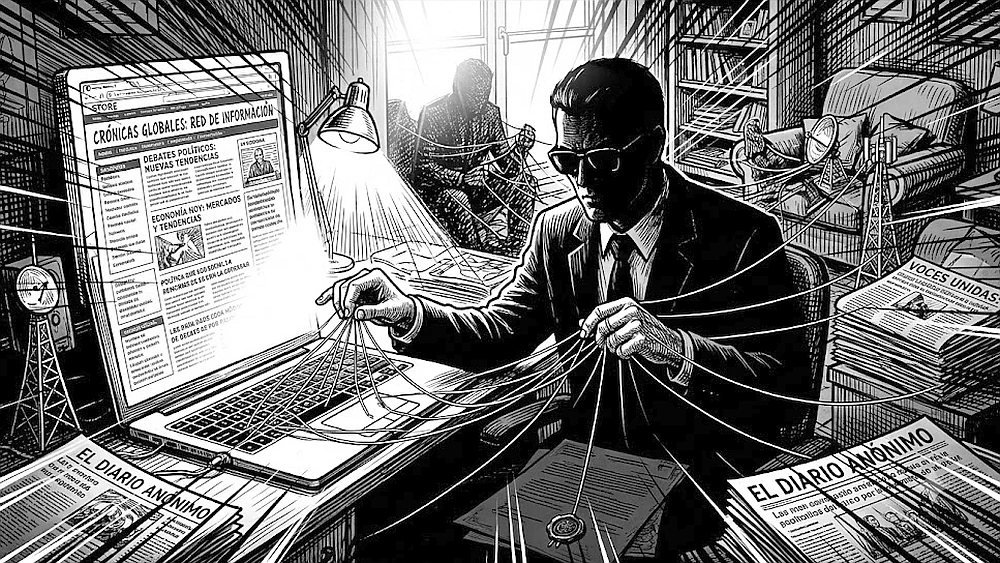 illustration: Gemini
Modern societies create complex structures in which different groups try to influence political decisions. Researchers from the University of Malaga, Álvaro Serna-Ortega, Andrea Moreno-Cabanillas, and Elizabet Castillero-Ostio, analyzed this phenomenon in spanish media. In an article published in the journal "Humanities & Social Sciences Communications" from the Nature group, the authors evaluate how online portals present pressure groups. Media presence constitutes a powerful tool because it allows for gaining public opinion support, informing supporters, and reaching politicians responsible for lawmaking more effectively.
Pressure groups use the media to achieve strategic goals, which gives their actions a clear political dimension. For instance, an energy company planning to block new ecological taxes can organize information campaigns in the press. Through the publication of appropriately selected articles, it tries to convince citizens that regulations will raise electricity prices for households. In this way, the organization builds public pressure on decision-makers, and the media become a tool in the fight for particular economic interests.
The authors collected a huge dataset comprising 13,431 articles that journalists published online between january 2013 and december 2023. The scientists analyzed the content of the seven most popular general news dailies in that country. In the collection of digital texts, they searched for keywords such as lobby or interest groups. These data allowed the researchers to draw precise conclusions regarding who controls the media message about behind-the-scenes influences in the state and how they do it.
Publication dynamics and ideological orientation of newspapers
Media interest in lobbying depends on the social and economic situation. Journalists published the most articles in 2013, which experts link to the financial crisis in Europe. In times of economic difficulties, companies and employers` associations intensify actions to influence regulatory processes and protect profits from government decisions. Conversely, in 2020, researchers recorded a sharp drop in the number of texts about pressure groups because editorial attention focused exclusively on the topic of the global pandemic.
The political orientation of the newsroom also strongly modifies the way newspapers choose topics and write about lobbying. Left-wing portals show significantly greater activity in raising this topic than right-wing media. Researchers perceive these differences very clearly when they analyze the percentage shares of individual titles in the total number of collected texts.
- Left-wing ideology portals are responsible for 50.33% of all published articles on lobbying.
- Right-wing newspapers generated 38.22% of texts during the studied period.
- The elpais.com portal published the most materials, achieving a result of 23.01% of the entire collection.
- The daily lavanguardia.com took second place, where researchers found 22.72% of texts.
- The conservative portal elmundo.es published 17.97% of articles on pressure groups.
These numbers prove that the three most active websites concentrate more than 63% of the entire media message about lobbyists. Journalists from left-wing newsrooms are more willing to write about social problems, while right-wing media concentrate on economic issues. For example, conservative newspapers pay attention to business matters, whereas progressive media more frequently write about minority rights or ecology. Such a division reflects traditional ideological lines and shows how newsrooms filter reality for their readers.
Dominance of political-economic topics and the role of indirect strategies
Scientists from the University of Malaga divide the topic of articles into macro-categories. The results show a predominance of topics related to the economy and politics. Business groups possess greater financial resources, which allows them to build relationships with digital media more effectively. On the other hand, social organizations must invest more effort to attract the attention of journalists to their demands.
| Interest macro-category | Percentage share in the text sample | Main ideological profile of the media |
| Political-economic interests | 61.84% | Conservative |
| Social interests | 25.79% | Progressive |
| Mixed interests | 12.37% | Progressive |
To perform this division, the spanish researchers created a program in the R language that automatically counted keywords assigned to ten detailed thematic areas. The researchers manually verified the results, thanks to which they obtained high data reliability at a level of 95%. This method showed that politics and the economy dominated more than half of the press discussion. For instance, journalists willingly describe the actions of organizations from the tourism sector that fight for favorable changes in the law and the establishment of new visitor records.
Relationship and tech. Study about love in the age of likes 👇
Álvaro Serna-Ortega, Andrea Moreno-Cabanillas, and Elizabet Castillero-Ostio introduce a distinction between autonomous editorial decisions and publications that indirect communication strategies triggered. Indirect lobbying consists in an interest group mobilizing public opinion through the media. Organizations send ready analyses to newsrooms or provide visual materials that make articles more attractive. Scientists noticed that this method allows lobbyists to shape the press narrative to a large extent.
- Indirect lobbying strategies led to the creation of 34.21% of all articles from the sample.
- In the category covering the primary sector, indirect lobbying is responsible for 66.67% of texts.
- In the area of environment and energy, the actions of lobbyists triggered 63.41% of press publications.
- The economy and trade sector recorded a share of indirect strategies at a level of 53.76% units.
- Researchers detected the lowest impact of indirect lobbying in the politics category, where it amounted to 11.01%.
These data reveal a dependency between the character of the industry and the way of its communication with the media. Technical industries, such as agriculture or energy, intensively apply indirect lobbying to explain complex processes to a broad audience. Conversely, journalists usually undertake purely political topics independently, without an impulse from external organizations. Newsrooms almost always attach visual elements to online texts, because as many as 99.81% of articles in the database contained photos or video materials attracting the attention of internet users.
Emotional tone of press articles
Another important aspect concerns the emotional coloring of the texts. The general image of lobbyists in the spanish press appears negative, which the average sentiment index score at a level of minus 11.18 points confirms. Journalists frequently present pressure groups as unclear entities that try to modify legislative processes in an unfair manner. Such a state of affairs results from the tendency of the media to favor critical news, which engages readers more strongly.
However, individual website analysis reveals one fascinating exception, which is the catalan daily lavanguardia.com. The authors of the study explain this phenomenon by the specificity of this newsroom. As the only portal, this website recorded a positive average sentiment score at a level of plus 5.98 points. This phenomenon is linked to the historical proximity of the newsroom to regional interest groups, and also to the fact that journalists created half of the texts there thanks to indirect lobbying strategies.
The logistic regression that the spanish scientists applied in the study proves that sentiment, interest category, and website possess the highest explanatory power and allow for predicting publication causes with accuracy at a level of 78.16%. The more positive the tone of the text is, the greater the probability that a well-thought-out campaign of a given interest group stands behind its creation. For communication specialists, a lesson flows from here that the proactive delivery of materials to journalists realistically changes the presentation manner of the entity in the media. Conversely, for the state, this fact constitutes a warning because unequal access of organizations to newspaper pages can significantly limit the diversity of public debate.
The full article Media coverage of lobbies in Spanish digital generalist press is available at https://doi.org/10.1057/s41599-026-06881-1


COMMERCIAL BREAK
New articles in section Media industry
Information laundering. Russian propaganda returns as news from China
KFi
Russian intelligence agencies use complex tactics to mask the primary source of their harmful narratives. Patrycja Krzyśpiak from NASK details this dangerous process of information laundering in a recent report.
Health disinformation on the internet. Diagnosis from an algorithm
Katarzyna Czechowicz
Health disinformation can cause a cancer patient to see a doctor when it is too late for effective treatment. It can also undermine trust in doctors and public institutions. As a result, people may refuse to cooperate even during a real external threat, experts warn.
Feminatives are not a given. How Polish women talk about their professions
SWPS
Polish women still rarely use female job titles. This comes from the latest report by the Center for Research on Social Relations at SWPS University. Women's professional activity proved to be a significant factor in using feminatives.
See articles on a similar topic:
Social media, journalism and advertising. Trust in sponsored content study
Krzysztof Fiedorek
Is sponsored content destroying credibility on social media? Research results are ruthless. We trust regular editorial posts in 87.5 percent of cases. When a bank pays for material, the rate drops to 20 percent. Young recipients equate commerce with falsehood.
Decline in Trust in Media. Analysis of the Reuters Digital News Report 2024
Krzysztof Fiedorek
The “Digital News Report 2024” by the Reuters Institute for the Study of Journalism highlights alarming trends concerning the declining interest in news and decreasing trust in media. These changes are not temporary but have become a long-term trend.
Social Media and Relationships. Interesting Research from Palestine
KFi
What does love look like in the digital age? Does technology bring people closer or push them apart? In an era where Facebook and Instagram replace dinner table conversations, social media has become a new space for marital relationships. Researchers from An-Najah National University examined how technology can build bonds but also sow uncertainty.
Freelancers 2025 in media and advertising. Useme report
Krzysztof Fiedorek
The modern media and communication market presents entirely new challenges for independent creators. Traditional services are giving way to more complex forms of messaging. The most popular industries in which Polish freelancers operate focus on companies' online presence and visual content.