
 po polsku
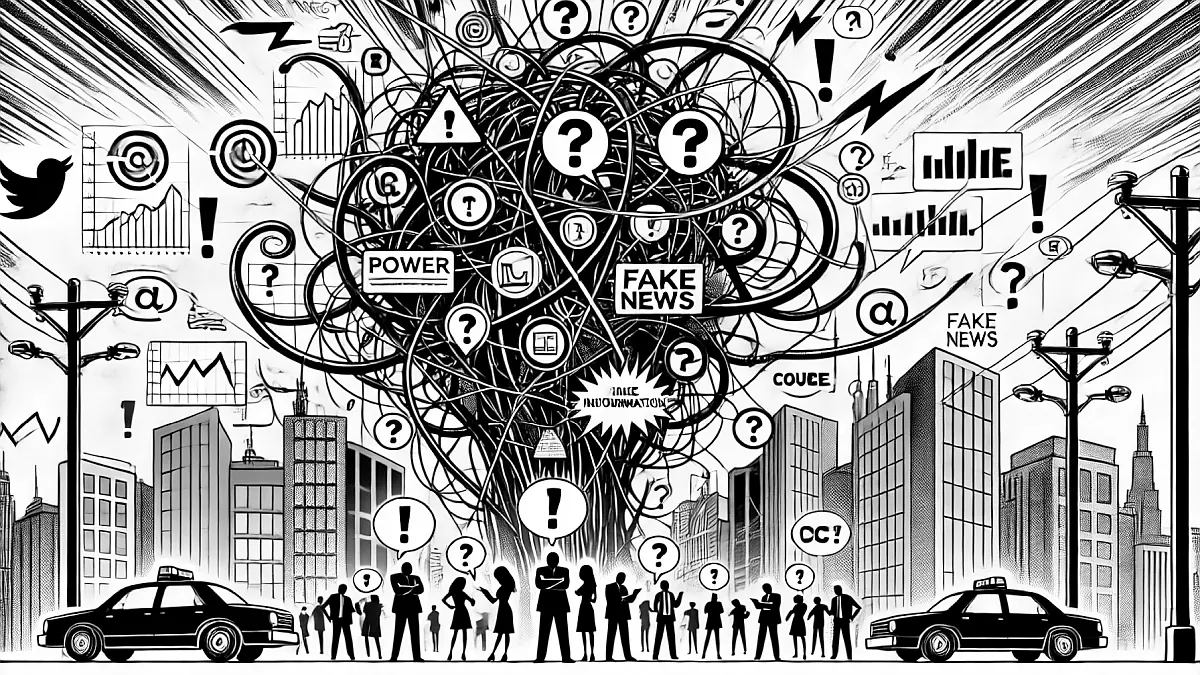 illustration: DALL-E
Journalists describe phenomena every day that science has not fully explained. Modern media reports on health, climate, or technology very often contain elements of risk and uncertainty. Charlotte Dries, Aileen Oeberst, Gabriel Egharevba from the University of Potsdam, Claudia R. Schneider from the University of Cambridge, and Michelle McDowell and Felix G. Rebitschek from the Max Planck Institute for Human Development attempted to systematize knowledge about this phenomenon.
The researchers published a report in the journal Royal Society Open Science titled The impact of uncertainty communication on trust in its sources: a systematic review and meta-analysis. The authors analyzed the results of experiments testing whether open communication about a lack of knowledge destroys audience trust in the source. Many publishers fear that admitting ignorance will undermine editorial credibility. The authors of the report checked whether these anxieties are justified.
- Scientists conducted 27 out of 28 experiments based on fictitious news texts.
- The authors of fifteen selected studies did not specify a concrete message author, which made recipients evaluate the press content itself.
- Exactly 12 research projects used the form of a classic article from a newspaper or news portal.
Authority of the information source
For example, when a person browses social media and encounters an article about a new biological threat, they often do not know the reputation of the specific author. At that point, the editorial phrasing determines how deeply the recipient will believe the presented arguments. The team led by Charlotte Dries proved that the recipient processes such information very cautiously, without showing extreme defensive reactions to news about gaps in the expert knowledge of the author of the article.
| Message sender | Number of experiments |
|---|---|
| Scientific community | 7 |
| Government institutions | 6 |
| Media newsrooms | 4 |
Journalists rarely rely on their own medical knowledge; they usually quote statements from experts or summarize the results of reports from renowned institutions. Charlotte Dries and her colleagues note that this structure of news naturally dilutes responsibility for lack of precision. The reader of a newspaper or internet portal can transfer potential grievances to research laboratories, sparing the newsroom itself, which reliably reports the actual facts. This psychological mechanism protects the position of the news media as an objective transmitter of reality.
The methodology of the collected studies revealed problems with maintaining experimental purity in communication analyses.
- Scientists reveal that 18 out of 28 experiments contained hidden uncertainty in control conditions. This means that texts that were supposed to pass for certain used words such as about or maybe.
- Additionally, in 9 studies, scientists detected that authors modified the complexity of the text or added information unrelated to the topic.
Despite these imperfections, the overall picture did not show drastic fluctuations in media credibility ratings.
The presentation of data. Numbers are more important than words
Choosing the appropriate data presentation format represents a daily challenge for every editorial team. The authors of the report describe how numerical and verbal forms affect the psyche of the reader. Journalists can present a lack of certainty using numerical ranges, for example, by writing about an increase in unemployment of 5 to 7 percent. An alternative path is using descriptive phrases, such as probable increase or slight fluctuations. Experiments show that dry numbers enjoy greater tolerance from the public than ambiguous verbal descriptions, which can arouse anxiety.
- A precise mathematical formulation builds an image of professionalism in the eyes of recipients, even if these numbers communicate a lack of final resolutions.
- When a reader sees a specified confidence interval or margin of error, they subconsciously attribute high reliability and methodological accuracy to the newsroom.
- Words tend to be more ambiguous and can suggest that a journalist deliberately avoids specifics or does not possess sufficient competence to describe the topic.
- For example, a press release saying that a new drug shows some efficacy sounds suspicious, while information about an efficacy of 80 percent with a margin of error gives a sense of objectivity.
Scientists conducting the analyses confirm that numbers have a calming effect on news consumers. The researchers also emphasize that only a few studies included modern visual forms, such as infographics or charts, which dominate contemporary news portals. As many as 16 papers relied exclusively on verbal messages, and only 9 combined words with numbers. This shows that theoretical knowledge about media communication still does not keep pace with the real practice in the press.
Journalists intuitively use progress bars, charts, or maps, while science still mainly investigates traditional, linear text messages. This discrepancy places an urgent need before future researchers to verify how modern visual society reacts to graphic charts.
challenges in building relationships with the message recipient
The most optimistic conclusion from the collected data concerns the strategic safeguarding of public trust in crisis situations. Experiments demonstrated that open communication about the variability of knowledge acts as an effective buffer against later accusations of lying. When media loyally inform from the beginning that data are preliminary, a subsequent change of facts does not provoke reader anger.
- For example, during a virus epidemic, dynamic changes in medical guidelines can destroy the reputation of authorities if they previously pretended to be absolutely infallible.
- If, however, press articles mentioned the dynamic nature of discoveries from the start, recipients show understanding for corrections.
The psychological analysis of readers also brought surprising conclusions regarding the demographic and ideological characteristics of the public. Factors such as partisan sympathies, general education, intelligence level, or individual tolerance for ambiguity do not change the way these messages are received. People with radical political views process information about a lack of certainty in exactly the same way as individuals with centrist views. Newspaper newsrooms do not need to adapt the degree of openness of their texts to the ideological profile of their subscribers. The only significant factor modifying reactions turned out to be the alignment of the presented evidence with the prior personal beliefs of the given reader.
The main barrier to fully translating these results into daily editorial practice remains the ephemeral nature of the conducted tests. Almost all experiments measured trust immediately after reading the prepared text, without offering any long-term studies. Readers build a deep relationship with a newspaper over years, when the newsroom delivers reliable analyses and commentaries to them daily. A single contact with a text raising doubts might not cause an immediate change in attitudes, but regular exposure to uncertainty could tire the recipient. Modern newsrooms must balance independently between scientific honesty and the natural need to provide recipients with clear, useful guideposts in a complex world.
The full article "The impact of uncertainty communication on trust in its sources: A systematic review and meta-analysis" is available at https://pure.mpg.de/view/item_3698296


COMMERCIAL BREAK

New articles in section Skills and knowledge
Audience mismatch. When and why short videos ruin a Youtube channel
KF × Gemini Deep Research
Shorts viewers stay in "swipe mode" and expect instant gratification. Watching a 30-minute documentary requires an active decision to click and a willingness for longer engagement. In specific situations, these mixed signals can seriously harm a Youtube channel.
Artificial intelligence in film and tv production. McKinsey report
Krzysztof Fiedorek
Global spending on video content has reached $180 billion, and the average viewer consumes it for 7.5 hours a day. Streaming is growing by 13%, while traditional television is losing 4% annually. As much as 84% of the US market is controlled by the seven largest players. Additionally, AI technology is reshuffling the market.
War reporter in the new reality. Evolving techniques, same purpose
KFi
What happens when war breaks out just across the border and journalists aren't ready? Polish reporters faced that question after Russia invaded Ukraine in 2022. Lacking training, they improvised: blurred details, hid names, and balanced trauma with truth.
See articles on a similar topic:
It's Easier to Lie and Swear in Foreign Language. Here is Scientific Proof
Ewelina Krajczyńska-Wujec
A decision made based on data presented in a learned foreign language may be different than if you made it based on data in your native language. Language changes the intensity of felt emotions, and it affects the ability to analyse problems and choose solutions, according to research by Rafał Muda, PhD.
Where to Publish Your Own Articles? Start Your Own Website
Bartłomiej Dwornik
If you want to try your hand at citizen journalism or simply run your own thematic blog, you’ll eventually face the decision of choosing your own domain name and server to host your site. In a report published by Interaktywnie.com, you’ll find expert advice on how to get started.
On TikTok, Music Rules. Three Tips from an Expert on How to Leverage It
BRM
Music dominates TikTok – more specifically, well-chosen music, as it often determines the success of a video, educational campaign, or advertisement. How should a company select music for TikTok content? Tips from Wojciech Psiuk, music supervisor from Sirens.
How LLMs are reshaping SEO. Smart content strategies for the age of AI
BDw
For years, SEO was a fairly predictable game. Pick the right keywords, optimize your content, and watch your website climb the rankings. But today, a silent revolution is underway - and it`s being led by large language models (LLMs) like ChatGPT, Claude, Gemini, and DeepSeek.