 po polsku
 ilustration: DALL-E
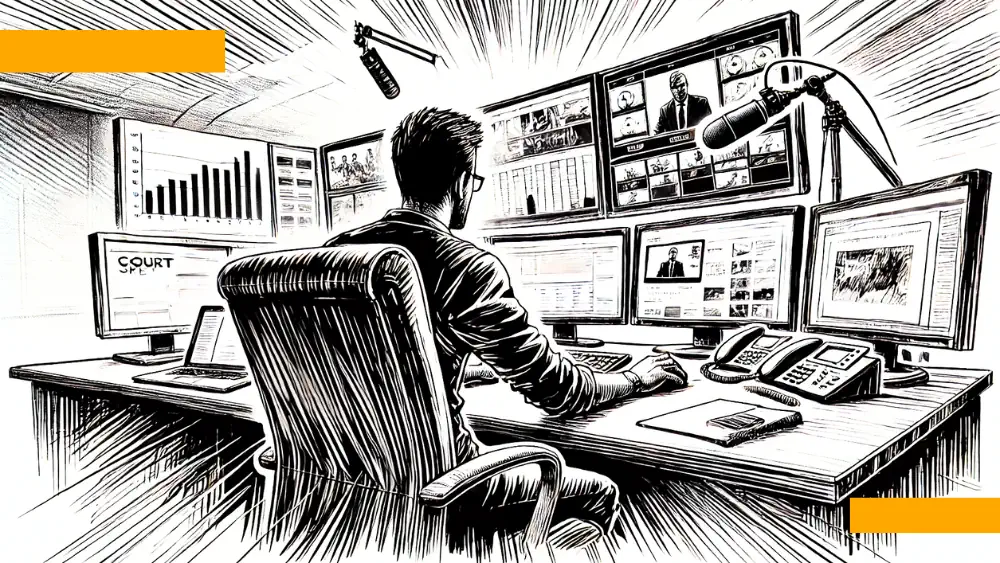
Imagine a soccer match or the closing of a financial stock market. The referee blows the final whistle, and a system publishes an online report with all necessary results in a fraction of a second. Such intelligent solutions work perfectly in simple sports texts, complex business reports, or local weather forecasts. Computer programs have been writing press articles independently for several years. We call this phenomenon automated journalism. Algorithms instantly analyze massive data sets and arrange ready texts.
Yan Li, a researcher from the Institute of Marxism at the Shenzhen Party School in China, published an interesting report in the prestigious scientific journal Humanities and Social Sciences Communications. The author examined the reactions of young news consumers living in China in great detail. He investigated how frequent contact with texts from artificial intelligence influences human belief in the reliability of today`s digital press.
Machines possess incredible operational speed, but they also have very serious flaws. Computer systems do not understand the broad social context and do not show moral judgment of the situations around us. Programs mechanically duplicate human biases hidden in the base data that the machine previously learned from. An ordinary journalist can easily catch subtle nuances and wisely balance the arguments of both sides of a difficult conflict. An algorithm simply puts individual words into correct sentences. This mechanical nature of technology raises many difficult questions about the future of disinformation and public trust in traditional news media.
Digital readers prefer the objectivity of machines
Digital consumers aged 18 to 35 grew up surrounded by the global internet and smartphones. These young people navigate the maze of information very efficiently and know new solutions perfectly. Yan Li from the Shenzhen Party School describes this interesting process. The researcher asked exactly 467 such individuals about their daily feelings and regular reading habits. Chinese readers demonstrate a very specific approach to digital news, which differs strongly from the views of older generations previously studied around the world.
The results of the conducted surveys provide fascinating data about the profile of a modern media user. Let us see who exactly the people are who read news created by advanced online algorithms on a daily basis.
| Demographic category | Specific group | Percentage share in the study |
|---|---|---|
| Age | 18-22 years | 26.8% |
| Age | 23-27 years | 33.5% |
| Age | 28-35 years | 39.7% |
| Education | Below high school | 6.0% |
| Education | High school | 25.7% |
| Education | Bachelor`s degree | 42.8% |
| Education | Higher or vocational | 25.5% |
Men accounted for 50.3 percent of the respondents, and women were exactly 49.7 percent. This group directly represents individuals who are highly familiar with new forms of virtual communication. Yan Li notes a very interesting social correlation in his report. Consumers from this age group intensely seek information that is extremely fast, completely reliable, and maximally neutral. Digitally generated news hits these specific informational needs of the young generation almost perfectly.
The conclusions from the report regarding the perception of objectivity present themselves as follows.
- The more frequently readers have regular contact with news from artificial intelligence, the less often they notice harmful biases in them.
- Young internet users strongly believe in the neutrality of computer systems and automated algorithms.
- Consumers constantly treat machine filters as a guarantee of a lack of human errors while writing the news.
- The lack of visible emotional involvement of the robot clearly builds an image of an objective press in the eyes of the youth.
In ten years there will be no journalists
An intelligent algorithm by definition does not have its own emotions, never deliberately favors any side of a loud dispute, and constantly uses very cool language. For a young consumer, such a raw writing style seems extremely fair and highly professional. A known psychological mechanism operates here, which academic researchers call the uses and gratifications theory. Modern consumers choose the media channels themselves that satisfy their huge hunger for pure facts deprived of human opinions fastest and best.
Many famous reporters loudly fear losing their jobs to computer programs in the coming decade. Meanwhile, regular readers look at this technological innovation very pragmatically every day. They treat complex computational programs as ordinary, extremely useful tools in the hands of press newsrooms. They strongly trust that a well-designed information system simply processes pure numbers and verified facts reliably. The machine has no personal political views, so in the eyes of a statistical reader, it does not distort the reality surrounding us in any visible way.
Who believes computer editors
Personal political views strongly shape the reception of modern technologies. Social attitude towards huge innovations in the media depends on very many environmental factors. The author from the Shenzhen Party School research institute proves that everyday politics plays a gigantic role here. He points to personal ideology as an extremely powerful information filter in the reader`s head. Scientists from China carefully analyzed the views of all participants of this social experiment.
| Political orientation | Percentage of respondents |
|---|---|
| Conservatives | 20.3% |
| Liberals | 26.8% |
| Centrists | 23.5% |
| Libertarians | 12.2% |
| Apolitical individuals | 17.2% |
The above statistical data show the diverse views of the participants of the Chinese study. The mentioned researcher linked these collected numbers with the declared level of citizen trust in computer journalists. Detailed results indicate that individuals with liberal views are much more willing to believe in the accuracy and reliability of automated press systems. In turn, declared conservatives show much greater and natural caution towards digital novelties. They definitely prefer traditional forms of transmission and suspect machines of hidden manipulations of important facts much more often.
The discovered correlations between personal views and belief in new technology show certain ironclad regularities.
- A specific political orientation very strongly influences an individual`s overall level of trust in mass, automated news.
- Modern readers are extremely eager to search online for articles confirming their own life beliefs.
- A high level of trust in artificial intelligence immediately translates directly into perceiving machine texts as one hundred percent accurate.
- Young consumers completely unconsciously bypass news services presenting opinions clearly contradictory to their established ideology.
The behavioral mechanisms described here operate almost completely automatically in our human minds every day. When a computer system regularly delivers news perfectly aligned with our own expectations, we instinctively begin to consider it an extremely reliable entity. The reader simply rewards their favorite newspaper or portal with their trust because it never delivers annoying and internally contradictory information to them.
Intelligent web algorithms quickly and permanently learn our hidden political and social preferences on the internet. Fast computers adjust the content displayed on our screens straight to the history of our previous daily clicks on the web. In this way, efficient machines create an invisible information bubble, which brings a sense of full comfort and alleged accuracy of the media message from artificial intelligence.
What about ethics and transparency? Yan Li admits that the new technology carries hidden threats to the functioning of democracy. Educated newspaper readers firmly expect truth and one hundred percent honesty from publishers. Press newsrooms must clearly and openly inform who exactly created a given article in their digital newspaper. He proposes very specific and cheap remedial solutions for modern media managers.
The entire study The impact of automated journalism on media bias, accuracy, and public trust: evidence from young Chinese news consumers is available at https://doi.org/10.1057/s41599-026-06612-6


COMMERCIAL BREAK

New articles in section Media industry
Information laundering. Russian propaganda returns as news from China
KFi
Russian intelligence agencies use complex tactics to mask the primary source of their harmful narratives. Patrycja Krzyśpiak from NASK details this dangerous process of information laundering in a recent report.
Health disinformation on the internet. Diagnosis from an algorithm
Katarzyna Czechowicz
Health disinformation can cause a cancer patient to see a doctor when it is too late for effective treatment. It can also undermine trust in doctors and public institutions. As a result, people may refuse to cooperate even during a real external threat, experts warn.
Feminatives are not a given. How Polish women talk about their professions
SWPS
Polish women still rarely use female job titles. This comes from the latest report by the Center for Research on Social Relations at SWPS University. Women's professional activity proved to be a significant factor in using feminatives.
See articles on a similar topic:
Reading Industry Magazines in Poland 2024: PBC Report
Sylwia Markowska
76% of readers of industry magazines are responsible for purchasing decisions in their workplace. To deepen the understanding of the role of industry press and how it is read, PBC surveyed 2051 respondents from 5 different sectors, gaining the latest insights into the reading habits of this segment of the press in Poland.
Review of media from around the world. See what they are buzzing about [LINK]
AUTOPROMOCJA Reporterzy.info
What is the media buzzing about? A review of the headlines of the most important newspapers and websites. Events of the day, country, world, media market, economy, sport, foreign media, and even gossip and curiosities. In real time and 24 hours a day. We invite you!
Poles on the Internet. RegionyNEXERY 2024 Report
KFi
The Internet not only connects people but also changes their daily habits in ways that seemed unattainable just a few years ago. Over 40% of Poles work remotely, and IoT devices are gaining popularity in rural areas. The #RegionyNEXERY 2024 report reveals surprising facts about the digital reality.
Algorithmic personalization study. Who and how understands digital media
KFi
Most internet users believe that everyone sees the same content online. Meanwhile, algorithms personalize messages so effectively that a young woman with higher education receives different information than her father. Researchers reveal who truly understands the mechanisms.