 po polsku
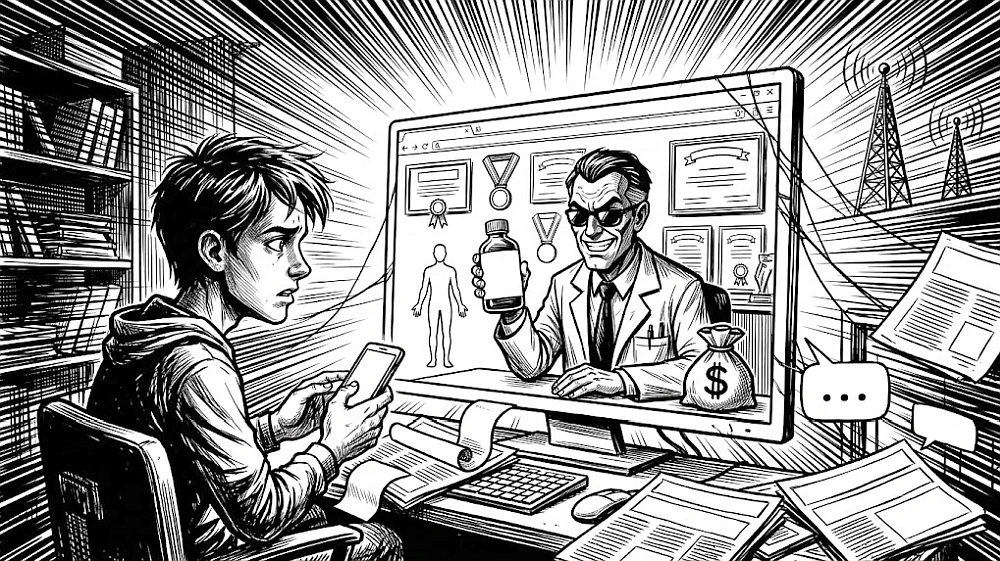 illustration: Gemini AI
Translation supported by Google Gemini
They discussed this topic in Warsaw during a debate titled “Diagnosis from an algorithm, therapy from TikTok. What to do with the infodemic?”. The meeting was attended by Prof. Wiesław Jędrzejczak from the Medical University of Warsaw, Prof. Dominik Batorski from the University of Warsaw, Monika Waćkowska-Kabaczyńska from the Chief Sanitary Inspectorate, Jakub Śliż, president of the Pravda Association, reporter Mirosław Wlekły, and Paweł Nowacki, co-founder of the Association of Digital Transformation Practitioners.
The debate summarized the project “Snake Oil Nation: Investigating Pseudoscientific Health Practices in Poland”, which focused on the growing market for pseudoscientific health practices in Poland. Its authors examined how private clinics, influencers, and brands sell unproven therapies and products, as well as how they gain the trust of consumers.
During the meeting, data from a Wroclaw Medical University report was presented. It showed that from January 2025 to May 2026, medical disinformation appeared in over 32 thousand media publications, reaching a total audience of about 2.6 billion. Additionally, over 347 thousand posts appeared on social media platforms, reaching users about 850 million times. The data included both false content and correcting materials.
Prof. Dominik Batorski from the University of Warsaw pointed out that a large part of medical disinformation is driven by money. Therefore, the project also analyzed ads for health-related products. Clearly pseudoscientific content made up only a small percentage of these ads, but reached huge audiences. Some ads disappeared only after reaching their targets.
However, the expert noted that the problem goes beyond obvious pseudoscience. - We have a large gray area of health-related products. Using them brings some benefits, but they are advertised in a problematic way, he said.
As he explained, this includes promises that are not supported by facts. Researchers found tens of thousands of such ads on Meta platforms alone. According to Prof. Batorski, demonetizing this content should be one way to fight disinformation. Platforms also need to take greater responsibility for spreading false information.
The scientist also stressed that professional communities must react more effectively to pseudoscientific practices in their own ranks. This applies not only to doctors, but also to the media, which, as he noted, sometimes promoted people creating pseudomedical content.
Reporter Mirosław Wlekły prepared a report on people using pseudoscientific therapies. He stressed that it is a mistake to believe that only poorly educated or uncritical people fall for medical disinformation. Its promoters are often charismatic and can persuade people who need help in tough situations. Therefore, anyone can become a victim of disinformation, especially when medicine cannot offer them or their loved ones a simple and sure solution.
- These people act as doctors, scientists, confessors, and psychologists. People with health problems look for help anywhere, and here they usually find guaranteed answers. Science is complex, and it rarely gives simple yes or no, black or white answers, he said.
He added that entering such an environment can lead to accepting more far-reaching conspiracy theories. He noted that pseudomedical content often blends with pro-Russian, anti-Ukrainian, or climate-change-denying narratives.
Jakub Śliż from the Pravda Association pointed out the need for belonging. Groups of people form around alternative therapies to support each other and meet offline. In his view, this makes the problem very hard to overcome. Any outside intervention can be seen as an attack and proof that the system is fighting them.
Śliż also said that fact-checkers face a harder task than purveyors of disinformation. Fact-checkers must verify sources and explain complex issues, while false messages can appeal to emotions and spread quickly online.
Prof. Wiesław Jędrzejczak noted that pseudoscience often gains credibility through language. Simple products and practices are described using scientific terms, which creates the impression that research backs them up. As examples, he mentioned “genetically modified water” and the term “dietary supplement”, which sounds much more technical than “food additive”.
Monika Waćkowska-Kabaczyńska from the Chief Sanitary Inspectorate spoke about a huge gap between the actions of disinformation spreaders and public authorities. - An influencer can record a video in 30 seconds, post it on a channel, and it takes off, getting shared and gaining reach. We must verify every piece of information, identify the source, and consult experts and lawyers. This takes time (...) because someone takes legal and official responsibility for every piece of information we release as an institution, she explained.
In her opinion, truthful information is also usually less appealing. A message stating that scientific evidence does not support a therapy loses emotionally to a story about a person who claims that doctors could not help them, but a specific method did.
Waćkowska-Kabaczyńska also stressed that the effects of disinformation go far beyond buying a supplement. It can undermine trust in doctors, government offices, and state institutions. In extreme cases, it can lead to people refusing to cooperate during a real external threat.
For this reason, the Chief Sanitary Inspectorate focuses on education and building resilience to disinformation from an early age. It runs programs for students and seniors, two groups that are especially vulnerable to false information.
Waćkowska-Kabaczyńska also drew attention to the need to simplify administrative language. - If the administration hides behind overly difficult language, it will not build trust. Therefore, plain language is key to reaching people with a clear message. We must train officials because habits of speaking ex cathedra and in the third person are very hard to eliminate.
source: PAP naukawpolsce.pl


COMMERCIAL BREAK
New articles in section Media industry
Information laundering. Russian propaganda returns as news from China
KFi
Russian intelligence agencies use complex tactics to mask the primary source of their harmful narratives. Patrycja Krzyśpiak from NASK details this dangerous process of information laundering in a recent report.
Feminatives are not a given. How Polish women talk about their professions
SWPS
Polish women still rarely use female job titles. This comes from the latest report by the Center for Research on Social Relations at SWPS University. Women's professional activity proved to be a significant factor in using feminatives.
Who trusts articles written by artificial intelligence? Results of a study from China
Krzysztof Fiedorek
Young readers trust machines more than human writers. When they consume news, they prefer the cool objectivity of algorithms over human emotions. They believe that articles created by AI are objective. As they interact with these texts more frequently, they rarely notice any harmful biases in them.
See articles on a similar topic:
Radio in Poland 2025. Analysis of listenership and listener behavior
Krzysztof Fiedorek
Radio attracts 17.3 million listeners in Poland every day, who spend over four hours with their receivers. Interestingly, as much as 86 percent of station time is listened to via traditional FM waves. Despite digitalization, the internet accounts for only 12.5 percent of the listenership share.
The most valuable female personal brands in Polish fashion. IMM report
KFi
The ten most popular people in Poland in the "fashion" category generate over 1.5 billion contacts across all types of media in a year. Their value is nearly 400 million zlotys. The ranking was prepared by the Institute of Media Monitoring for "Forbes Women" magazine.
Television 2025. Report by the European Broadcasting Union
Krzysztof Fiedorek
Europeans are watching less and less television. In 2024, the average viewing time was 3 hours and 13 minutes per day. Only 54% of young people had any contact with TV, and public broadcasters held a 23% share. Television is losing relevance, especially among the youngest viewers.
Gen Alpha avoids tough topics. What young people are really looking for
Krzysztof Fiedorek
Generation Alpha prefers humor in 46% of cases, while only 12% are interested in news and political topics. Young people and children consciously limit what negatively affects their emotions - according to the report "Gen Alpha Unfiltered" published by GWI.