
 po polsku
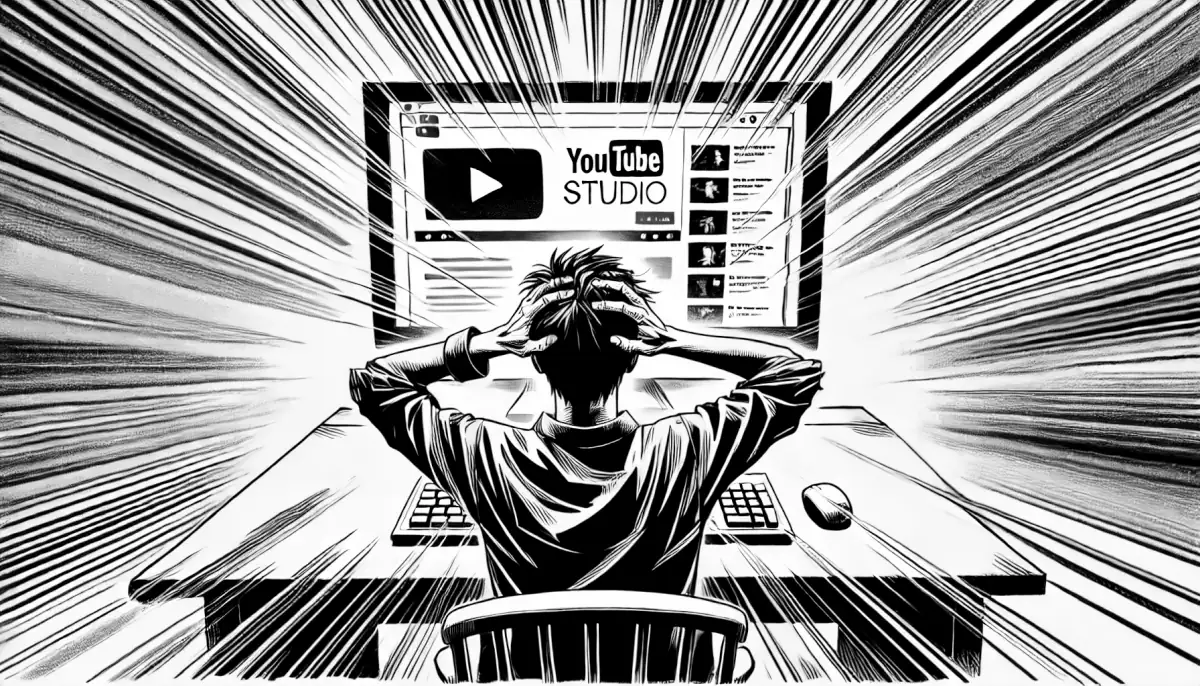 illustration: DALL-E
The reach drop mechanism due to audience mismatch is a phenomenon repeatedly diagnosed by Youtube creators. It results from the fact that the algorithm tests new long-form video on current subscribers. If the base suddenly gets dominated by people acquired through short forms who have no interest in long viewings, the click-through rate (CTR) and watch time drop drastically, which the system reads as a signal to stop promoting the material. Based on their analytics, creators confirm that reach problems stem from this mismatch of viewer intent, not from a deliberate "punishment" from the algorithm.
The "Audience Mismatch" phenomenon is a situation where a creator attracts a group of subscribers to their channel who want a completely different way of consuming content than the main pillar of their work. In the case of storytelling channels, this problem manifests in a clash between lovers of fast, high-stimulus entertainment and viewers expecting a deep narrative.
How audience mismatch harms a channel?
Why does this phenomenon occur? This process stems from differences in viewer psychology and the mechanics of content testing by YouTube. The cause is different consumption modes. These translate into conflicting signals sent to the Youtube algorithm. The consequences can be disastrous.
- Subscriber base disruption: When your short video gains popularity, it can quickly bring thousands of new subscribers who subscribed to the channel solely for short forms.
- Negative signal for the algorithm: When you publish your main, long video, the YouTube algorithm shows it first to your subscribers (including those newly acquired from Shorts). Because the new group ignores this format, the thumbnail click-through rate (CTR) drops drastically. Even if they click it, they quickly turn it off, ruining watch time (retention).
- Distribution halt: The algorithm interprets low CTR and poor retention among your own subscribers as proof that the video is of low quality, so it stops recommending it to a broader audience on the Home Page.
How to avoid this and protect long videos?
You can neutralize this risk by applying an appropriate funnel and attention management strategy:
- Strict thematic consistency: Your short videos must be inextricably linked to the topic of your long materials. If you run a true crime channel, do not upload funny trends or casual thoughts just to get views. Thematic consistency guarantees that you attract people interested in your target niche.
- Designing a "Curiosity Gap": Never summarize the whole story in 60 seconds. Use Shorts as teasers that introduce tension, ask a question, or cut off at the most exciting moment. The viewer must feel an itch to decide to watch the long form.
- Redirection via "Related Video": Treat Shorts as a tool for discovering your channel (top of the funnel), not the final product. Use the native related video feature (the link icon displayed directly on the Shorts screen) to physically and easily transfer an intrigued viewer straight to the full, long episode.
- Separating channels as a last resort: YouTube staff on the platform`s official channels recommend a simple rule: if you create content for the same target group, keep it on one channel. However, if you know that your Shorts are targeted at a completely different audience than long videos, you should create a separate channel for them to avoid mixing signals.
The report was supported by Gemini Deep Research.


COMMERCIAL BREAK
New articles in section Skills and knowledge
How to reliably report uncertain data. A scientific meta-analysis
KFi
Numbers and mathematical intervals have a calming effect on news consumers. Political views, intelligence levels, or reader education do not alter how people process information about incomplete knowledge. Here are the results of dozens of media experiments regarding trust in the press.
Artificial intelligence in film and tv production. McKinsey report
Krzysztof Fiedorek
Global spending on video content has reached $180 billion, and the average viewer consumes it for 7.5 hours a day. Streaming is growing by 13%, while traditional television is losing 4% annually. As much as 84% of the US market is controlled by the seven largest players. Additionally, AI technology is reshuffling the market.
War reporter in the new reality. Evolving techniques, same purpose
KFi
What happens when war breaks out just across the border and journalists aren't ready? Polish reporters faced that question after Russia invaded Ukraine in 2022. Lacking training, they improvised: blurred details, hid names, and balanced trauma with truth.
See articles on a similar topic:
How to Write an Article That Google Loves and People Understand
Bartłomiej Dwornik
The order of priorities in this guide's title is intentional. In 2024, to reach a larger audience, you must first convince the algorithms to display your content to readers. First - the article must be factually sound. Second - it should look appealing and be easy to read. We’ll focus on the latter.
How ChatGPT, Google Gemini, and Other Large Language Models Work
Krzysztof Fiedorek
These powerful algorithms can generate text, translate languages, write various types of creative content, and answer your questions in a way that often feels like a conversation with a person. But how is it possible for a machine to mimic human intelligence so well?
AI slops and microtargeting. Why wou should NOT LIKE the bread horse
Bartłomiej Dwornik
"I grew this garlic chive all by myself on the windowsill. But I bet you won't congratulate me." Do you also see an influx of such posts in online communities? Be careful. This is called AI slop (or Boomer Trap), and it is NOT just a harmless game or entertainment. It is a well-thought-out mechanism in which the currency is you. First, your time and engagement. And soon, your money.
How Information is Created?
Agnieszka Osińska
The media construct the world for us - the audience. However, most viewers, listeners, or readers do not have direct access to the issues discussed in the reports.