 po polsku
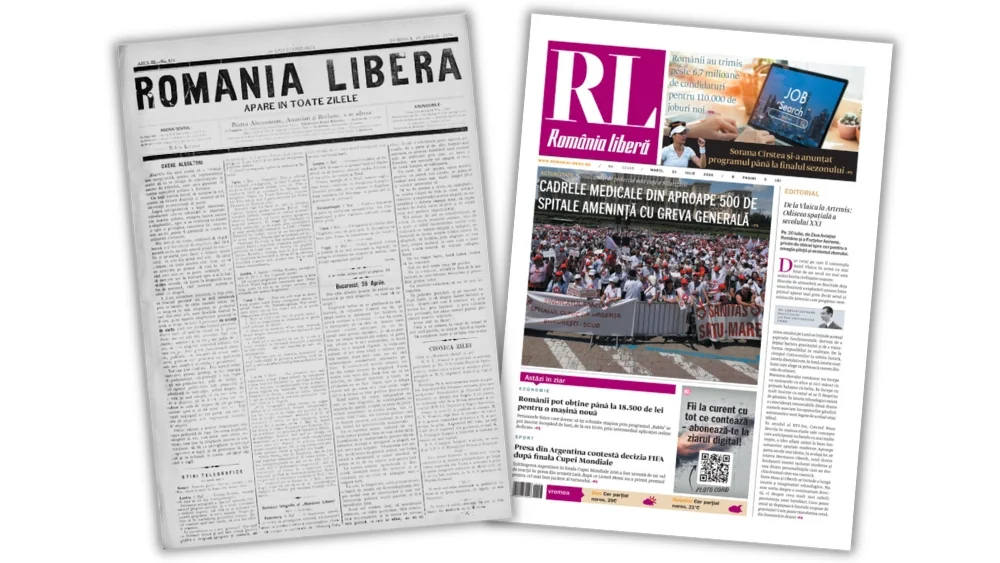 fot. public domain/Biblioteca Digitală a României • romanialibera.ro
Laurian, a graduate of the Faculty of Literature and Philosophy in Bucharest and a doctor of philosophy (Paris, Brussels), had been active in journalism since 1872. He was the creator and editor of the magazine Tranzacțiuni literare și științifice (Literary and Scientific Transactions), but his România Liberă was a thoroughly political newspaper, although he also devoted much space to literature, especially patriotic works.
The date of the first edition was not accidental. The declaration of independence had been known for a long time, but May 15 was also the anniversary of the National Assembly in Blaj, where freedom of the press was proclaimed, and Dimitrie`s father was one of the creators of that document.
The first issue of Free Romania had 4 pages with 4 columns each and a clear thematic division into sections and departments:
- Serviciu de știri (telegraphic service)
- Editorial (editorial)
- Cronica zilnică (daily chronicle)
- Varietăți (varieties)
- Fapte diverse (miscellaneous facts)
- Ultima oră (latest news)
The fourth page belonged entirely to advertisements.
Popular in Romania, with offices in Paris and Vienna
From its very first days, the newspaper declared its defense of the country`s independence. In his inaugural editorial, Laurian wrote: "This is the organ of a group representing moderate left-wing ideas. We will fight today in the press, tomorrow on the border, for the independent and free existence of a prosperous Romania."
The newspaper`s editorial office was located at 11 Lipscani Street in Bucharest, and it was printed at Ștefan Mihăilescu`s printing shop at 14 Covaci Street, where the entire administration of the daily was moved in 1880. From the very beginning, both the editorial office and the print shop were bustling. Laurian had strong support from fellow writers, and he actively promoted young creators. One of the first contributors was Barbu Ștefănescu Delavrancea. The young author debuted with a poem dedicated to Queen Elisabeth, but he quickly learned the ropes of journalism and began hosting the column section Zig-Zag, signing with the pen name Argus. Close associates also included Duiliu Zamfirescu, Octavian Goga, B.P. Hasdeu, and Carmen Sylva.
The daily (published every day) quickly gained followers and became the most popular publication of those years, not only in the capital but also in other cities. It also had advertising and distribution offices in Paris, Hamburg, and Vienna. It cooperated with HAVAS, the world`s first news agency.
After just two years of operation, Laurian ran a world-class newspaper with reliable domestic and international news, a column section, and graphics, although only in advertisements. The daily was clear, well-composed, with distinctly separated texts and a variety of fonts.
Between 1882 and 1884, the newspaper even had its own correspondent in Paris. Barbu Ștefănescu Delavrancea undertook law studies in France during those years. He wrote current articles for România Liberă, as well as reports from Parisian art salons. After returning to the country, he became an editor-reporter. He had a distinctive style. His articles, such as Hasdeu from 1881, although unsigned, were recognizable. Over time, both he and other authors began signing their texts, which was not the norm in other newspapers.
An interesting fact of those years was that the daily published texts by women. One of the favorite authors was the Belgian writer Marie Nizet, a lover of all things Romanian.
Merger with Epoca
România Liberă and Laurian kept their finger on the pulse of Romanian politics for the next decade. Social and economic issues occupied much space in the columns of the newspaper. The cultural section developed greatly. Literature, painting, and theater were present almost daily, and readers appreciated it very much. Theater reviews and literary serials signed by Don Padil strengthened the daily`s standing. Translations of Lermontov`s poetry and Guy de Maupassant`s works increased circulation and attracted more readers. The newspaper was closely linked with the circle of Junimists (a conservative literary environment centered around Titu Maiorescu), which is why it was considered the organ of that society.
For a short time, between September 16 and November 4, 1884, the daily published a special supplement with the same title. The first editorial stated: "We will try poetry, novels, short stories, reproductions of selected literary works from past eras, rare and forgotten works, so that they become known and available to the new generation." However, the publication did not succeed and had to be abandoned. The newspaper was still considered a political publication despite everything.
And yet... In 1889, a merger took place. România Liberă was merged with the magazine Epoca to create a new publication, Constituționalul, which lasted less than two years. On December 14, 1900, after merging with Timpul, it changed its name to Conservatorul and was published until 1914.
Five decades of silence
România Liberă, after 12 years of prosperity, fell silent for nearly five decades... though not entirely. When Conservatorul disappeared from the press market, attempts were made to revive România Liberă. Unfortunately, there were many daily newspapers, papers, and magazines covering political topics at that time (Universul, Adevărul, Seara), and Free Romania lacked breakthrough power due to a lack of funds.
The first issue of the revived publication appeared on September 20, 1915. It had only two pages, the second of which consisted exclusively of advertisements. Although the creators called themselves a newspaper, in reality it was a brochure and appeared sporadically until the end of 1920. In addition to political articles, social and cultural topics were also included. Poems were printed and photos were even published. Unfortunately, nothing helped, and the publication vanished for years to come.
In 1926, România Liberă appeared again, this time as a literary periodical. Both the previous edition and the 1926 version referred to the 1877 newspaper, claiming rights to it and historical continuity. In this form, printed sporadically, Free Romania survived until 1940.
The first years of World War II were a time of silence for the newspaper, but in 1943 the daily woke up, though not entirely legally. On January 28 (in Paris), the first issue was published underground by communist activists. Its editor-in-chief was Grigore Preoteasa. The purpose of the newspaper was to criticize fascism, the government of the time, and to campaign for Romania`s departure from the Axis powers.
On January 28, 1943, the first issue of our newspaper appeared. We thus concluded a year of struggle and leadership, a year in which "Free Romania" kept the promises made at publication: to call, despite the Gestapo and security services, constantly upon the entire Romanian spirit to unite and fight decisively to end the Hitlerite war, to remove Nazi elements from the country, for a free and independent Romania... The seed we sowed is sprouting. "Free Romania" has spread throughout the country, bringing ardent patriotism, determination to sacrifice, and dedication to fighting the Hitlerite plague by all means. The collapse of Hitlerite Germany is near. "Free Romania", the only free newspaper in Romania, continues to occupy an honorable place, proudly holding the banner of the anti-Hitler fight for the nation`s freedom and independence (RL, Paris, January 28, 1944). The daily was published simultaneously in French.
Abroad, the publication survived until early August 1944, but as early as August 24 an editorial office was opened in Bucharest, and the newspaper legally entered Romania`s media market as the organ of the National Council of the National Democratic Front.
The same title, different values
The first Romanian issue was edited in the secretariat of a Bucharest school, and among its creators were Alexandru Graur (V. Condrea), co-creator of the Dictionary of the Romanian Language, and the editor-in-chief at the time, Mihail Sebastian.
The daily, although referencing the historical publication, did not resemble it in any way and celebrated different views. Sebastian, who wrote many texts for the first issue, realized on the night of August 23 during typesetting that this would not be a newspaper with national traditions like the one from 67 years earlier, but ordinary communist press subordinated to the party. That same night he resigned from his post and withdrew his articles. Years later, he recalled the situation: "I congratulate myself that my adventure with `România Liberă` ended quickly, before I put my signature there. Working under a regime of secret committees would be impossible; indoctrinated stupidity is harder to bear than pure stupidity. After three days, following the attack by Graur and his gang, I understood that I was entering an editorial room terrorized by conformism" (he was expected to support Jewish emigration to Palestine, and the communists wanted to subordinate the newspaper to themselves).
Despite the initial problems, the newspaper was published because Grigore Preoteasa took charge of the editorial staff on behalf of the party, the same man who led it in Paris. His task was to get the work organized, chart the paths, and establish the foundations of editorial work. The task was accomplished, and from the end of 1946, journalist Nicolae Bellu sat in the editor-in-chief`s chair.
During its first year of operation, România Liberă appeared daily, including Sundays. Depending on the number of topics covered, it had 4 to 8 pages and 7 columns. As befitted a party organ, the main topics were the party, its aspirations, activities, and the support of the nation. If cultural issues were raised, politics still played the primary role. The war was still ongoing, so many articles covered the alliance with Germany, the actions of the government at the time, and the coup d`état in August 1944.
The daily had a clear division into sections and departments:
- VIAȚA POLITICĂ (political life)
- ULTIMELE ȘTIRI (latest news)
- PROBLEME ȘI EXPERIENȚE (problems and experiences)
- JUSTIȚIE (justice / judiciary)
- REVISTA PRESEI (press review)
- ECONOMICE-SOCIALE (economic and social affairs)
- PROVINCII / PROVINCIA (provinces) - regional events section
- RĂZBOIUL (war) - war dispatches section
- FRONTUL POLITIC (political front) - short political news section
- FRONTUL MUNCII - din întreprinderi (labor front - from enterprises / workplaces) - a more specialized part of the labor section
Each issue contained topically relevant photographs, cartoon satires appeared on the front page, and on October 24 (the recovery of Transylvania) and December 25, 1944, the front page received a red color. A year later, the same color appeared more frequently, and on May 6, the entire front page was multi-colored (end of the war). From that time on, the title of the daily began to be permanently underlined with a red line, and from August, even some major article headlines were red. Over time, the section and all topics related to the war disappeared, and Free Romania began to take root, this time in communist soil.
Leaders of communist labor
Alongside Nicolae Bellu, Costin Murgescu was active in the editorial team. He was not only a journalist but also an economist and a lawyer. He was entrusted with organizing a network of both domestic and foreign correspondents, as well as the Agitprop section. He organized courses and training sessions. By 1950, the newspaper had about 70 correspondents, mostly young and highly committed people, with the majority serving as volunteers. Murgescu also wrote columns and articles, and as an economist, he challenged the so-called Valev plan, which aimed to create economic enclaves. The plan failed, and the journalist became the director general of the Institute of World Economy. Women were also present in the daily. Ecaterina Oproiu, privately Murgescu`s wife, ran the cultural department. She founded the magazine Cinema and earned the nickname sacred monster of Romanian culture. At the same time, a young journalist named Virgil Lazăr began working at România Liberă, later becoming one of the most famous representatives of the democratic press after the 1989 revolution.
From 1945, when Free Romania settled into the communist world, Sunday editions were discontinued. The daily was published from Monday to Saturday, with Saturday featuring the weekend edition. Until December 1947, Romania was a monarchy, but starting the new year, the communists took power, and România Liberă had to accept this to continue existing. From 1950, the paper became the official press organ of the People`s Councils. Editors tried hard to keep sections like Fișier bibliografic (Bibliographic File) or Cărți noi în librării (New Books in Bookstores), as well as the entire cultural section, in print. This was no simple task. It was somewhat easier to digest the news in the supplement to the main edition, Magazin, a weekly journalistic, cultural, and entertainment magazine that launched in January 1949 and survived for decades.
In the late 1940s, Nicolae Bellu was appointed director of National Cinematography, and Mircea Rădulescu took over the editorial office. These were still relatively quiet times, but for promoting the new ideology, the paper received the Ordinul Muncii (Order of Labor) award in late 1949. Its image was placed next to the title starting in January 1950, and in 1951 Grigore Preoteasa became editor-in-chief once again.
Preoteasa enjoyed strong support from the new authorities, and the paper was the only one in the country with permission to print advertisements. It had a dedicated department and resources. Although all employees, including the editor-in-chief, belonged to the party, years later the paper was considered the least ideological of that era. Until 1950, its subtitle read: The largest newspaper of news and reportage, but Grigore Preoteasa introduced changes beyond just the subtitle:
- removed color
- introduced a modular layout (more short texts and notes)
- more politics
- "screaming", bold headlines
- more text, denser pages
- font changes
- elimination of humor and satire from the front page
- making the daily resemble Soviet newspapers
And so, entering the 1950s, Free Romania became a politicized paper, whereas it had been an informative one. Around the same time, an even more political publication gained influence on the market: Scânteia. A race for everything began, from popularity and circulation to backing by the highest offices. This pattern continued for the next four decades.
The Rominia Libera episode
In 1953, a spelling reform occurred in the Romanian language. Many changes were introduced, including replacing â with î. Consequently, the title of the daily changed to Rominia Libera, though after some time it returned to its former spelling. After 1953 (the death of Stalin), the climate in Romania, as in the rest of the Eastern Bloc, thawed slightly. Terror eased, but not for long; the system remained. When an anti-communist uprising broke out in Hungary in 1956, Romania immediately imposed restrictions, controls, and purges. The press came under strict censorship.
On November 4, 1957, a plane crash occurred near Moscow in which Grigore Preoteasa died. It was a strange crash. Only the Soviet pilots died, while Romanian dignitaries survived unharmed. However, Preoteasa was in the cockpit at that moment. An account of this accident was written by Florea Ceaușescu, brother of the country`s future leader, who worked at the daily in the agriculture department. Because Nicolae Ceaușescu was aboard the plane, Florea was sent to Moscow. For years, people whispered about the accident in the editorial hallways, but no one asked aloud. Only after 1989 did the truth come to light...After Preoteasa`s death, Nicolae Bellu took over the editorial staff once again. The former editor`s first move was to return to the color red. The title of the weekend edition and major events changed color. The Sunday edition also returned, along with satire on the front page, specifically the cartoon feature Punctul pe "i" (Dotting the "i"). The daily still had 4 to 8 pages, 7 columns, and a section breakdown. The slogan above the title, Workers of the world, unite!, remained. But there were also new changes:
- a more concise, slogan-driven language was introduced
- the page layout became more orderly and spacious
- headlines functioned as slogans
- large, clear, more informative photos
- no advertisements
However, nothing changed in terms of content. The main themes remained: the party, communism, the power of the nation, and the working class, to which everything was subordinated.
In the 1960s, the main sections were:
- Politică internă/viața politică (internal politics/political life), including government decisions, local council activities, and speeches by dignitaries
- Actualitatea internațională (international news), mainly from the socialist bloc and based on Agerpres dispatches
- Economie/construcția socialistă (economy/socialist construction), state investments, industry
- Agricultură (agriculture)
- Învățământ/Cultură (education/culture)
- Sport (sports)
The network of domestic correspondents (C. Azotti, P. Scolan), the commentators section with their Puncte de vedere (point of view) featuring Mariana Pîrvulescu, and the photography section led by Nicu Vasile all operated quite efficiently.
The Ceaușescu era
In March 1965, the president of the State Council, Gheorghe Gheorghiu-Dej, died, and Nicolae Ceaușescu took his place. A period of dictatorship and terror began for Romania. In August of the same year, Romanians received a new constitution that defined the socialist nature of the state and the role of the Romanian Communist Party, while România Liberă became the daily of the National Council of the Socialist Unity Front, as reflected in its subtitle. Although the newspaper`s name meant Free Romania, neither the country nor the paper was free. The country was increasingly shackled, and the daily was muzzled. Journalists had to comply if they wanted to keep their jobs. Tudor Gheorghiu, Dante Poli, G. Ionescu from the domestic and political department knew this all too well.
The latter, along with V. Dănciu, covered the Prague Spring and the Warsaw Pact intervention in Czechoslovakia extensively. Romania did not participate in the event, and Nicolae Ceaușescu condemned the invasion. Consequently, military training was announced in the country, and arms production began.
By standing up against the USSR, Romania distanced itself from Soviet policy, with the final blow being its criticism of Soviet aggression against Bessarabia. The country fell out of favor in the Eastern Bloc, but the leadership decided (along with Yugoslavia at the time) not to get involved in the Cold War. The country`s policy shifted toward Western Europe. Romania was the only socialist state to sign trade agreements with the European Community and recognize West Germany. The press wrote extensively about this, but the reality was different. Although the country gained recognition in the West, Ceaușescu pursued his own internal agenda: corruption, nepotism, and dictatorship.
In 1970, two journalists joined the team at Free Romania who would later leave an indelible mark on national journalism: Mihai Băcanu and Octavian Paler. The latter became editor-in-chief, and the former became the newspaper`s first director after the 1989 revolution. Paler, who joined from television, led the daily for the next 13 years, until 1983.
Despite censorship and party control, the newspaper revamped its image, striving to be a world-class daily:
- large, bold headlines
- greater contrast between text and titles
- more human-interest stories
- light criticism, though not directed at everyone
- simpler language (closer to the reader)
- attention-grabbing photos
- more journalistic formats (columns, short stories)
- more columns (8)
The authorities must have been satisfied with the editorial team`s work, as in late 1972 the paper was awarded the State Order of the Star of the Socialist Republic of Romania. From January 1973, an image of the order appeared next to the banner alongside the Order of Labor. Until the late 1970s, nothing changed in the daily`s appearance or content. The cult of personality, the creation of the Securitate (political police), and foreign loans were subjects of quiet conversation, as speaking openly was forbidden. However, these national troubles led to a miners` strike in the Jiu Valley in 1977 and a deteriorating economic situation in 1979 due to the oil crisis. A wave of public discontent was set in motion.
Underground press and editors behind bars
The 1980s opened with economic hardship and turmoil. Scarcity of basic goods, especially food, long lines, power outages, surveillance, arrests, and news blackouts became the norm. Newspapers remained silent under threat of imprisonment. In January 1988, four journalists from România Liberă, Petre Mihai Băcanu, Anton Uncu, Mihai Creangă, and Alexandru Chivoiu, began publishing an illegal paper called România (Romania), criticizing the government, its leader, communism, and everything that brought the country to ruin. The newspaper was confiscated, and the journalists were jailed. However, the damage was done, and on December 16, 1989, a nationwide revolt erupted. The communist regime was overthrown, and its leader Nicolae Ceaușescu, along with his wife, was executed before television cameras on December 25. The National Salvation Front, led by Ion Iliescu, took power in Romania.
On December 22, the arrested journalists were released. They returned to the newsroom, which immediately moved to cut ties with the old regime. Petre Mihai Băcanu became the first director in the paper`s history. It was announced that the daily was changing its status to an anti-communist publication with a democratic orientation. It also became the first Romanian daily under private ownership. Its owner became Association "R", with Anton Uncu serving as editor-in-chief from 1989 to 1996. Former editor-in-chief Octavian Paler, upon release from house arrest, assumed the role of honorary director and columnist.
Leaders of communist labor
Alongside Nicolae Bellu, Costin Murgescu was active in the newsroom. He was not only a journalist but also an economist and a lawyer. He was tasked with organizing a network of both domestic and foreign correspondents, as well as the Agitprop section. He organized courses and training. In 1950, the newspaper had about 70 correspondents, mostly young and committed people, with most of them working as volunteers. Murgescu also wrote columns and articles, and as an economist, he challenged the so-called Valev plan based on creating economic enclaves. The plan collapsed, and the journalist became director general of the Institute of World Economy. Women were also present in the daily. Ecaterina Oproiu, Murgescu`s wife, ran the cultural section. She founded Cinema magazine and earned the nickname of the sacred monster of Romanian culture. At the same time, young journalist Virgil Lazăr began working at România Liberă, becoming one of the most famous figures of the democratic press after the 1989 coup.
From 1945, when Free Romania settled into the communist world, Sunday editions were dropped. The paper appeared from Monday to Saturday, with Saturday serving as the weekend edition. Until December 1947, Romania was a monarchy, but starting the new year, communists took power, and România Liberă had to accept this to survive. From 1950, the daily became the official press organ of the People`s Councils. Editors tried hard to keep sections like Fișier bibliografic (Bibliographic file) or Cărți noi în librării (New books in bookstores), along with the entire cultural section, in print. However, this was no simple task. It was somewhat easier to swallow news in the supplement to the main issue, Magazin, a weekly opinion, culture, and entertainment magazine that started publishing in January 1949 and survived for decades.
In the late 1940s, Nicolae Bellu was appointed director of National Cinematography, and Mircea Rădulescu took over the newsroom. These were still relatively quiet times, but for promoting the new ideology, the paper received the Ordinul Muncii (Order of Labor) award in late 1949. Its image appeared next to the title from January 1950, and Grigore Preoteasa became editor-in-chief again in 1951.
Preoteasa enjoyed strong support from the new authorities, and the paper was the only one in the country allowed to run advertisements. It had a dedicated section and funds. Although all staff members, including the editor-in-chief, belonged to the party, years later the paper was considered the least ideological of that era. Until 1950, its subtitle read: The largest newspaper of news and reportage, but Grigore Preoteasa introduced changes beyond just the subtitle.
- removed color
- introduced a modular layout (more short texts and notes)
- more politics
- "screaming", bold headlines
- more text, denser pages
- font changes
- elimination of humor and satire from the front page
- making the daily resemble Soviet newspapers
And so, entering the 1950s, Free Romania became a politicized paper, whereas it had been an informative one. Around the same time, an even more political publication gained influence on the market: Scânteia. A race for everything began, from popularity and circulation to backing by the highest offices. This pattern continued for the next four decades.
The Rominia Libera episode
In 1953, a spelling reform occurred in the Romanian language. Many changes were introduced, including replacing â with î. Consequently, the title of the daily changed to Rominia Libera, though after some time it returned to its former spelling. After 1953 (the death of Stalin), the climate in Romania, as in the rest of the Eastern Bloc, thawed slightly. Terror eased, but not for long; the system remained. When an anti-communist uprising broke out in Hungary in 1956, Romania immediately imposed restrictions, controls, and purges. The press came under strict censorship.
On November 4, 1957, a plane crash occurred near Moscow in which Grigore Preoteasa died. It was a strange crash. Only the Soviet pilots died, while Romanian dignitaries survived unharmed. However, Preoteasa was in the cockpit at that moment. An account of this accident was written by Florea Ceaușescu, brother of the country`s future leader, who worked at the daily in the agriculture department. Because Nicolae Ceaușescu was aboard the plane, Florea was sent to Moscow. For years, people whispered about the accident in the editorial hallways, but no one asked aloud. Only after 1989 did the truth come to light...After Preoteasa`s death, Nicolae Bellu took over the editorial staff once again. The former editor`s first move was to return to the color red. The title of the weekend edition and major events changed color. The Sunday edition also returned, along with satire on the front page, specifically the cartoon feature Punctul pe "i" (Dotting the "i"). The daily still had 4 to 8 pages, 7 columns, and a section breakdown. The slogan above the title, Workers of the world, unite!, remained. But there were also new changes:
- a more concise, slogan-driven language was introduced
- the page layout became more orderly and spacious
- headlines functioned as slogans
- large, clear, more informative photos
- no advertisements
However, nothing changed in terms of content. The main themes remained: the party, communism, the power of the nation, and the working class, to which everything was subordinated.
In the 1960s, the main sections were:
- Politică internă/viața politică (internal politics/political life), including government decisions, local council activities, and speeches by dignitaries
- Actualitatea internațională (international news), mainly from the socialist bloc and based on Agerpres dispatches
- Economie/construcția socialistă (economy/socialist construction), state investments, industry
- Agricultură (agriculture)
- Învățământ/Cultură (education/culture)
- Sport (sports)
The network of domestic correspondents (C. Azotti, P. Scolan), the commentators section with their Puncte de vedere (point of view) featuring Mariana Pîrvulescu, and the photography section led by Nicu Vasile all operated quite efficiently.
The Ceaușescu era
In March 1965, the president of the State Council, Gheorghe Gheorghiu-Dej, died, and Nicolae Ceaușescu took his place. A period of dictatorship and terror began for Romania. In August of the same year, Romanians received a new constitution that defined the socialist nature of the state and the role of the Romanian Communist Party, while România Liberă became the daily of the National Council of the Socialist Unity Front, as reflected in its subtitle. Although the newspaper`s name meant Free Romania, neither the country nor the paper was free. The country was increasingly shackled, and the daily was muzzled. Journalists had to comply if they wanted to keep their jobs. Tudor Gheorghiu, Dante Poli, G. Ionescu from the domestic and political department knew this all too well.
The latter, along with V. Dănciu, covered the Prague Spring and the Warsaw Pact intervention in Czechoslovakia extensively. Romania did not participate in the event, and Nicolae Ceaușescu condemned the invasion. Consequently, military training was announced in the country, and arms production began.
By standing up against the USSR, Romania distanced itself from Soviet policy, with the final blow being its criticism of Soviet aggression against Bessarabia. The country fell out of favor in the Eastern Bloc, but the leadership decided (along with Yugoslavia at the time) not to get involved in the Cold War. The country`s policy shifted toward Western Europe. Romania was the only socialist state to sign trade agreements with the European Community and recognize West Germany. The press wrote extensively about this, but the reality was different. Although the country gained recognition in the West, Ceaușescu pursued his own internal agenda: corruption, nepotism, and dictatorship.
In 1970, two journalists joined the team at Free Romania who would later leave an indelible mark on national journalism: Mihai Băcanu and Octavian Paler. The latter became editor-in-chief, and the former became the newspaper`s first director after the 1989 revolution. Paler, who joined from television, led the daily for the next 13 years, until 1983.
Despite censorship and party control, the newspaper revamped its image, striving to be a world-class daily:
- large, bold headlines
- greater contrast between text and titles
- more human-interest stories
- light criticism, though not directed at everyone
- simpler language (closer to the reader)
- attention-grabbing photos
- more journalistic formats (columns, short stories)
- more columns (8)
The authorities must have been satisfied with the editorial team`s work, as in late 1972 the paper was awarded the State Order of the Star of the Socialist Republic of Romania. From January 1973, an image of the order appeared next to the banner alongside the Order of Labor. Until the late 1970s, nothing changed in the daily`s appearance or content. The cult of personality, the creation of the Securitate (political police), and foreign loans were subjects of quiet conversation, as speaking openly was forbidden. However, these national troubles led to a miners` strike in the Jiu Valley in 1977 and a deteriorating economic situation in 1979 due to the oil crisis. A wave of public discontent was set in motion.
Underground press and editors behind bars
The 1980s opened with economic hardship and turmoil. Scarcity of basic goods, especially food, long lines, power outages, surveillance, arrests, and news blackouts became the norm. Newspapers remained silent under threat of imprisonment. In January 1988, four journalists from România Liberă, Petre Mihai Băcanu, Anton Uncu, Mihai Creangă, and Alexandru Chivoiu, began publishing an illegal paper called România (Romania), criticizing the government, its leader, communism, and everything that brought the country to ruin. The newspaper was confiscated, and the journalists were jailed. However, the damage was done, and on December 16, 1989, a nationwide revolt erupted. The communist regime was overthrown, and its leader Nicolae Ceaușescu, along with his wife, was executed before television cameras on December 25. The National Salvation Front, led by Ion Iliescu, took power in Romania.
On December 22, the arrested journalists were released. They returned to the newsroom, which immediately moved to cut ties with the old regime. Petre Mihai Băcanu became the first director in the paper`s history. It was announced that the daily was changing its status to an anti-communist publication with a democratic orientation. It also became the first Romanian daily under private ownership. Its owner became Association "R", with Anton Uncu serving as editor-in-chief from 1989 to 1996. Former editor-in-chief Octavian Paler, upon release from house arrest, assumed the role of honorary director and columnist.
An independent (again) opinion newspaper
The new Free Romania appeared with a red title, without medals, and with the subtitle: The daily of all patriotic and democratic forces in Romania. Over the following days, articles covered the decree of the National Salvation Front, democracy, the death of the former leader, and the draft of a new constitution. Starting in January 1990, the daily changed its subtitle to: Independent newspaper of opinion, information, and reporting. It also stood in opposition to the new government, and its circulation reached 1.5 million copies by the end of the year.The daily changed its image in every aspect. It completely cut ties with the previous system. Besides removing medals, slogans, and introducing a new subtitle, the changes included:
- content focus, less propaganda
- a new page and text layout (modular)
- decorative frames
- more diverse headlines
- information hierarchy
- more sections
- opinions, commentary, criticism
References were made to the historical newspaper from 1877, its national focus, and patriotism. It was recognized as the starting point for this new, democratic publication, establishing that România Liberă was 112 years old. Well, communism existed and could not be denied, but... work had been done under coercion.
Free Romania in the early 1990s, besides democratic content, conducted its own investigations, published often satirical columns and news, and offered entertainment. It was a normal daily newspaper for the people. In its structure, it was:
- lightweight
- dynamic
- modern
- more journalistic
- market-oriented
The humor present in the daily was critical, exaggerated, and sharp. The head graphic designer during those years was Ion Barbu. In his regular column Iadeș (Wishbone, a Romanian game), he mocked everyone and everything. Color testing also began. Red had been used and carried negative associations, so dark pink (magenta) was chosen. From 1995, it became a permanent color throughout the newspaper, and starting in April 2001, a permanent color palette was introduced in Free Romania.
Foreign investors
The decade following the revolution did not bring the flood that was supposed to cleanse everything and start fresh. Initial euphoria turned into disappointment. While in 1996 people still believed it could be changed, by 1998 they were saying this is not it, this is not how it was supposed to be. Press freedom, commentary, criticism, and opinions once again stuck in the throat of the authorities. At România Liberă, younger colleagues of the veteran staff spoke up, writing about contemporary Romania not through history but through the present day, and they were not pleased (Marius Ghilezan, Roxana Iordache).
Journalists did not rest on their laurels. Besides basic editorial work, they engaged in public service. They participated in the University Square phenomenon (Golaniada), where 50,000 people gathered every evening from April 22 to June 15, 1990, in the first post-December social protest. This led to a four-day suspension of publication (June 14–18) and charges of incitement to violence. They also took part in the campaign to establish the institution of the Ombudsman (1991).
The newspaper itself saw an increase in topics and sections. Politics, Economy, Disclosures, and Mapamond were the most popular sections of those years. On March 1, 1996, a special supplement called Aldine (Bold font) was launched. It was part of the main paper and hosted debates while discussing current issues. Key journalists in this section included Mihai Creangă and Șerban Iliescu. Over time, topics expanded to include culture and literature. Year by year, the paper gained more pages, and in 1998 the first articles appeared on the internet (https://romanialibera.com). However, the official professional website launched on April 28, 2001 (https://romanialibera.ro).
Like all Romanian newspapers, România Liberă had its ups and downs in the 1990s. After an initial boom and surge in circulation, figures began to drop. The internet gained ground, and print newspapers saw declining circulation. Faced with economic difficulties, a decision was made in 2000 to sell the daily to the German company WAZ MediaGroup. Entering the new century, Free Romania was one of the three most popular newspapers. Published simultaneously in four regional editions, it contained 28 to 32 pages and was colorful and clear. Unfortunately, the main topics remained power struggles, corruption, and crime, though broader topics like education, labor migration, and a healthy society also emerged.
Conflict with the owner
These topics interested journalists and readers more, but the new owner demanded a change in editorial direction, greater neutrality, and commercialization. Conflicts arose between the newsroom and the owner. The matter reached the European Commission, and on December 13, 2004, an official protest by journalists was published in România Liberă, accusing German owners of ignoring public interest, specifically pointing to Klaus Overbeck for trying to dictate what could be printed in the paper. Journalists at Evenimentul Zilei (Events of the Day), owned by the Swiss company Ringier, faced a similar issue. As a result of this conflict, Petre Mihai Băcanu resigned as director (December 23, 2004), but remained as director-founder and secured a clause stating that the editorial team could not be dismissed for the next 4 years.
On March 28, 2005, three Romanian journalists, including Ovidiu Ohanesian from România Liberă, were kidnapped in Baghdad. Their ordeal lasted 55 days. They were threatened with beheading, and photos of them in graphic situations were released. The journalists were freed, but these events led to protests and accusations regarding the lack of protection for foreign correspondents.
In February 2006, Emil Hurezeanu took over as general manager of Free Romania. However, journalist discontent persisted, leading to government reprimands and strict editorial audits. Meanwhile, WAZ gradually began pulling out of Eastern Europe, citing declining circulation, competition, economic difficulties, and lack of advertising. Romania was not the only country in the at-risk group; Bulgaria and Serbia were affected as well. WAZ reduced investment in print, sold off assets, and shifted toward digital media. Step by step, it withdrew from the Romanian market and in 2010 sold Free Romania to local businessman Dan Adamescu. Before that occurred, a weekly supplement called New York Times International Weekly appeared in English, featuring selected articles from The New York Times. Despite this, the paper reached a circulation of just 48,754 copies.
Adamescu, a Romanian with dual German citizenship and a businessman, returned to the country after the December revolution and quickly amassed a fortune. He became the second wealthiest person in the country and held shares in Medien Holding, owned by WAZ. He wanted Free Romania to spark public interest in other businesses in his portfolio (finance, real estate, hospitality). He also invested in a new image for the paper.On March 15, 2010, România Liberă reached readers with a completely new design, beyond just colors. It featured:
- an issue split into two parts: I - current events, political life, editorials, and opinions; II (Viața RL) - education, culture, health, sports
- a new text layout
- a new article structure
- a new logo
- an expanded investigative section
- more non-political events
The website was also modernized and expanded. The new version was spacious, professional in every respect, and up to international standards. Much credit went to the editor-in-chief at the time, Dan Cristian Turturică, who spent many years in the US observing how American dailies operated.
Apparent freedom of the media
Over the following years, the newspaper placed great emphasis on running its own investigations, which were published in the section Investigații România Liberă (Investigations of Free Romania) . The leading journalists of this department included Sorin Semeniuc (corruption and abuse of power) and Adriana Constantinescu (geopolitical influence and repression networks). For their work, they received reader praise and journalism awards. The section Casa ta in 48 de ore (Your home in 48 hours) gained high popularity alongside social reportages. On May 8, 2014, a podcast website was also launched.
During this time, the country faced frequent government changes, political conflicts, public protests, and debates on judiciary reforms. Unfortunately, the press lacked real freedom. Editorial pressure from various sides, journalist intimidation, and blocked publications occurred daily. România Liberă was the daily that spoke out most loudly against these practices. However, dark clouds soon gathered over this newspaper as well.
In November 2015, following disputes with the owner and newsroom manager Adrian Rusa, editor-in-chief Dan Cristian Turturică resigned along with his two deputies, Laurențiu Mihu and Gabriel Bejan. Investigative journalist Răzvan Chiruță took the chief position in the newsroom. In 2016, Dan Adamescu was charged with corruption and arrested. Sabrin Orcan assumed the role of director. Both the new director and the daily defended the owner. They accused the government of attacking free media, manipulating facts, harassing the family, and attempting to seize assets. Adamescu received a 4-year prison sentence but died on January 24, 2017, in a prison hospital. The newspaper then announced: Romania Liberă will launch a series of exclusive investigative reports on the true beneficiaries and mafia group members who since 2014 planned to kill Dan Adamescu and strip his companies in Romania of assets.
Voice of opposition to autocrats
After Dan died, his son Alexander inherited his assets. Unfortunately, trouble persisted in the newsroom. Like his father, Alexander faced corruption charges and an arrest warrant. He hid abroad. In 2017, the holding company publishing Free Romania declared bankruptcy. In November, a group of journalists led by Orcan left the newsroom to found a new magazine, Newsweek România.
Despite the chaos, the daily survived. With a smaller team, under court and shareholder supervision, and with strong reader support, the newspaper stayed afloat. Media Holding Group was renamed Romania Libera Media Group. Staff size shrank slightly, but two years later the newspaper worked as it should. It was managed by an Editorial Board consisting of Horia Alexandrescu, Adrian Halpert and Lilian Bâdescu. Alongside the core team of journalists, photographer Paul Ioneșcu and graphic artist Val Ivan worked full-time.
The daily used a broadsheet format with 24 pages, 11 sections, and 8 pages of classifieds. Vivid, colorful, and professional photos accompanied engaging articles. In July 2018, Iulian Capsali became editorial director, with Mihai Ciorcan and Șerban Bușcu serving as senior editors. There was no editor-in-chief position. The România Liberă newsroom employed 26 people at that time, rebuilding its market position. Beyond its main office in Bucharest, the daily maintained branches in 9 cities across the country: Constanța, Brașov, Timișoara, Cluj-Napoca, Buzău, Arad, Sibiu, Oradea, and Botoșani.
Journalists continued investigating corruption and state errors (Cristi Ciupercă, Narcis Daju). They covered national political affairs (Cristian Hagi) and international events (George Dumitrescu). Meanwhile, Marius Ghilezan and Eugen Șerbănescu presented opinions on current affairs. Other writers covered health (Elena Marinescu), lifestyle (Dodo Niță), and economics (Florin Budescu), while Val Ivan maintained humor. The daily was active on social media and ran a professional website. Just as things seemed back on track, the COVID-19 pandemic broke out. The newsroom focused on its digital edition. It offered support, advice, and information. Although the print edition remained on the market, page counts were reduced to cover essential news.
In July 2021, Adelina Tonder, a journalist with 13 years of print media experience, took over the main editorial post. She replaced her colleague Adriana Constantinescu. As the coronavirus still raged, her first move was improving and updating the newspaper website.
The work of the daily and Romanian journalists receives international recognition. In 2023, the newspaper joined the organization RSF/JTI (Reporters Without Borders). Today, they work with an international community to protect press freedom and journalists. The organization`s report was published in the daily.
Today, after ups and downs and decades of communism, the daily still exists. It remains one of the most widely read publications on the Romanian media market. It is smaller in size, spanning only 8 to 16 pages, half of which are ads. However, it still covers important national and international topics, reports on sports, and addresses culture and health.
Although more readers visit the website, the print edition retains loyal followers. Journalists state that their paper remains the voice of opposition to autocrats and the former Securitate. They pursue a mission of creating a world where readers receive high-quality journalism and experiences, where we can build close relationships with them, making them feel part of a community sharing common values and interests. In 2027, despite interruptions and hardships, România Liberă plans to celebrate its 150th anniversary.
Timeline of România Liberă:
- 1877, May 15 - first issue of România Liberă
- 1884, September 16 - November 4 - unsuccessful edition of a special supplement with the same title
- 1889 - merger with the Epoca newspaper. The title disappears from the market
- 1915, September 20 - 1920 - attempts to revive România Liberă
- 1926 - 1940 - România Liberă as a literary periodical
- 1943, January 28 - publishing of România Liberă revived in Paris
- 1944, August 24 - daily published in Bucharest
- 1944, October 24 - first color in the newspaper (red)
- 1945, May 6 - first front page in color
- 1949, January - Magazin cultural supplement
- 1949, December - newspaper receives state distinction (Ordinul Muncii) (image next to the title)
- 1950 - România Liberă as organ of the People`s Councils
- 1950, January - first redesign of the daily`s image
- 1953 - spelling change of the title (quick return to old spelling)
- 1965, March - România Liberă as organ of the National Council of the Socialist Unity Front
- 1972, December - daily receives the Order of the Star of the Socialist Republic of Romania (image on the front page)
- 1988- January - four România Liberă journalists sent to prison
- 1989, December - Association “R” becomes owner of România Liberă
- 1990, April 22 - June 15 - participation of newspaper journalists in the University Square phenomenon
- 1990, June 14 - 18 - printing of the newspaper suspended
- 1991 - magenta color dominates the daily
- 1996, March 1 - Aldine supplement
- 1998 - first România Liberă articles on the internet
- 2000 - România Liberă acquired by the German WAZ group
- 2001, January - România Liberă in full color
- 2001, April 28 - website launches
- 2005, March 28 - kidnapping of Romanian journalists in Baghdad
- 2010 - Dan Adamescu becomes owner of România Liberă
- 2010, March 15 - completely new version of the newspaper
- 2014, May 8 - podcast website launches
- 2017 - establishment of Romania Libera Media Group
- 2023 - group joins Reporters Without Borders
Sources:
- https://romanialibera.ro/
- https://romanialibera.ro/special/incomod-de-la-1877-105850/
- https://romanialibera.ro/romania-libera-140-de-ani/legendele-care-circulau-in-redactia-romaniei-libere-in-anii-50-tipograful-zidit-intr-o-pivnita-si-scandalul-dintre-graur-si-sebastian-434376/
- https://upload.wikimedia.org/wikipedia/commons/1/13/Rom%C3%A2nia_liber%C4%83_1879-04-29%2C_nr. _0579. pdf
- https://istoriapresei.ro/romania-libera-bucuresti/?utm_source=copilot. com
- https://en.wikipedia.org/wiki/Rom%C3%A2nia_Liber%C4%83
- https://fr.wikipedia.org/wiki/Rom%C3%A2nia_liber%C4%83
- https://ro.wikipedia.org/w/index. php?title=Fi%C8%99ier:Rom%C3%A2nia_liber%C4%83_1879-04-29, _nr. _0579. pdf&page=3
- https://www.bibliotecadeva.ro/periodice/romania_lib/1963/11/rominia%20_libera_1963_11_5933. pdf
- https://www.bibliotecadeva.ro/periodice/romania_lib/1963/10/rominia%20_libera_1963_10_5911. pdf
- https://bazhum.muzhp.pl/media/texts/przeglad-historyczny/2009-tom-100-numer-1/przeglad_historyczny-r2009-t100-n1-s47-69. pdf
- https://romanialibera.ro/cultura/cu-mihai-eminescu-in-redactia-ziarului-romania-libera-779250/
- https://romanialibera.ro/despre-noi/
- https://www.catavencii.ro/romania-libera-sau-cum-sa-te-sinucizi-cu-sisu-n-dusman/
- https://life.ro/povestea-romania-libera-unul-dintre-cele-mai-vechi-ziare-din-romania/
- https://www.pressreader.com/newspapers/n/romania-libera/issues?srsltid=AfmBOopj4l5whFSMvxt6Wwn0DwWAOghur3ztZTdF_10pjW_8eUHq-QoV&page=83
- https://cpj.org/2005/03/attacks-on-the-press-2004-romania/
- https://www.romania-insider.com/nova-group-buys-stake-from-waz-in-romania-liberas-publisher-becomes-sole-owner
- https://romanialibera.ro/la-zi/exclusive-bucharest-tribunal-judge-to-be-persecuted-or-arrested-for-defying-a-mob-group-in-the-adamescus-case/?utm_source=copilot. com
- https://garciamedia.com/blog/romania_libera_new_logo_new_look_new_start/


COMMERCIAL BREAK

New articles in section History of the media
Havas. The history of the world's first news agency
Małgorzata Dwornik
The idea of two bankrupt Frenchmen in 1835 turned out to be brilliant: use information as a commodity. Along with translators, messengers, and correspondents, they hired a flock of carrier pigeons. These birds carried news from London to Paris in a single day. The product of L'Bureau Havas quickly became popular far beyond Europe.
El Mercurio de Valparaiso from Chile. The oldest Spanish language newspaper in the world
Małgorzata Dwornik
The first issue started a revolution in South America. It survived 200 years of turbulent history: headquarters fires, editorial office looting, economic crises, and dictatorship. Today, El Mercurio de Valparaiso holds a unique status in the Chilean media market. And the title of a UNESCO World Heritage site.
The history of La Jornada. Lesson in independence from a mexican daily
Małgorzata Dwornik
It was created through the determination of journalists and the support of a Nobel laureate. Even students and the homeless contributed to the first issue. It survived earthquakes, financial crises, and political attacks. Today, the Mexican daily La Jornada is a strong, independent brand.
See articles on a similar topic:
History of television in Australia. It all began with a studio in a windmill
Małgorzata Dwornik
Already in 1885, thanks to Telephane, an invention by Henry Sutton, it was possible to watch horse races for the Melbourne Cup. The first real television broadcasts, conducted from 1934 at the old windmill on Wickham Terrace in Brisbane, were watched by only 18 television owners, but by the following year, test transmissions had begun in other major cities.
Weekly News Of The World. History of success and downfall
Małgorzata Dwornik
The publication appeared on the market in 1843 and quickly gained popularity. In the 1930s, Winston Churchill contributed to its pages. Two decades later, it set a world record with 8.6 million copies, thriving on sensationalism and scandal. Crossing boundaries ultimately sealed the fate of News of The World. It disappeared in 2011 due to a massive phone-hacking scandal.
Morgunblaðið. History of The Morning Paper from Iceland
Małgorzata Dwornik
The first issue appeared on Sunday, 2 November 1913. It had eight pages and was written entirely in Icelandic. The paper quickly gained a loyal group of readers. It was the first to focus heavily on women’s issues. No letter to the editor went unanswered.
Hürriyet meaning freedom. History of Turkey’s flagship newspaper
Małgorzata Dwornik
For 73 years, the Turkish Hürriyet made its mark not only on the history of Turkish media. It never bowed to any authority, which often brought dark clouds over the newsroom. The print edition today has only 212000 copies, but the newspaper’s website is now the fourth largest news service in Europe.