 po polsku
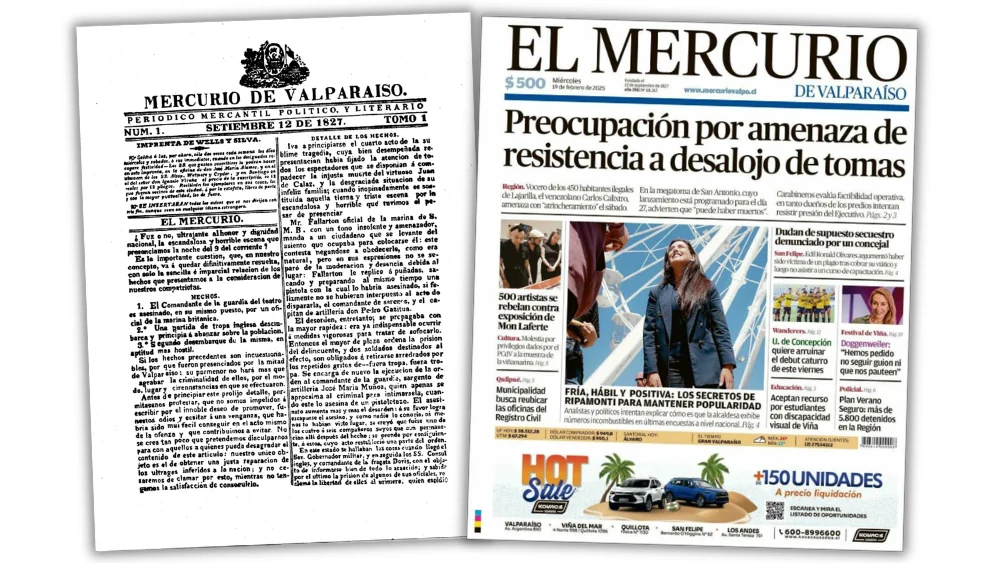 photo: public domain/Wikimedia Commons • mercuriovalpo.cl
Although Chile had been an independent republic for nine years by 1827, few changes occurred here, and the Catholic Church still held great influence over native politics. One of the more serious decisions of the government back then was the abolition of slavery in 1823, but even this did not significantly improve the economy of the country.
Against the background of this uneasy situation, Pedro Félix Vicuña Aguirre, the son of a deputy, minister, and future vice president of the Republic, began to take his first steps in his political and business career. As he came from a very wealthy family, care was taken regarding his education. He finished studies in the field of humanities and commerce. This helped him in making a lifelong decision.
Pedro Vicuña was fascinated by the profession of a journalist from his earliest years. At just 21 years old, he managed to marry and move from the capital, Santiago, to the coastal town of Valparaiso. Here he bought a printing press and founded the journal El Telégrafo Mercantil y Político (Commercial and Political Telegraph), whose first issue appeared on October 3, 1826.
El Mercurio. The merchant of Valparaiso
Although Vicuña managed quite well and succeeded in publishing 89 issues of the Telegraph, his vision of a true newspaper changed when he met two printers: Ignacio Silva Medina and Thomas Wells. The three enthusiasts quickly came to an agreement, and as early as September 12, 1827, a new publication, El Mercurio de Valparaíso (The Merchant of Valparaiso), appeared on the media market of Valparaiso.
The first issue had 4 pages with two columns each. It had no illustrations (with the exception of a graphic above the title) and contained modest news from the world and the country, along with more extensive regional news. Information about subscriptions and prices was included right on the first page, stating that the Merchant would appear twice a week: on Wednesdays and Saturdays. The subtitle proclaimed it a commercial, political, and literary publication. Of course, it did not lack advertisements.
Pedro Vicuña took on the role of editor-in-chief, while Silva and Wells took over the functions of printers, distributors, and managers. The Merchant was warmly received, although its initial circulation was not astonishing. However, the number of readers grew over time. It became a tradition that one resident of a tenement house would buy the newspaper, and a reading for everyone would take place on a designated day.
Over time, sections like letters to the editor and an editorial article appeared among the clearly divided sections. The content varied and was rather descriptive, but from the first issue, attention was paid to the weather forecast, food prices, and a schedule of arriving ships. Some advertisements even featured small engravings (mostly of ships). The graphic above the title changed over time.
Vicuña oversaw everything in a very modest editorial office since a permanent team did not exist. Friends and acquaintances wrote the articles, so it was not high-flying journalism.
A newspaper on the move
However, El Mercurio de Valparaíso stayed on the market. It broadened its subject matter (health, nature), improved its content and style, and became a daily newspaper starting May 5, 1829. In the same year, Vicuña sold his shares and returned to Santiago. Four years later, in 1833, Wells did the same. Silva remained alone on the battlefield, and journalist José Luis Calle became the new co-owner.
For the following years, the Merchant fulfilled its role as best as it could. It informed, advertised, and even entertained, but it passed from hand to hand, which also involved changing the location of the printing house. When French doctor Bernardo Pery Etchart became the owner in 1838, the printing press moved to Plazuela San Agustín, but in 1840, the new owner, printer Manuel Rivadeneyra, changed the address to Aduana Street.
The machines and the editorial office moved along with the printing houses. This state of affairs continued until 1901, when the newspaper put down permanent roots at Esmeralda 1002. During this time, the newspaper also changed its appearance several times. Etchart focused on advertisements on the front page, while Rivadeneyra focused on literature and book publishing. From September 1, 1842, when José Santos Tornero, owner of the first public bookstore, became the next holder of the daily, it transformed into a political-social publication and changed its format.
The Merchant remained in the hands of the Tornero family for the next 33 years (with his sons taking the helm from 1864). During this time, it evolved from an ordinary newspaper into a significant and professional daily:
- a group of native and foreign journalists and writers joined the editorial team (José Joaquín Vallejo, Juan Bautista Alberdi, Andrés Bello, and others)
- the newspaper introduced a policy of excellence and prestige
- the texts gained substance and linguistic correctness
- a column section was introduced (1844)
- a serialized novel section was established (May 1844)
- new columns were launched (El Mercurio del Vapor "The Steamship Mercurio" 1848)
- a regional edition was launched, El Mercurio de Provincias (August 13, 1853, to December 31, 1859)
- the editorial office moved to a newly constructed building (1869)
- the printing machinery was modernized
- the political, social, and commercial departments were expanded
- the first head of the editorial staff was appointed (Manuel Blanco Cuartin, 1869)
The newspaper flourished and brought in revenue. Santos Tornero was hailed as a mentor and creator of the popular publication, although he himself stated: To be an apostle of truth, a defender of law and order, and a tireless advocate of national progress, one does not need to mention his name. El Mercurio bears the stamp of its destiny: it will not depart from it (editorial, 1951).
A merchant worth a million pesos
Sitting behind the main editorial desk, he adhered to the principle: El Mercurio will treat political topics exclusively from a dignified and elevated perspective, proper to a serious and independent newspaper. He taught this to his sons, who inherited the business after him. And yet...
In 1870, Camilo Leteliera Gormaza became a partner of Recaredo Santos Tornero (the son), who was the owner, editor, and director at the time. In 1875, Tornero sold him his shares and left for Europe.
Unfortunately, Gormaza could not handle running the publishing house and the newspaper due to the huge debts left behind by young Tornero. Banker Agustín Edwards Ossandón saved the difficult situation by purchasing the publishing house building in 1875, and two years later, the entire company, including El Mercurio de Valparaíso. His son, Agustín Edwards Ross, became the head of the whole operation. A new era then began in the history of the Chilean daily.
Agustín Edwards Ross inherited his father`s fortune at the age of 26. Despite his youth, he managed it prudently and with tact. Although he held various public positions then and later, journalism was his pride and joy. The Merchant, bought for next to nothing (100,000 pesos), was worth a million ten years later and brought in serious profits.
Relationship and tech. Study about love in the age of likes 👇
Until his death in 1897, Ross adhered to the principles and direction adopted by the editorial board upon purchase:
- distance from all political struggles
- devotion to national affairs
- reconciliation of diverse Chilean environments
- the common man as the paramount issue
Over twenty years, he led the newspaper not only to the top of the domestic media but also marked its footprint on the international market. The newspaper stood out not only for its very organized and reliable content but also visually. Ross based it on the well-known English and American publications of that time:
- a large format similar to today`s Broadsheet
- clear headlines and titles for individual sections and columns
- 5-6 columns per page
- clear print
- classic font
- economical use of space
In 1882, Ross bought a second newspaper (a literary one) called El Época, and although the paper itself brought losses, the cooperation established with famous writers from other countries proved valuable: José Martí (Cuba), Menéndez y Pelayo (Spain), Anatole France, Guy de Maupassant, and Alphonse Daudet (France). These acquaintances also came in handy at El Mercurio de Valparaíso.
To conquer the capital of Chile
Running two newspapers, a publishing house, and holding public functions led to the creation of an official position of director in 1880, whose duties included supervising the editorial team. The first to hold this honorable position was Jorge Delano Edwards.
When Agustín Edwards Ross passed away in 1897, his fortune went to his three sons: Agustín, Carlos, and Raúl. The father advised his heirs to run the newspaper together and cooperate closely. For the following years, the brothers acted in harmony, but out of the three, the eldest brother, Agustín Edwards McClure, wrote his name in golden letters in the history of Chilean journalism, while Carlos became a chemical engineer, and Raúl was more interested in agriculture and politics.
For three years after their father`s death, the three brothers and Jorge Edwards ran the editorial board in harmony. However, the new century and a new era brought significant changes.
Agustín Edwards McClure, who was the only one of the brothers to follow in his father`s footsteps, realized that operating in the capital of the country gave him greater opportunities both in politics and as a publisher of the well-known and popular newspaper of that time. Therefore, on June 1, 1900, he opened a branch of El Mercurio in Santiago as an afternoon newspaper, but just two years later, in 1902, the daily was published in the morning and became an independent publication.
Thus a media power was born
At the same time, a publishing house was established in the capital in 1900, which very quickly grew into a media powerhouse. McClure, who traveled to the United States quite often, brought back the latest technologies and journalistic innovations from there, investing all of it in his subsequent newspapers. Eight of them were created in the first decade of the new century alone:
- Las Últimas Noticias (November 15, 1902)
- Zig-Zag, a magazine (February 19, 1905)
- El Mercurio de Antofagasta (December 16, 1906)
- Correvuela, a popular and illustrated weekly (January 1, 1908)
- Sucesos, an information guide on social life, demonstrations, deaths, and celebrations (September 17, 1908)
- El Peneca, a children`s magazine (November 23, 1908)
- Selecta, an art magazine (April 1909)
- Familia, a magazine for women and the home (1909)
The publishing house flourished, but it was located in Santiago, and the Merchant from Valparaiso, although still popular and with its own facilities, became a regional newspaper - important, but only regional. The owners operated in the capital, and El Mercurio was quite quickly associated with Santiago.
In 1901, however, the historical significance of the daily from Valparaiso was recognized, and the 74-year-old newspaper received a new editorial building with a printing house and a beautiful sculpture of Mercury on top, which became its symbol. The modern machine park was unique in the region, and the Merchant not only printed other publications on the market but also improved its technical image. Even drawings began to appear.
Even though McClure took most of the fame of the daily with him to the capital, the Merchant from Valparaiso survived. Even then, it was the longest continuously operating newspaper in Chile. Much of this was due to the people - journalists and printers who gave it their time and heart.
In the first decade of the new century, its subsequent directors took care of their readers:
- Humberto Fernández Godoy (January 1901 - October 1904)
- Juan Esteban Ortúzar (October 1904 - March 1908)
- Guillermo Pérez de Arce Adriazola (March 1908 - March 1915)
Godoy ran the newspaper in accordance with the recommendations of his predecessors. He did not criticize, judge, or comment. However, in 1903, he expressed his opinion, which resulted in an attack on the editorial office.
"You vile, flat newspaper!"
On April 15, 1903, a dockers` strike broke out in Valparaiso, joined by other social groups. The protest lasted until May 12, and the Merchant reported on the course of events: La huelga de estibadores (April 17, 1903), Las causas de los sucesos de Valparaíso (May 14, 1903), and Artículos prensa sobre la huelga de Valparaíso 1903 (May 15, 1903). Unfortunately, Godoy condemned the protest, as a result of which the strikers launched an attack on the editorial office on May 12.
Although the damage was considerable, none of the employees were hurt, but 7 people from the attacking group died at the doors of the office building. Society remembered this event for quite a long time. Softening the stance toward the protesters on May 14 and calling the strike a sacred right did not help. The daily caught it hard: You vile, flat newspaper, you who flaunt your usury, stop insulting the worker as you did yesterday, clumsy and cowardly. You humiliate yourself, you flatter him, covering yourself with shame, and generously offer him a fragment in the chronicle. Late, very late you came with your wretched prestige to change people, you miserable newspaper (El Matasiete, May 18, 1903).
Regarding cultural matters, the editorial work of novelist and playwright Vítor Domingo Silva, who associated himself with Valparaiso for 15 years, was appreciated during this time. He signed his articles and columns with the pseudonym Cristóbal de Zárate. Poetry in the so-called empty spaces style also appeared. The text was written in the form of geometric figures and without punctuation. Those from April 1903 had the appearance of the letter T, and the rest of the form (a square) was empty.
Among the interesting facts from this period, we should also note the creation of new columns like Sport or Vida Social (social life). During holiday periods (Easter, Christmas), special issues were published, and most importantly, in addition to thematic literary content, these publications were in color. Various diagrams and charts were also frequently present. In issue 23011 from April 2, 1903, the situation in the criminal world and the work of the police in Valparaiso were presented very accurately with their help. Thanks to the new printing machines, not only technically good graphics but even the first photos appeared.
Julio Pérez Canto. One of the most prominent
In 1904, Godoy handed the director`s chair over to Juan Esteban Ortúzar for the next four years, who happened to celebrate the 80th birthday of the newspaper but also had to report on further riots and strikes (the so-called meat riot, 1905), the creation of copper mines and a new railway line (1906), or the earthquake in August 1906. However, it was Guillermo Pérez de Arce Adriazola who took over the editorial office in 1908 for a longer period - for 17 years, until 1915.
He was a lawyer by profession and held several social positions. He was 25 years old when he took over the editorial office of the Merchant. He knew the value of this old newspaper and knew it was needed in this region of the country. The port of Valparaiso had its share in the history and economy of the country. Wanting to encourage readers to buy his newspaper, he introduced:
- a film review column
- cartoon humor, and over time, political humor
- more information from the region
- fewer advertisements on the front page
- politics and international affairs inside the issue
When World War I broke out, information about it was repeated from the younger brother in Santiago, but opinions and comments on the economy, which declined as in many countries, were discussed on an ongoing basis. The affairs of the port and everything related to it lively interested the residents of the city because they lived from it. The city department and local economy received expanded columns.
Chile lived its own affairs: The first health code (1909), the opening of the Transandine Railway (1910), the creation of a new party (the Socialist Workers` Party, 1912), or the law on chairs due to workers (1915) are just a few topics of those years.
In March 1915, the editorial office of the Merchant was taken over by Julio Pérez Canto, a lawyer, diplomat, and journalist. From 1911, he was a financial editor in Santiago. His career as a diplomat and politician allowed him a new perspective on the political and foreign department of the newspaper. Although he was the head of the editorial board for only five years, he was recognized as... one of the most prominent journalists the newspaper ever had (José Pelaez y Tapia) and as... one of those who wrote themselves into the history of El Mercurio in Santiago and Valparaíso, where he gave his intelligence, tireless work ethic, and honesty to the service of information progress, the dissemination of principles of sound political and economic orientation, and the development of popular culture (Raúl Silva).
Among Canto`s close associates was Rafael Luis Barahona, a lawyer and journalist. He associated himself with the Merchant for nearly 23 years, and from 1918, he served as the chief editor and columnist. Thanks to him, the legal section flourished, as did advice for readers in this area of life.
In the 1920s, photographer Casimiro Salas was a very popular personality. Although he operated mostly in the capital and collaborated with El Mercurio there, his photos were also published in the Valparaiso editions.
Jubilee euphoria. 100 years of El Mercurio
After five years of leading El Mercurio in Valparaiso, Canto took over the editorial office in Santiago, and Joaquín Lepeley Contreras took the chair of the port newspaper for three decades. He happened to organize the centenary celebrations of the newspaper in September 1927. The editorial office did not hide its jubilee euphoria and published a special issue for this important occasion, which had 120 pages, 8 thematic sections, and a color cover. Reminiscences, history, and an analysis of the day back then were placed on the center pages. There were promises and congratulations. And what interested readers most: the daily survived, is here, and will be, because it is important for the region and the country.
Contreras`s time spent in the editorial office of the Merchant was the period of the end of World War I, the years between the two wars, and that second, more tragic war and its aftermath.
During the interwar period, Chile had no stability. Political chaos, coups d`état, and government crises were the main topics of those years. However, the Merchant focused on the affairs of the region. It praised the resourceful local authorities (M. October 19, 1930), promoted regional entrepreneurs (advertisements), and educated (it supported the law on compulsory primary education, 1920).
Contreras, who was a professor of Spanish grammar, took care of the linguistic correctness of his readers but also of their health. He founded a Rotary Club within which he carried out various campaigns (anti-alcohol, polio), and the effects of this work were visible in the pages of El Mercurio. Using modern facilities and support from Santiago, the daily published good quality photos, and was transparent and efficiently composed. The editorial board collaborated with writers, poets, and activists who left their mark not only on Chilean soil but also in the world (Pablo Neruda).
Crisis, war, and issue number 50,000
When the global economic crisis hit (1929), the newspaper, although it had troubles itself (lack of paper, inks), supported the suddenly impoverished population of the city. Valparaiso as a port felt this condition strongly, and although the local authorities did what they could, strikes and protests broke out.
Relationship and tech. Study about love in the age of likes 👇
Against this economically difficult background, the women`s movement, which had long been fighting for its rights, gained strength, and Contreras, as another editor of a popular newspaper, supported the ladies. In 1934, women`s voting rights were approved at the local level. This is an indirect success for the Merchant as well.
When World War II broke out, Chile declared its neutrality, but in reality, it balanced between the Axis powers and the USA. German influence in this region was large, and it was difficult for the government to make a specific decision. However, in 1943, under pressure from the USA, Chile broke off relations with the Axis group. This was also the climate in the Chilean press.
Two years earlier, on June 18, 1941, Agustín Edwards Mac-Clure passed away, recognized as a pioneer of modern Chilean journalism. He left his entire fortune (the bank and publishing houses) in the hands of his son, Agustín Edwards Budge, who managed it until his death in 1956. By that time, El Mercurio was already functioning as a company and a brand and had consolidated its position in the Chilean media market. The Merchant from Valparaiso also belonged to this group.
Although the daily from Santiago took upon itself the burden of being the national and political newspaper, in Valparaiso, it was not forgotten where its roots were. From the beginning of the newspaper`s existence, the publication of round numbers was celebrated:
- The ten-thousandth issue appeared on Saturday, December 29, 1860
- The twenty-thousandth - on Wednesday, February 28, 1894
- The thirty-thousandth - on Wednesday, May 31, 1922
- The forty-thousandth - on Wednesday, April 30, 1947
However, the most grand celebrations were recorded in 1974, when the fifty-thousandth edition appeared on Friday, September 20. In those festive days, the Merchant was, as befitted a jubilee, in festive attire, with special material and decoration, and in 1974, a commemorative medal was even issued.
The decade of the 1950s in the country was a time of relative calm, the growth of leftist ideas, the figure of Salvador Allende (he came from Valparaiso), and minimal economic growth (thanks to copper). At the same time, Valparaiso, which lost its status as the most important port, focused on artists and especially on photographers. Sergio Larrain belonged to this second group, documenting city life, the community, and its culture. Working-class neighborhoods, docks, and the port dominated. These topics also found their place in the pages of El Mercurio de Valparaiso.
Women were not forgotten, as they received voting rights already in 1949 and voted for the first time in presidential elections on September 4, 1952.
24 pages, 7 days a week
The year 1953 brought the inauguration of the first School of Journalism. In the same year, the National Journalism Prize was established, and two years later, in 1955, its laureate was the director and editor of El Mercurio de Valparaíso, Joaquín Lepeley Contreras, which also brought prestige to the newspaper itself.
The Merchant in those years was a publication issued every morning, 7 days a week. It had 24 pages, 8 columns, and was full of good quality photos. It often contained photo reports from special events, like the one from January 4, 1953 (the funeral of the victims of the bomb attack in Valparaiso on January 1). Articles were not signed, and their style was rather narrative and informative.
In December 1955, Contreras, being 73 years old, parted with the editorial office (he died two years later). His place was taken by Francisco Le Dantec Brügger, who had been making the most important decisions since October.
Brügger, as written on the geni.com website, was... a brilliant journalist by profession, passion, and vocation, who through observation and writing characteristic of his trade, captured and recorded on paper scenes, places, and sensations of Valparaíso from bygone years. He was also a volunteer firefighter. He reconciled both passions in life and in the newspaper. The Merchant under his tenure became famous for the series Crónicas del viejo Valparaíso (Chronicles of old Valparaíso), which was written through all the years of running the editorial office (until March 1967) and published as a book in 1984.
The appearance of caricatures and comic strips in the daily can also be credited to his account. Until the 1960s, the Merchant did not print this type of entertainment. It happened very sporadically and in the form of a single image. Alberto Reyese was responsible for the illustrative part of the daily, but it was useful graphics rather than entertainment graphics. In 1966, Brügger hired cartoonist Renzo Pecchenino Raggi, known under the pseudonym Lukas, who breathed life into a newspaper that for almost 140 years preferred content over style... In the pages of the Merchant appeared:
- caricatures and comic strips
- situational humor
- the section Cuaderno de apuntes (Sketchbook)
- the supplement Suplemento de los jueves (Thursday supplement)
At the request of Andrés Aburto Sotomayor, then director of the Merchant, in 1977, Lukas created his most popular character - Don Memorario, who daily, in the pages of El Mercurio de Valparaíso, commented with a touch of nostalgia on national events. Lukas died on February 7, 1988, and in 2018, the book Lukas in El Mercurio de Valparaíso was published with his drawings.
Meanwhile, fundamental changes were also taking place in Santiago. The company was expanding, and Agustín Edwards Eastman became the president of the whole operation in 1958, supervising it over the subsequent decades. In March 1967, Francisco Le Dantec Brügger handed the management of the editorial office in Valparaiso over to Fernando Durán Villarreal, a journalist, lawyer, and academic.
A symbolic blue headline
Villarreal, when he took over the editorial office of the Merchant, was an experienced journalist after years of work at La Union, where he was editor-in-chief, and at El Mercurio in Santiago. In Valparaiso, he wrote essays hiding under the pseudonyms Androvar and FDV. He spent a total of about 30 years at the daily. He was recognized as a brilliant, competent editor with great authority. Despite his age, he was open to innovations both technical and those from daily life. During his tenure, color appeared in the daily. Blue headlines became a symbol of the newspaper, and large color photos appeared on the front page of Sunday editions.
When Pinochet`s junta began to rule in September 1973, Villarreal and the Merchant supported its actions. This is not surprising, especially since the daily was in opposition to the government of Salvador Allende, which withdrew government support (advertisements). In June, the court rejected the National Party`s application to suspend the operations of the newspapers El Mercurio de Valparaíso and La Estrella (both papers of the same owner) accused of violating the State Security Law.
In 1974, Villarreal was appointed to the post of Chile`s ambassador to France, which is why he said goodbye to the editorial office already in December 1973, and his position was taken over by Alex Varela Caballero.
The years spent in Valparaiso by Caballero were the first years of Pinochet`s rule. These were not easy times. The military introduced mass repressions, step by step eliminated political life, and introduced censorship. And yet, for 16 years, as encyclopedia.com states, El Mercurio enthusiastically supported Pinochet`s neoliberal economic policies, downplayed the scale of poverty and human rights violations, and generally sought to discredit civilian and religious critics of the government.
This observation concerned mainly Agustín Edwards Eastman, who introduced his own terror to the entire company and the newspaper from Santiago. The one from Valparaiso could not break ranks, and yet Caballero rebelled, conveying information in a specific way regarding banned books, closed radio stations, or the absolute lack of censorship of correspondence.
A similar editorial policy was conducted by subsequent directors from Valparaiso:
- Andrés Aburto Sotomayor, July 1976 - June 1979
- Leopoldo Tassara Cavada, July 1979 - June 1986
- Germán Carmona Mager, July 1986 - April 1990
The times were hard, but it cannot be denied that the top brass took care of their newspapers. In the decade of the 1980s, El Mercurio de Valparaiso entered:
- in color
- without sensationalism and violence in headlines
- with larger information on topics: economy, infrastructure, administration
- more reader friendly
- with expanded sports and culture sections
- with new departments like economics or housing
When another economic crisis began in 1981 and Valparaiso found itself at its center, Leopoldo Tassara Cavada, the then director of the newspaper, had quite a tough nut to crack. The company was pro-government, but the daily could not remain passive in the face of closed factories, unemployment, and the collapse of local businesses. Therefore, the editorial board adopted a strategy of softening the message: it did not question the neoliberal model as such, did not undermine the legitimacy of the military authorities, and avoided the language of political responsibility, but at the same time: it wrote about the crisis in technical, regional, and sectoral terms, shifting the blame to international factors, management errors, and global market fluctuations. The problems of the region were separated from the correctness of the model.
The end of Pinochet, the end of censorship
In 1987, the Merchant celebrated its 160th anniversary. This period also marked the beginning of the fall of Pinochet`s junta. Germán Carmona Mager guided the daily through the final years of the dictatorship. He rejoiced with readers over the new constitution in 1988 and the first free elections in 1989. The Merchant started the 1990s without censorship and pressure.
In April 1990, Enrique Schroder Vicuña took the main editorial chair. He held this position for almost the whole decade until 1998. He focused on building the prestige of the port and the city. He also cared about nature protection and local culture. The paper discussed these topics extensively and regularly. In addition, computers were introduced to the office, which helped the work of journalists. There was plenty to write about during these years. This included the presidency of Eduardo Frei Ruiz-Tagle from 1994 to 2000 and democratic stabilization. The paper also covered the 1995 Antofagasta earthquake, which caused huge losses. Finally, it reported on new social programs, including those for women in 1997. Readers were well informed about all these events in the pages of the Merchant.
In 1998, El Mercurio appeared on the internet as a unified entity. On November 11, the ELMO website launched. Santiago quickly dominated the site, and news from Valparaiso became just a section. However, two years later, on August 16, 2000, the port newspaper launched its own website at www.mercuriovalpo.cl.
Carlos Schaerer Jiménez achieved this corporate success after taking over from Vicuña on September 9, 1998. He directed the editorial office for two years. He successfully brought the newspaper into a new era. On October 30, he handed the daily to Marco Antonio Pinto Zepeda, who later, in October 2007, passed it to Juan Pablo Toro Vargas.
The first decade of the new century brought changes beyond the newsroom. Digitalization attracted a wave of new, younger readers. Both Zepeda and Vargas took care of this group. They introduced more topics related to young audiences. This was especially true in culture, such as music, cinema, and literature. They also added more city news and sports. They used a lighter linguistic style, shorter headlines, and gentle humor. The newspaper became increasingly colorful, and the entertainment section expanded its columns.
The newspaper from the first decade of the 21st century was divided into several distinct sections:
- Actualidad - local and social events
- Opinión - journalistic commentaries
- Deportes - sports
- Reportaje - features
- Espectáculos - entertainment
- Servicios - additional service content like horoscopes or weather
...and it was known not only in the region but across the country. The front page featured one large photo and navigation to important articles. In April 2002, Marco Zepeda celebrated the 60,000th issue of the Merchant with his readers.
El Mercurio as a UNESCO heritage site
A year later, Valparaiso was included on the UNESCO World Heritage list on July 3, 2003. From 2003, the newspaper began a visual transformation. This included changes to the layout, font sizes, and title position. Adjustments were made in 2005, and in 2009, Vargas remodeled the issue. A year later, the Merchant received another facelift. It went through this process several more times. Finally, in April 2014, under the guidance of Pedro Urzúa Bazín, it adopted its current look. Since July 2009, readers could also follow El Mercurio news on Twitter, which is now X.
Pedro Urzúa Bazín took over the editorial office on January 31, 2011. His time came with the growth of the internet. Therefore, the sales of the Merchant began to fall. Bazín tried to keep the daily`s place in the local market. However, other active newspapers and news websites proved to be a major challenge.
Student strikes and protests, the largest in the country`s history, did not bring improvement despite constant coverage. Only a huge city fire changed this trend. It broke out on April 12, 2014, and lasted for two days. Photo reports showed its massive scale, which boosted circulation. This was not a joyful success, but the paper received praise for its approach and documentation. It was called a theater of images. El Mercurio proved that it deserves to be called a solid, reliable, and professional newspaper.
Four months later, on August 4, 2014, Carlos Vergara Ehrenberg took the main editorial chair. He seems to serve the local media well, as he remains there today. He is the head of the Merchant and the entire regional publishing house. In the first years of his tenure, he brought the daily into social media. He launched the Facebook page in October 2017 and Instagram a year later in July.
The year 2017 marked the 190th year of the newspaper. Although it had a provincial role, it celebrated grandly. After all, it was and remains the oldest newspaper in the country and the oldest Spanish-language paper in the world. It survived and has its loyal readers. Senator Francisco Chahuán recalled the history of the daily at the ceremony. He added:
Many important events are described in this medium, it is an invaluable source of national history and leads a true crusade for decentralization and regionalization. Ignacio Walker added to his colleague`s statement: El Mercurio is not just a newspaper; it is an institution of men and women deeply rooted in their company and dedicated to it, which has earned its place in Chilean history and Senator Pérez San Martín concluded: El Mercurio de Valparaíso is a media outlet that reacts to what you say and where you pay attention to issues that other media ignore.
Work for this jubilee started even earlier. On September 12, 2015, a special article by Carlos Vergara Ehrenberg appeared. The director recalled the past and its creators. He also introduced the editorial team of that time. It was not large, and women took the lead:
- Amalia Carvallo - journalist
- Alejandra Delgado - journalist
- Sandra Rojas - journalist
- Carolina Torres - journalist
The female part was supported by the men:
- Ian Ashcroft Proust - head of the news department
- Andrea Lagos - editor of the anniversary edition
- Pablo Tomassello - photojournalist
- Raúl Goycoolea - photojournalist
- Miguel Campos - photojournalist
- Gustavo Alvarado - photojournalist
- Jessica Campos de la Paz - graphic design and typesetting
Writers from Valparaiso also received help from journalists in Santiago. Today the team is different, but women still rule there.
The looted editorial office rises from its knees
In October 2019, the journalists of the Merchant had to face fire once again. This time it affected them directly. On October 6, 2019, a wave of protests broke out due to a rise in public transport fares. This spark triggered more fires, which escalated. A state of emergency was introduced on October 18. On October 19, around 22:00, strikers broke into the El Mercurio de Valparaiso building. They destroyed and looted the rooms, and finally set them on fire. Old printing presses were also destroyed.
The attackers accused the journalists of lies and favoring the government. Although the fire destroyed the offices, including La Estrella de Valparaíso, the staff left safely. The newspaper came out the next day because the team worked from home. The main printing plant is located outside the city and in Santiago. The Inter-American Press Association called the attack on the two papers a major blow to press freedom. The army stopped the protests, and by October 21, the streets were empty. Fifteen people died in the riots. Subways, banks, and shops were destroyed in many Chilean cities. The fare hike was canceled.
Two years later, the COVID-19 virus arrived. The Merchant, like all Chilean daily papers, did its job well. It gave news, supported the public, and offered advice. It urged people to get vaccinated. Although the crisis increased social gaps, Chile managed one of the best vaccination drives in the world.
Today, Carlos Vergara Ehrenberg still guides the ship named El Mercurio Valparaiso. In 2027, the daily will celebrate its 200th birthday. It still has a lot to boast about. Its circulation slightly went over 13,000 copies on weekdays. However, it reaches 16,000 on Saturdays and 37,000 on Sundays. It is available on social media and has its own website. It is an opinion-forming paper that represents the perspective of the port city. It maintains its independence from the capital`s El Mercurio. It acts as a local medium, not a center of power. It cares about culture, education, history, and the health of its readers. Everything is on 16 pages, or 24 on Sundays, in 6 columns. It features clear sections, full color, and professional photo reports.
We wish them another 200 years!
Timeline of El Mercurio Valparaiso
- 1827, September 12 - the first issue of El Mercurio de Valparaiso
- 1829, May 5 - El Mercurio becomes a daily newspaper
- 1842, September 1 - the daily changed its status from an information sheet to a political-social publication + format change
- 1844 - a column section and a serialized novel section were created
- 1853, August 13 - the regional edition El Mercurio de Provincias launched
- 1860, December 29 - the ten-thousandth issue
- 1869 - the editorial office and printing plant received a new building
- 1869 - the first head of the editorial staff was appointed
- 1877 - the newspaper goes into the hands of Agustín Edwards Ossandón
- 1880 - appointment of the director position, which combined the tasks of the publishing head and chief editor
- 1894, February 28 - the twenty-thousandth edition
- 1900, June 1 - a branch of the newspaper is established in the capital city of Santiago
- 1901 - a new editorial building with a printing house
- 1901 - the first graphics
- 1902 - El Mercurio in Santiago becomes an independent publication
- 1903 - the first photos
- 1903, May 12 - attack on the editorial office of El Mercurio de Valparaiso
- 1906 - the first political humor
- 1922, May 31 - the thirty-thousandth issue
- 1927, April - the centenary of the daily
- 1947, April 30 - the forty-thousandth edition
- 1953 - the School of Journalism was established
- 1956 - the first episode of the Chronicles of Old Valparaiso series
- 1966 - the first caricatures and comic strips
- 1968 - the first color headlines and photographs
- 1974, September 20 - the fifty-thousandth edition of the newspaper
- 1977 - the hero of El Mercurio de Valparaiso, Don Memorario, was born (author Lukas)
- 1977, April - the 150th anniversary jubilee
- 1990-1999 - the era of computerization in the editorial office
- 1998, November 11 - the first ELMO website of both El Mercurio dailies
- 2000, August 16 - the launch of the own website of the daily from Valparaiso
- 2002, April - the sixty-thousandth edition of the daily
- 2003-2014 - modernization of the newspaper
- 2009 - the newspaper on Twitter (X)
- 2017, April - 190 years of the newspaper`s existence
- 2017, October - the Facebook account launched
- 2018, July - the Instagram account
- 2019, October 19 - attack on the editorial office, fire consumed several floors
- 2027, April - 200 years of El Mercurio de Valparaiso
sources:
- https://filanaval.blogspot.com/2017/09/el-mercurio-de-valparaiso-190-anos_9.html
- https://upload.wikimedia.org/wikipedia/commons/a/a3/El_Mercurio_de_Valpara%C3%ADso_-_n%C2%B0_1%2C_12_de_septiembre_de_1827.pdf
- https://commons.wikimedia.org/wiki/Category:El_Mercurio_de_Valpara%C3%ADso
- https://www.biobiochile.cl/biobiotv/programas/efemerides/2025/09/12/efemerides-12-de-septiembre-de-1827-salio-a-circulacion-el-primer-diario-el-mercurio-de-valparaiso.shtml
- https://elhistoriador.com.ar/12-de-septiembre-de-1827-se-funda-en-chile-el-periodico-el-mercurio/
- https://web.archive.org/web/20080515102405/http://www.edicionesespeciales.elmercurio.com/destacadas/detalle/index.asp?idnoticia=0131052005021X0330121&idcuerpo=405
- https://es.wikipedia.org/wiki/El_Mercurio_Sociedad_An%C3%B3nima_Period%C3%ADstica
- https://www.memoriachilena.gob.cl/602/w3-article-93378.html
- https://es.wikipedia.org/wiki/El_Mercurio_de_Valpara%C3%ADso
- https://www.wikitree.com/wiki/Edwards_Ross-1
- https://plnmyr.medium.com/el-descubrimiento-del-blanco-en-la-construcci%C3%B3n-de-portadas-y-en-el-dise%C3%B1o-de-productos-digitales-b788b48da780
- https://www.memoriachilena.gob.cl/602/w3-article-96978.html
- https://museodeprensa.udp.cl/el-mercurio-de-valparaiso-la-otra-joya-del-pacifico/
- https://www.cristianastete.cl/producto/el-mercurio-de-valparaiso-1827-1927-numero-especial-del-centenario/
- https://www.bibliotecanacionaldigital.gob.cl/bnd/628/w3-propertyvalue-753836.html
- https://www.encyclopedia.com/humanities/encyclopedias-almanacs-transcripts-and-maps/mercurio-el
- https://cinechile.cl/archivos-cinechile-de-1900-a-1920/
- https://wanderlog.com/place/details/4955135/el-mercurio-de-valpara%C3%ADso
- https://www.alamy.com/stock-photo/el-mercurio-newspaper-valparaiso.html?sortBy=relevant
- https://www.senado.cl/comunicaciones/noticias/sus-190-anos-rinden-homenaje-diario-el-mercurio-de-valparaiso
- https://medallaschile.blogspot.com/2021/12/edicion-50000-el-mercurio-de-valparaiso.html
- https://www.memoriachilena.gob.cl/602/w3-article-95793.html
- https://www.epicentrochile.com/2012/10/26/golpe-a-valparaiso-la-partida-de-enrique-schroeder/
- https://elcomercio.pe/mundo/latinoamerica/protestas-en-chile-el-mercurio-de-valparaiso-manifestantes-incendian-edificio-del-diario-mas-antiguo-de-chile-noticia/?ref=ecr
- https://cpj.org/2019/10/demonstrators-set-fire-to-el-mercurio-de-valparais
- https://www.senado.cl/comunicaciones/noticias/sus-190-anos-rinden-homenaje-diario-el-mercurio-de-valparaiso


COMMERCIAL BREAK

New articles in section History of the media
Havas. The history of the world's first news agency
Małgorzata Dwornik
The idea of two bankrupt Frenchmen in 1835 turned out to be brilliant: use information as a commodity. Along with translators, messengers, and correspondents, they hired a flock of carrier pigeons. These birds carried news from London to Paris in a single day. The product of L'Bureau Havas quickly became popular far beyond Europe.
România Liberă. 150 years of history of the Romanian press
Małgorzata Dwornik
On May 14, 1877, Romania officially declared independence from the Ottoman Empire, and just one day later, the newspaper România Liberă (Free Romania) appeared on the Bucharest market. Its founder, first director, and journalist was Dimitrie August Laurian, strongly supported by Professor Ştefan Mihăilescu.
The history of La Jornada. Lesson in independence from a mexican daily
Małgorzata Dwornik
It was created through the determination of journalists and the support of a Nobel laureate. Even students and the homeless contributed to the first issue. It survived earthquakes, financial crises, and political attacks. Today, the Mexican daily La Jornada is a strong, independent brand.
See articles on a similar topic:
The Beginnings of Periodical Publishing in Poland
Bartłomiej Dwornik
The first printed works - non-periodical "flyer newspapers" - appeared in Poland in the early 16th century. They were published only for significant occasions to describe these events, sometimes even in verse.
Hind Nawfal and Al Fatat. The first women's magazine in the Arab world
Małgorzata Dwornik
The Egyptian phenomenon, founded by the "mother of female journalists", lasted only two years in the market. However, in that short time, it accomplished so much for Arab women that it is still called a "revolutionary" today. The Arab "Girl" and its founder were the first significant female voices in this culture.
Barbara Walters. The queen of impossible interviews from ABC television
Małgorzata Dwornik
Barbara Walters began her media career in 1951 with advertising and producing a children's program. In the 1960s, she shattered the glass ceiling. Her interviews on NBC brought her to the height of popularity, but it was her programs on ABC that earned her the title of the queen of television.
Jamal Khashoggi. A media trap, illusion of freedom, and price of free speech
Małgorzata Dwornik
He knew Osama bin Laden personally and advised Saudi kings, only to eventually become their greatest critic. Jamal Khashoggi entered the consulate in Istanbul and vanished without a trace, shocking world public opinion. This is the story of a man who traveled the path from palace salons to exile, paying the ultimate price for the fight for freedom of speech.