
 po polsku
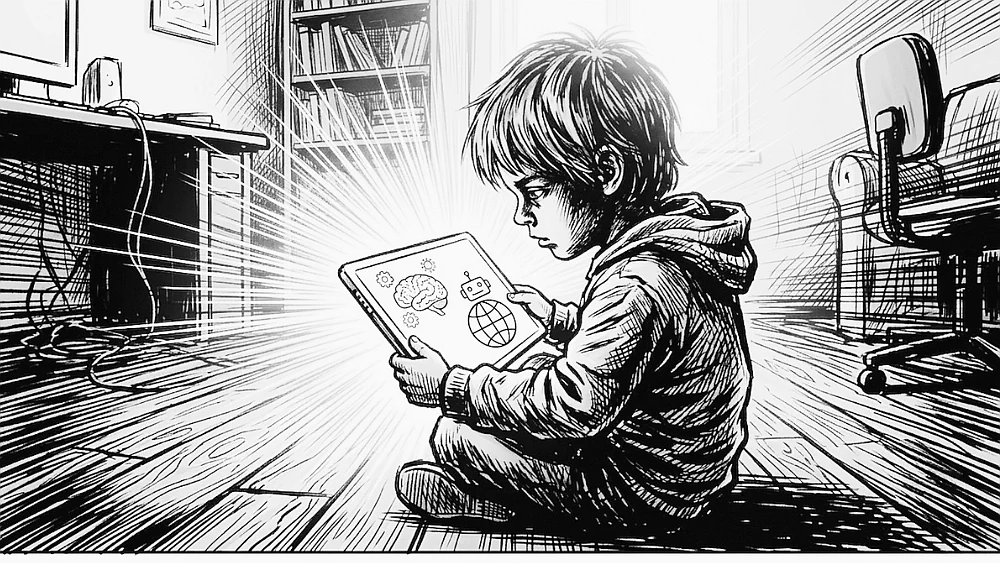 illustration: Gemini
New evidence clearly demonstrates the scale and speed at which children around the world are turning to AI. At the same time, it exposes the risks and divisions that this technology brings with it. More than 2 million children - or one in ten - admit that they look to AI for advice on matters that worry them. In turn, about 13 million children declare that they use artificial intelligence for learning and homework. While children are increasingly using AI, the regulations governing its use - including those protecting the youngest - are struggling to keep pace with them.
Children are the most exposed to the operations of AI systems (including their design, business models, or the use of their private data), while having the least power to avoid or challenge them. They are the first to feel the effects of the lack of appropriate regulations and will live with their consequences the longest. Despite this, most AI regulations do not put the well-being of children first.
Although artificial intelligence offers children huge opportunities for learning, play, or developing creativity, we are only beginning to uncover the evidence of its impact on cognitive development, emotional dependence, or exposure to dangers. In practice, an entire generation is growing up inside a global experiment.
The children themselves also perceive these threats. Across the 10 countries studied, one-third of children expressed concerns that AI could be used for scams, fraud, or spreading disinformation. Meanwhile, one-quarter fear that their photos or videos could be manipulated to create pornographic deepfakes. Too many systems reach the hands of children without any protective barriers - safety seems to be a secondary issue in them.
Ahead of the upcoming first Global Dialogue on AI Governance, UNICEF calls on governments, the private sector, and partners to include child rights - and especially the right to safety and protection - in global AI regulations by:
- Investing in research into the impact of AI on children`s development and well-being, with a particular focus on risks.
- Tightening regulations, governance systems, and corporate accountability to stop the sexual exploitation of children using AI.
- Designing AI systems with maximum safety and transparency, so that every child has a chance to be protected while benefiting from new opportunities.
- Providing AI education and supporting children along with their parents or caregivers in safely navigating the digital world.
Investing in digital infrastructure and ensuring stable internet access for every child and their caregivers at home and school to eliminate digital inequalities between and within countries.
This is a decisive moment. The decisions we make about AI now will shape the safety, privacy, well-being, and equal access to opportunities for children for decades to come.


COMMERCIAL BREAK

New articles in section Media industry
Information laundering. Russian propaganda returns as news from China
KFi
Russian intelligence agencies use complex tactics to mask the primary source of their harmful narratives. Patrycja Krzyśpiak from NASK details this dangerous process of information laundering in a recent report.
Health disinformation on the internet. Diagnosis from an algorithm
Katarzyna Czechowicz
Health disinformation can cause a cancer patient to see a doctor when it is too late for effective treatment. It can also undermine trust in doctors and public institutions. As a result, people may refuse to cooperate even during a real external threat, experts warn.
Feminatives are not a given. How Polish women talk about their professions
SWPS
Polish women still rarely use female job titles. This comes from the latest report by the Center for Research on Social Relations at SWPS University. Women's professional activity proved to be a significant factor in using feminatives.
See articles on a similar topic:
Radio Listenership in Poland 2024: Demographics, Trends, and Statistics
Krzysztof Fiedorek
Why do millions of Poles still choose radio? What drives RMF FM's dominance and Eska's surprising results? The latest "Audio Track" report from the National Media Institute reveals listenership data, demographics, and evolving trends. How does the digital revolution affect traditional stations?
Deepfake Blurs Truth and Falsehood. Human Perception Research
KFi
Studies indicate that only 60% of deepfake images can be correctly identified by humans. As AI begins to dominate content production, the problem of differentiation fatigue grows – users lose confidence in assessing the authenticity of information and fall into cynicism.
Radio, Streaming, and Podcasts. Total Audio 2024 Report about Poland
Krzysztof Fiedorek
Audio content is a daily companion for Poles. According to the Total Audio 2024 study conducted by Adres:Media on behalf of the Radio Research Committee, as many as 90% of respondents listen to audio content at least once a week, and 80% do so daily. The average listening time is nearly five hours per day.
Artificial Intelligence in the Media. Reuters Digital News Report 2024
Krzysztof Fiedorek
AI has gained prominence in recent years, and its application in producing, distributing, and presenting news content continues to grow. However, this development is met with mixed feelings by audiences, which has significant consequences for media trust and its future.