 po polsku
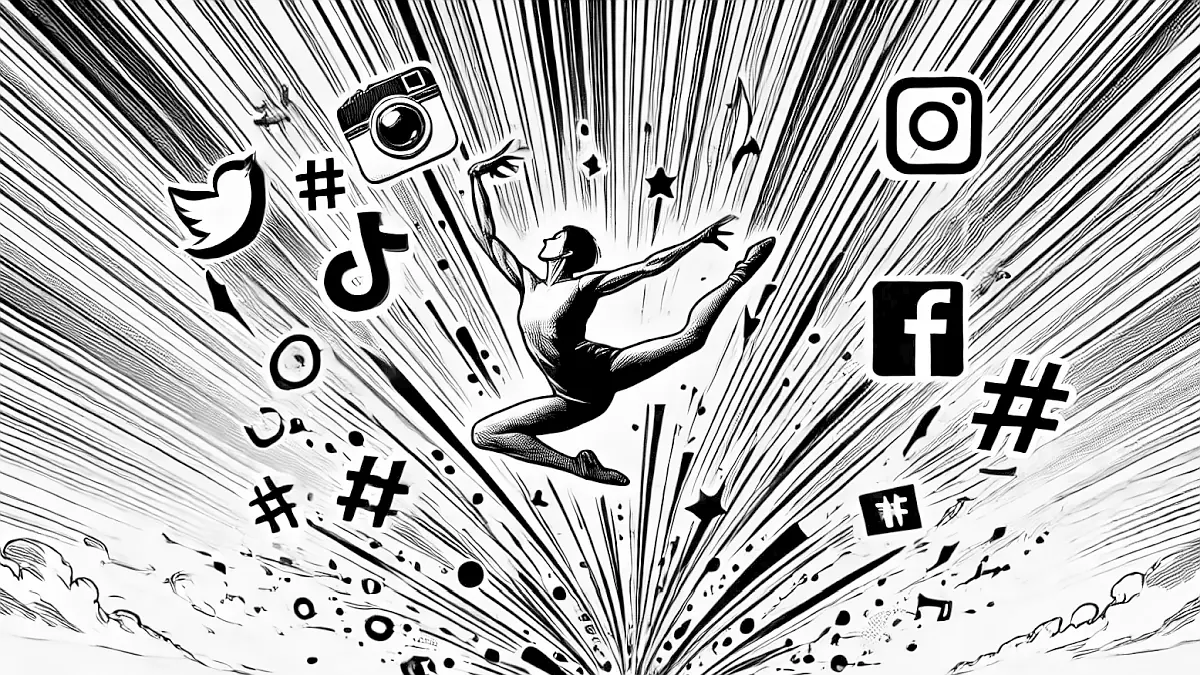 illustration: DALL-E
Dance in Poland is undergoing a media transformation. Once seen mainly as a niche art form, today it is a dynamic content driver-bridging culture, sport, entertainment, and branding. The recent report "Dance Presence and Perception in Polish Media" by Instytut Monitorowania Mediów (IMM), prepared for the National Institute of Music and Dance (NIMiT), captures this shift in numbers and narratives. Over 78,000 media publications and 197,000 social media posts within a year clearly show: dance has moved into the mainstream.
Three faces of dance, one expanding footprint
The IMM report confirms what practitioners already sense-dance resists categorization, and that works in its favor. It performs simultaneously in multiple media roles, attracting a wide range of outlets. General news portals alone accounted for 71% of all dance-related coverage, confirming dance"s ability to cut through thematic silos.
According to the study, three main narratives dominate media portrayals of dance:
- As artistic expression, it channels emotion and tells stories-earning space in cultural and opinion sections.
- As sport, it reflects discipline and competition-particularly when linked to televised dance-offs or Olympic breaking.
- As entertainment, it appeals through energy and accessibility-visible in talent shows and viral clips.
This multiplicity allows media editors to place dance across formats, from interviews to sports highlights. Its hybrid nature increases editorial flexibility, audience appeal and, crucially, brand interest.
Ave numbers reveal unexpected rankings
Between March 2024 and February 2025, dance generated a media reach of 1.6 billion potential contacts-meaning the average Pole above age 15 was exposed to dance-related content approximately 50 times. But the more surprising figure lies in the advertising value equivalency (AVE).
Dance reached an AVE of PLN 746.8 million, placing it near disciplines like speedway (PLN 768.8 million) and well ahead of MMA (PLN 636.3 million) or handball (PLN 505.5 million). This positioning challenges old hierarchies between "serious" sport and "soft" culture.
- Football – PLN 9,050 million AVE
- Tennis – PLN 3,496 million AVE
- Swimming – PLN 3,238 million AVE
- Volleyball – PLN 2,235 million AVE
- ...
- Dance - PLN 746.8 million AVE
- Speedway - PLN 768.8 million AVE
- MMA - PLN 636.3 million AVE
- Handball - PLN 505.5 million AVE
- Chess - PLN 447.3 million AVE
This data, published in the "Dance Presence and Perception in Polish Media" report, underscores the commercial potential dance now commands.
Between high reach and significant AVE, brands see a well-lit stage. Sebastian Tomaszewski, IMM analyst and co-author of the report, notes: "Dance conveys community, emotion, and energy. These values resonate across industries-from fashion and fitness to lifestyle and beauty."
Sponsorship rethought: emotion meets data
The cultural sector often struggles to speak the language of business. But dance offers a promising bridge. According to the report, dance in Poland holds a projected sponsorship potential of around PLN 1 billion. Behind this estimate lies not just popularity, but brand compatibility.
Marketers value dance for the same reasons audiences do: its energy, visual richness and emotional pull. Importantly, it allows for socially conscious campaigns. Supporting dance supports health, inclusion, youth development, and education-all key pillars of CSR.
Dr. Maria Opałka, lead author of Dance in Poland 2025, sees this as a turning point: "Business and art speak different languages-value versus values. But with dance, we observe a new dialogue forming. It`s emotional, measurable, and sustainable."
This shift encourages cultural institutions to reframe their strategies-not by abandoning identity, but by articulating relevance in data terms: reach, engagement, impact.
Dance goes viral. And visual
Dance"s strongest momentum may lie not in broadcast media, but in its digital life. In the same 12-month period, social media featured nearly 200,000 dance-related posts. Their reach? Over 931 million. And their AVE? A solid PLN 62.3 million.
While Facebook dominated in content volume, Instagram led in user engagement:
| Platform | Share of Interactions |
|---|---|
| 73.8% | |
| ~20% | |
| TikTok | ~5% |
This insight comes from IMM"s deep dive into the 996 most engaging posts by cultural institutions. Despite fewer posts, Instagram generated almost three-quarters of all interactions. Its image-driven, aesthetic-friendly environment turns every dancer into a micro-influencer-and every choreography into a potential campaign.
TikTok, on the other hand, led the conversation in entertainment-related dance. It captured 40% of dialogue in this segment, particularly thanks to viral street dance clips and performance snippets from shows.
YouTube remained consistent, holding a 10-20% share across most categories. Its longer format gives room for full-length performances and backstage storytelling.
Two styles in the spotlight
Not all dance genres perform equally. Within the social and media buzz, two styles dominated in terms of both exposure and AVE:
- Ballroom dance: 21,400 mentions, AVE of PLN 3.64 million. Driven by celebrity programs and TV competitions.
- Street dance: 5,700 mentions, AVE of PLN 648,000. Spiked around the Olympic debut of breaking.
This data confirms what social feeds already hint at: the public doesn"t just watch dance-they follow it, engage with it, and share it. The dance floor has expanded far beyond theatres, reaching smartphones and ad budgets alike.
The study was conducted by Instytut Monitorowania Mediów S.A. on behalf of the National Institute of Music and Dance. It was funded by the Ministry of Culture and National Heritage. The full report is available at: https://www.kongrestanca.pl/taniec-media-sponsoring


COMMERCIAL BREAK
New articles in section Marketing and PR
How and why online stores lie. TrustMate report
Marek Jaworowski
Experts from the TrustMate.io platform analyzed the most common procedural errors and inaccuracies that lead Polish online stores to wrongly deny buyers their rights. They also prepared an appeal path for consumers who heard a refusal from customer service.
Online shopping in Poland. Report by the Chamber of Digital Economy
Patrycja Sołtysik, Izba Gospodarki Elektronicznej
For the fourth consecutive year, 100% of internet users declare making a digital purchase at least once, and 93% have shopped online in the last six months. 97% of purchases in Poland involve an internet-connected device at some stage - most commonly a smartphone.
Coffee for moms. This is how they recharge parents' batteries at the Wrocław children's hospital
Reporterzy support
24 hours, 7 days a week, for 3 months. Non-stop. That is the average time a mother spends in an oncology hospital, caring for her child during treatment. A new project has launched at the Przylądek Nadziei (Cape of Hope) children's oncology clinic in Wrocław. In a simple way, it helps parents reduce stress, calm their emotions, and boosts their energy for caregiving. And that directly translates into the effectiveness of the children's treatment.
See articles on a similar topic:
Artificial Intelligence and Marketing. Industry Expectations and Concerns
KrzysztoF
Marketers using generative artificial intelligence see its potential but also perceive risks. The Generative AI Snapshot Series survey conducted by Salesforce and YouGov shows that the industry expects significant changes - and soon.
More AI bots in customer service. However, Poles want people
Andrzej Sowula
Over three quarters of Poles (75.9%) have already had contact with a bot in a customer service department and nearly one in four is satisfied with this service. This means an increase of 7.7% over the past two years. At the same time, only 8.1% of Poles fully trust the bots serving them.
Bots on Hotlines. Armatis Customer Experience Index Study
KF
Nearly two-thirds of Poles report encountering a chatbot or voice bot when contacting customer service. This type of service often triggers negative emotions. Almost three-quarters of Poles would prefer to wait in line for human assistance rather than be served immediately by a bot.
Dance in the media mirror. Between culture, business and viral fame
KFi
Over 78,000 media pieces, 1.6 billion potential views, and 197,500 social media mentions-dance in Poland is no longer niche. With a combined media value exceeding PLN 800 million, it now outperforms MMA, handball, and hockey.