
 po polsku
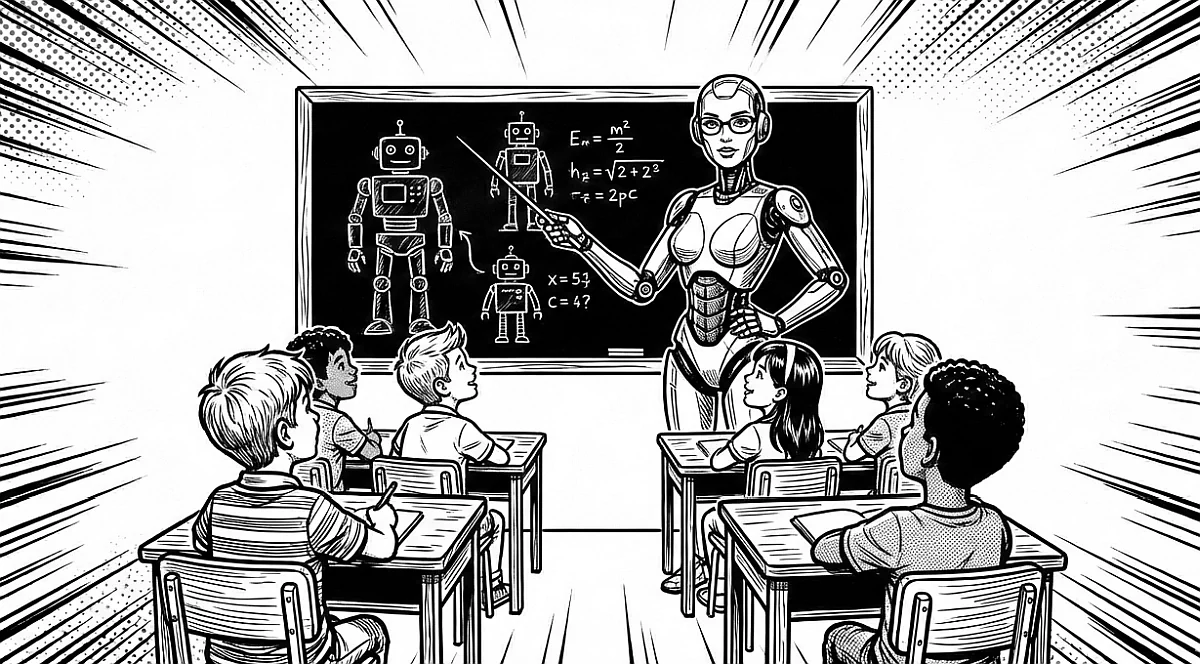 illustration: Gemini
Social robots, which assist humans in daily functioning, are increasingly being used in education. It is already known that robots and virtual assistants can have a positive impact on children`s educational outcomes and support their social development. It also turns out that they can increase the engagement of the youngest in learning.
Therefore, it is important to understand how children navigate contacts with them and in what situations child-robot interactions are most beneficial. This was the focus of researchers from SWPS University: Dr. Konrad Maj, Ariadna Gołębicka, and Zuzanna Siwińska in the study described in the article "How children learn from robots: Educational implications of communicative style and gender in child-robot interaction" published in "Computers & Education".
- Robots in education can be programmed in various ways. They can adapt teaching methods to the individual needs of students, as well as increase motivation and engagement through play or provide immediate feedback - lists Dr. Konrad Maj, a social psychologist, head of the HumanTech Center for Social and Technological Innovation, and lead author of the research. - However, one should not forget that interactions with robots also raise certain doubts, such as whether long-term contact with them will not negatively affect children`s social behavior.
How do children react to humanoid robots?
The study used the 120-centimeter humanoid robot Pepper (created by SoftBank Robotics), which resembles a child. Designed for social contact, the device is equipped with sensors, cameras, and microphones. All this allows Pepper to recognize speech, gestures, and certain emotions. The participants of the study were 251 children aged 7-12.
The researchers considered two aspects: the robot`s communicative style towards a human (polite or commanding) and its "gender" (female or male), which they determined by giving the device a name (Adam or Ada). They chose these factors because they are linked to how children interpret the robot`s intentions, warmth, and authority, which directly affects engagement and academic results. This may be significant for the future design of social robots.
The scientists wondered, among other things, whether children addressed politely by the robot would also be polite to it, whether younger children would be more likely to anthropomorphize the robot (attribute human traits to it) than older ones, and whether girls would have greater tendencies to do so.
During the study, children could get to know the robot, which imitated animals for them, and they observed its reaction to an attempt to take its photo (a polite or categorical message not to do so), to which they were to respond. Afterward, they answered questions about Pepper. They were asked, for example, whether they thought this robot could be happy, whether it dreams, or whether it imagines things.
How will children imitate a robot that asks or commands?
It turned out that children dealing with a polite robot almost always responded to its reaction politely. Those to whom the robot spoke in a commanding way also responded in a polite manner in most cases, rather than replicating its authoritative communication style, which indicates that in this case, established social norms prevail over imitation.
Younger children and girls were significantly more likely to anthropomorphize the robot. It also turned out that human traits were attributed to polite robots more often than to commanding ones, especially when their tone matched gender expectations. Thus, the situation most conducive to this was when the robot was programmed as polite and female.
- Our results lead to the conclusion that social cues in interactions between children and robots in education are exceptionally important - believes Dr. Maj. - Adapting the robot`s communication style to children`s developmental level and their social expectations can increase student engagement and potentially support positive learning outcomes.
As he adds, robots are increasingly appearing in classrooms, so understanding how children perceive and react to them will determine whether they serve as effective learning partners in the future.


COMMERCIAL BREAK

New articles in section Media industry
Information laundering. Russian propaganda returns as news from China
KFi
Russian intelligence agencies use complex tactics to mask the primary source of their harmful narratives. Patrycja Krzyśpiak from NASK details this dangerous process of information laundering in a recent report.
Health disinformation on the internet. Diagnosis from an algorithm
Katarzyna Czechowicz
Health disinformation can cause a cancer patient to see a doctor when it is too late for effective treatment. It can also undermine trust in doctors and public institutions. As a result, people may refuse to cooperate even during a real external threat, experts warn.
Feminatives are not a given. How Polish women talk about their professions
SWPS
Polish women still rarely use female job titles. This comes from the latest report by the Center for Research on Social Relations at SWPS University. Women's professional activity proved to be a significant factor in using feminatives.
See articles on a similar topic:
Work in the media. We have more recruitment offers at Reporterzy.info [LINK]
AUTOPROMOCJA Reporterzy.info
Thanks to cooperation with the recruitment website Talent.com, the database of recruitment advertisements published in Reporterzy.info has been significantly enriched. We invite you to browse current job offers and internships in the media and advertising industry from the largest Polish cities.
Violence in Media and Child Rearing
Małgorzata Więczkowska
The influence of mass media on individuals is now an undisputed fact. There is no place today where this impact on religious, moral, political, social, or educational attitudes cannot be felt.
Social Media and Relationships. Interesting Research from Palestine
KFi
What does love look like in the digital age? Does technology bring people closer or push them apart? In an era where Facebook and Instagram replace dinner table conversations, social media has become a new space for marital relationships. Researchers from An-Najah National University examined how technology can build bonds but also sow uncertainty.
How artificial intelligence misrepresents the news. PBC analysis
Sylwia Markowska
In news summaries generated by the most popular models in Polish, as many as 46% of responses contained at least one significant error, 27% had serious issues with sources (missing, misleading, or incorrect), and 19% contained hallucinations and outdated information.