
 po polsku
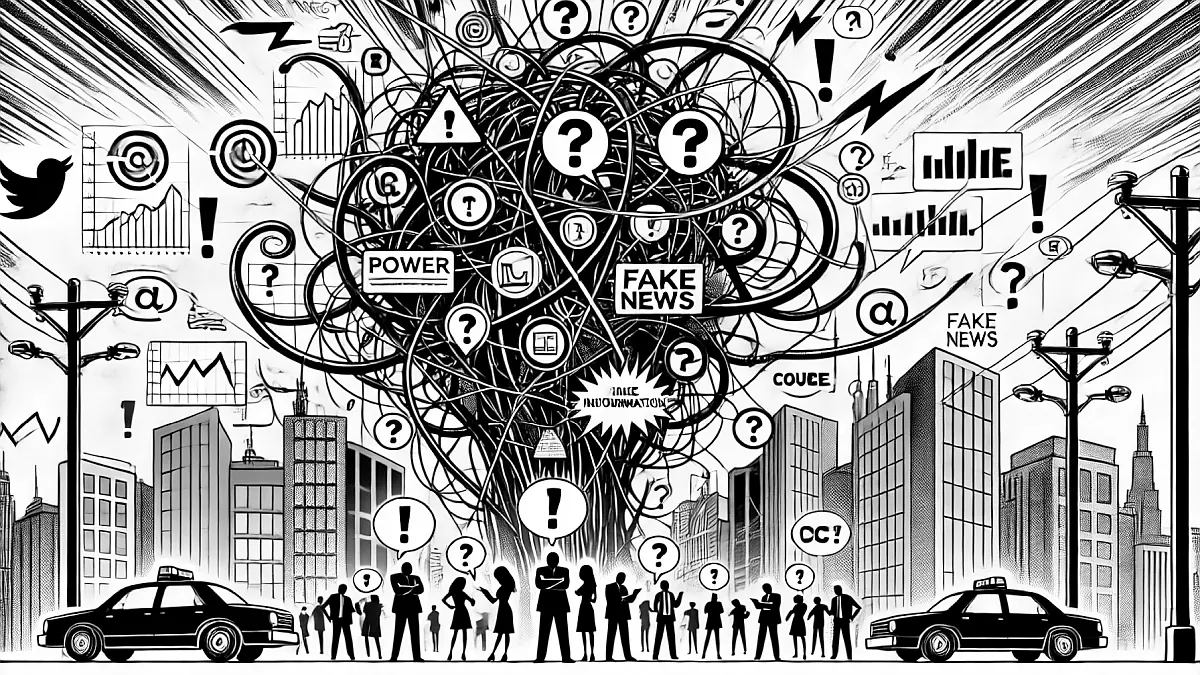 illustration: DALL-E
In the assessment of Dr. Michał Marek from NASK, factors such as social polarization make Poles particularly susceptible to disinformation. In the study "Are Poles not being fooled by disinformation?" conducted for the Association of Digital Transformation Practitioners, it was reported that:
- 42% of respondents are unsure if they encounter false information in social media,
- 36% are unable to assess whether they have ever been fooled by disinformation on the internet,
- 45% of those surveyed declare they often encounter fake news on platforms such as Facebook, Instagram, TikTok, or YouTube,
- 25% admit that they also often fall for it.
As reported, every seventh Pole does not encounter intentionally misleading content or sees it very rarely, while for every fifth internet user, disinformation has become a daily occurrence.
The Head of the External Threat Analysis Team at NASK, Dr. Michał Marek, when asked by PAP about the tendency of Poles to succumb to disinformation, admitted that no society is completely immune to false information. - We are not as resistant to disinformation as we sometimes evaluate ourselves, or as we would like to see ourselves - he said.
He noted that Poles are strongly polarized both politically and ideologically. Consequently, we react strongly to world events, especially those of international scope, such as the assessment of US policy, further support for Kyiv, and issues related to domestic politics - he added.
The expert explained that disinformation is difficult to detect by so-called average recipients because it is well-camouflaged and tailored to the potential recipient`s worldview. Examples include groups and forums on social networks that infect recipients with conspiracy-themed content, threatening Armageddon, World War III, or being pushed into a war with Russia, which are placed alternately with neutral content, such as DIY advice. - A person does not even know when they are being steered by false news. It may even reach a point where, through subliminal actions, they will be steered in such a way that they begin to perceive their own state as a hostile entity threatening them - he added.
The study shows that the most uncertain age group in identifying fake news is Generation Z.
- 58% of people between 18 and 24 "have no opinion" on this matter because they are not convinced whether what they see is "fake" or true information;
- furthermore, 44% are not sure if they have ever fallen for this type of content;
- on the other hand, 10% of them are aware of content masquerading as truth in social media, seeing it "very often";
- 10% admit that they very often fall for it;
- 5% of respondents believe they have "not at all or almost never" encountered disinformation on their "socials".
Regarding those most susceptible to misleading content on the internet, Michał Marek pointed to two high-risk groups. - The first are the elderly, and the second are the youngest. At the same time, he noted that the content affecting them and the tools used for influence are different - he explained. He added that in the case of youth, it is primarily TikTok, while among people over 50 - Facebook, for example.
1049 journalists in Europe silenced by lawsuits 👇
However, most respondents believe they recognize disinformation and do not fall for fake news; furthermore, about 39% claim they have never or almost never fallen victim to disinformation - the study stated. This group may include people over 65, i.e., seniors who declare they see more disinformation but are nevertheless certain that "they are not being fooled."
- 25% of this age group admitted that they "very often" see fake news in social media,
- 20% "not at all or almost never see it",
- 29% have no opinion on the matter.
- 3% are misled,
- 39% say it has never happened to them.
As it turns out, the level of education is not a barrier that can protect us from disinformation. According to the study results, "people with higher education notice fake news more often, but at the same time succumb to it almost as often, at 25%, as people with basic education."
- Of course, education matters, but I would not treat it as a factor that 100% determines this. Nevertheless, I have encountered research results indicating that education is important because, for instance, it relates to language proficiency, which increases the ability to verify information - said Michał Marek.
Emotional state also plays a significant role in the level of resistance to fake news. According to the NASK expert, people dissatisfied with their lives, disappointed, or struggling with financial problems are more susceptible to disinformation activities. On the other hand, people in a better emotional state are more often able to control their emotions and - even during a crisis - attempt to verify information.
- Only 9% of respondents admit they could "definitely" distinguish a real photo from an image created by artificial intelligence,
- 43% declare they would have a problem with it.
The group that takes the lead this time regarding difficulty in detecting disinformation is the elderly aged 65 plus. For 57% of them, it is "hard to say" whether they are able to distinguish real graphics from those modified or generated by AI.
According to the expert, it is particularly worth sensitizing this group - especially in the face of the increasing appearance of AI-generated materials - not to uncritically trust everything that appears online, especially on social media, and to place greater trust in official announcements and traditional media.
- To protect yourself from disinformation, it is worth staying calm in the face of alarming or controversial posts and materials encountered on the internet. When we encounter alarming information online, let`s not forward it, like it, call people, or tell our friends if we are not certain that a given crisis situation actually took place. Let`s wait for official announcements confirming or denying the information. Common sense and emotional control are fundamental - concluded Michał Marek from NASK.
The study "Are Poles not being fooled by disinformation?" was conducted on an internet panel (omnibus) on a representative sample of 850 adult Poles in mid-December 2025. The Association of Digital Transformation Practitioners Praktycy.eu was founded in 2024 by former managers of major Polish media outlets to support journalists and media in the transformation process.
source: PAP Nauka w Polsce


COMMERCIAL BREAK
New articles in section Media industry
Information laundering. Russian propaganda returns as news from China
KFi
Russian intelligence agencies use complex tactics to mask the primary source of their harmful narratives. Patrycja Krzyśpiak from NASK details this dangerous process of information laundering in a recent report.
Health disinformation on the internet. Diagnosis from an algorithm
Katarzyna Czechowicz
Health disinformation can cause a cancer patient to see a doctor when it is too late for effective treatment. It can also undermine trust in doctors and public institutions. As a result, people may refuse to cooperate even during a real external threat, experts warn.
Feminatives are not a given. How Polish women talk about their professions
SWPS
Polish women still rarely use female job titles. This comes from the latest report by the Center for Research on Social Relations at SWPS University. Women's professional activity proved to be a significant factor in using feminatives.
See articles on a similar topic:
Information bubbles. Study of Instagram, Tik Tok and You Tube users
Urszula Kaczorowska
A staggering 96 percent of the time people spend online is spent on anything but consuming information. This, says Professor Magdalena Wojcieszak means ‘we have over-inflated the issue of information bubbles and disinformation.’
The print media market 2025. Three global trends
Krzysztof Fiedorek
The market value is 359.53 billion dollars, yet the erosion is visible to the naked eye. The decline for newspapers will amount to -2.3 percent. Despite this, print retains strength: it generates 76 percent of subscription revenues and enjoys 82 percent consumer trust. The future of the industry is defined by hybrid strategies and niche specialization.
Children and communication with machines. Experiment by SWPS researchers
SWPS
How do primary school students treat humanoid robots? Researchers from SWPS University have shown that in most cases, children relate to robots politely, and younger children and girls more often perceive them as possessing human characteristics.
Video content in Poland. What and how we watch
Paweł Sobczak
Video content is watched remotely, but streaming services are mainly enjoyed in the comfort of home. This is how the consumption of audiovisual content by Poles in 2025 can be summarized. This is the result of an analysis of a study conducted by SW Research and data from the company MEGOGO.