
 po polsku
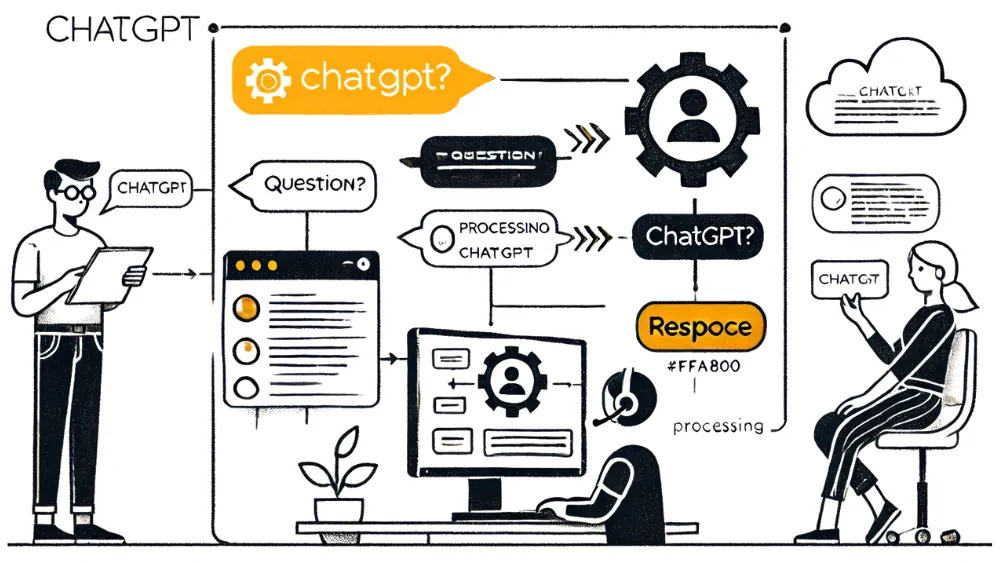 illustration: bing.com/create
Large language models (LLMs), like ChatGPT and Google Gemini, are among AI’s most impressive achievements. In recent years, artificial intelligence (AI) has revolutionized many areas of our lives. Although their function may seem magical, it’s actually based on solid mathematical and computer science foundations.
What Are Large Language Models and How Do They Work?
LLMs are language models trained on vast amounts of text data, enabling them to understand and generate human language naturally. These models use neural network architectures that mimic how the human brain works.
- Training: Building an LLM begins with gathering vast amounts of text data. This includes articles, books, websites, and even chat conversations. The model is then trained on this data, learning to recognize patterns and relationships between words.
- Text Generation: When we ask an LLM a question or give it a command, it analyzes the input text and tries to understand its meaning. Then, it generates a response by selecting words and phrases that are most probable in the given context.
- Reinforcement Learning: LLMs are continually improved through reinforcement learning. This means the model receives feedback from people on the quality of the text it generates, helping it to improve its skills and produce better responses.
Training data is like fuel for large language models (LLMs). It enables models to learn patterns, relationships, and contexts that allow them to generate coherent and meaningful text. The training data for ChatGPT, Google Gemini, and other LLMs is incredibly diverse, covering nearly all forms of text available on the internet: articles, books, websites, blog posts, comments, news, and even source code. The quality of training data is crucial to the quality of the text generated.
Architecture of Large Language Models
Large language models are incredibly complex systems that can be simplified to advanced "writing machines." However, unlike their mechanical predecessors, LLMs can "understand" language and generate coherent text.
The foundation of every LLM is neural networks. These are mathematical models inspired by the structure of the human brain. They consist of numerous interconnected artificial neurons that process information. In LLMs, these neurons process words and phrases.
How does it work in practice? When we input a text prompt in ChatGPT or Google Gemini, the model transforms it into a sequence of numbers representing individual words. The data then passes through successive layers of the neural network. In each layer, an attention mechanism allows the model to focus on different parts of the input text, enabling it to understand the context. Finally, the model generates a sequence of numbers, which is then converted back into text.
Limitations of AI Content Generators
While LLMs are advanced models, they also have limitations. Understanding these is key to using the technology responsibly.
- Lack of True Understanding: LLMs do not have a true understanding of the world and often struggle with fully grasping context, especially with complex or unusual queries. The generated text is based on patterns learned from training data.
- Possibility of Generating False Information: The model can produce text that is incorrect or misleading.
- No Consciousness: LLMs do not have consciousness or personal opinions. The text they generate reflects only the data on which they were trained.
ChatGPT, Google Gemini, and other AI content generators hold enormous potential but also raise ethical questions. One of the biggest concerns regarding the development of these systems is their potential use in generating misinformation, fake news, and influencing public opinion.
Challenges and the Future of LLMs
LLMs are continuously evolving, and their capabilities are expected to grow. Large language models will likely improve at mimicking human conversation and handling increasingly complex tasks. However, it’s essential to remember that LLMs are tools that should be used thoughtfully. Their development faces several challenges.
- Resource Consumption: Training and running LLMs require vast computational power, leading to high costs and a negative environmental impact.
- Bias: LLMs are trained on massive datasets that may contain hidden biases, leading to text generation that reinforces stereotypes and discrimination.
- Hallucinations: LLMs can generate text that sounds convincing but is entirely false. This phenomenon, known as hallucination, is a major problem associated with LLMs.
- Privacy: Collecting large amounts of text data to train LLMs raises significant privacy concerns.
- Interpretability: The operation of LLMs is very difficult for humans to understand, complicating error diagnosis and model improvement.
Researchers worldwide are working to address these issues. Current research focuses on improving energy efficiency, addressing bias, enhancing reliability, preventing hallucinations, and ensuring privacy protection.


COMMERCIAL BREAK

New articles in section Skills and knowledge
Audience mismatch. When and why short videos ruin a Youtube channel
KF × Gemini Deep Research
Shorts viewers stay in "swipe mode" and expect instant gratification. Watching a 30-minute documentary requires an active decision to click and a willingness for longer engagement. In specific situations, these mixed signals can seriously harm a Youtube channel.
How to reliably report uncertain data. A scientific meta-analysis
KFi
Numbers and mathematical intervals have a calming effect on news consumers. Political views, intelligence levels, or reader education do not alter how people process information about incomplete knowledge. Here are the results of dozens of media experiments regarding trust in the press.
Artificial intelligence in film and tv production. McKinsey report
Krzysztof Fiedorek
Global spending on video content has reached $180 billion, and the average viewer consumes it for 7.5 hours a day. Streaming is growing by 13%, while traditional television is losing 4% annually. As much as 84% of the US market is controlled by the seven largest players. Additionally, AI technology is reshuffling the market.
See articles on a similar topic:
Video, Photo, or Text? What Really Works in Social Campaigns
KFi
Can ecology go viral? How can complex environmental issues be communicated in an engaging and effective way? A study by Wenye Mao and Yuko Nishide from Tohoku University analyzes two elements of narrative strategy: the type of medium (posts, posters, videos) and the mode of storytelling (individual vs. group).
How ChatGPT, Google Gemini, and Other Large Language Models Work
Krzysztof Fiedorek
These powerful algorithms can generate text, translate languages, write various types of creative content, and answer your questions in a way that often feels like a conversation with a person. But how is it possible for a machine to mimic human intelligence so well?
Betteridge's Law. Is every headline with a question mark a gimmick?
Krzysztof Fiedorek
Betteridge's Law is a journalism hypothesis suggesting that any headline ending with a question mark can be answered with “no.” This rule applies to yes-or-no questions. It wasn’t actually created by Ian Betteridge and… it’s mostly untrue.
On TikTok, Music Rules. Three Tips from an Expert on How to Leverage It
BRM
Music dominates TikTok – more specifically, well-chosen music, as it often determines the success of a video, educational campaign, or advertisement. How should a company select music for TikTok content? Tips from Wojciech Psiuk, music supervisor from Sirens.