 po polsku
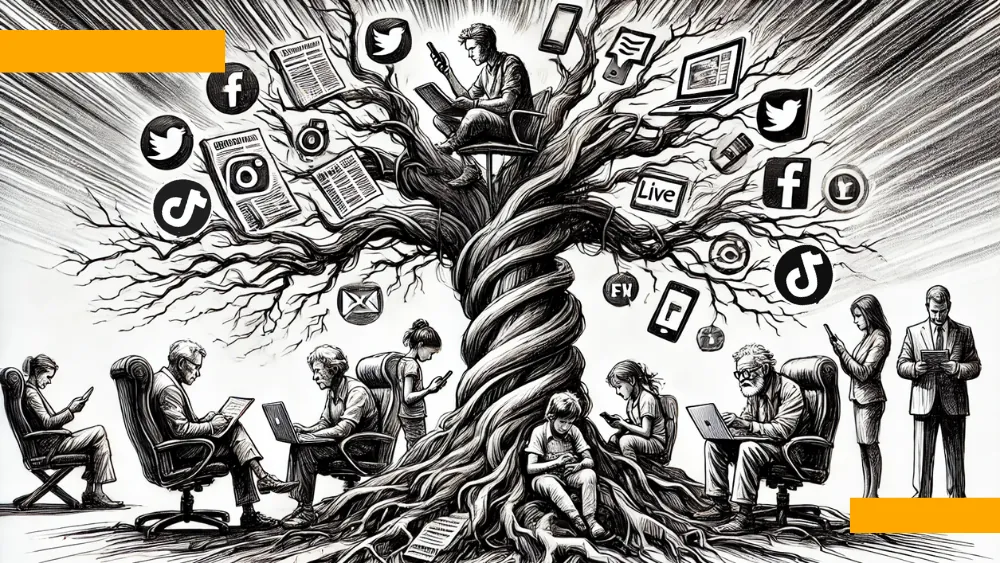 illustration: DALL-E
"The 2025 Social Media Report" by Shauna Moran and Tyler Ashe from GlobalWebIndex is shedding light on how our online behavior is evolving. The conclusion? Users are tired, but they’re not quitting social media. They want more authenticity and less posing. And brands? Brands must adapt to a new reality - one shaped by artificial intelligence, micro-communities, and a culture of "imperfection."
Time for “Less, But Better”
More and more people are saying they’re cutting back on time spent on social media. And while this doesn’t mean a mass exodus, the trend is clear. In 2024, 31% of users said they had reduced their social media use. In comparison - only 23% said the same in 2020.
| Year | Percentage of Users Reducing Social Media Use |
|---|---|
| 2020 | 23% |
| 2022 | 28% |
| 2024 | 31% |
What does this lead to? Platforms like Instagram and TikTok are no longer just places for self-presentation. Users are now looking for valuable content, information, and even... peace. They’re tired of seeing yet another vacation photo in the “everything’s perfect” style. They prefer people they can relate to.
Authenticity and Everyday Life: A New Aesthetic Direction
According to the GWI report, one of the strongest trends in 2025 is moving away from perfectionism. “Raw,” spontaneous, and authentic content is now more engaging than carefully produced videos.
- 42% of users aged 16–24 say they value “relatable content” more than “aesthetic content.”
- 35% of respondents prefer following people like themselves rather than celebrities or influencers.
- On TikTok, “day in the life” videos - simple, unpolished, but honest - are gaining popularity.
There’s also a subtle frustration. Users feel pressure to create “pretty” content, even though they’re increasingly uninterested in doing so. Brands need to understand that professional campaigns don’t always win over a spontaneously recorded video at home.
Micro-Communities and New Gathering Spaces
The The 2025 Social Media Report clearly highlights the rising importance of closed and niche communities. In an overstimulated world, users are turning to smaller groups - where they feel safe, can be themselves, and talk without judgment.
- Reddit and Discord are gaining popularity among younger generations.
- 27% of internet users under 34 say they value “compact communities with shared interests.”
- Facebook Groups and Telegram channels are becoming quiet leaders in engagement.
Example? Beauty brand Glossier dropped big ad campaigns in favor of moderated user groups. That’s where the most valuable insights are born and new ideas are tested. In this transformation, communities are no longer just audiences. They become co-creators, testers, and brand ambassadors.
Most Used Social Media Platforms by Generation
| Rank | Gen Z (16–27) | Millennials (28–41) | Gen X (42–60) | Baby Boomers (61–78) |
|---|---|---|---|---|
| 1 | YouTube | |||
| 2 | YouTube | YouTube | ||
| 3 | YouTube | |||
| 4 | TikTok | TikTok | TikTok | TikTok |
| 5 | x.com | x.com | x.com | x.com |
| Most Distinctive App | Snapchat | Threads | Kuaishou | Nextdoor |
Artificial Intelligence - Partner or Rival?
You can’t talk about social media today without mentioning AI. According to the GWI report:
- 39% of users have used AI tools to create content on social media.
- 48% of millennials believe AI helps them be more creative.
- The most commonly used tools are chatbots for post creation, photo editors, and music generators.
This trend comes with challenges. On one hand, AI democratizes creation - anyone can now create, edit, and publish like a pro. On the other hand, questions about authenticity and originality arise. Will audiences want to consume “machine-made” content?
It’s also worth noting that AI is changing how platforms work. Algorithms are getting more advanced, able not only to suggest content but to predict user needs.
1049 journalists in Europe silenced by lawsuits 👇
Influencers Face a Trust Crisis
Although the influencer marketing industry is still growing, its landscape is shifting fast. In 2025, audiences are much more sensitive to fakeness and artificiality.
Here’s the new list of expectations for online creators:
- Transparency in collaborations and sponsored content.
- Real stories instead of polished success narratives.
- The ability to engage in dialogue with followers.
Interestingly, the report says 41% of people aged 25–34 trust micro-creators more than stars with millions of followers. This shift means that for brands, reach is no longer everything - credibility matters most.
In this context, the rise of “creator economy 2.0” is key - a model based on long-term collaboration and relationships, not just one-off product promotions.
The full GWI report "The 2025 Social Media Report" is available at https://www.gwi.com/reports/social-media-trends/


COMMERCIAL BREAK
New articles in section Media industry
Vulnerable to disinformation. Study of fake news in social media
KFi, azk/ bst/ amac/
As many as 58 percent of Generation Z individuals are unable to recognize fake news in social media. Among those over 65, this figure stands at 29 percent - according to a study published in Poland by NASK and the Praktycy.eu association.
Radio in Poland 2025. Analysis of listenership and listener behavior
Krzysztof Fiedorek
Radio attracts 17.3 million listeners in Poland every day, who spend over four hours with their receivers. Interestingly, as much as 86 percent of station time is listened to via traditional FM waves. Despite digitalization, the internet accounts for only 12.5 percent of the listenership share.
Tags, hashtags and links in video descriptions. Youtube SEO after Gemini AI update [ANALYSIS]
BARD
Once, positioning a video on Youtube was simple. It was enough to stuff the description with keywords and wait for results. Those days are not coming back. In 2026, the algorithm is no longer a simple search engine that connects dots. It is the powerful Gemini AI artificial intelligence that understands your video better than you do.
See articles on a similar topic:
First Trillion Dollars. Advertising Market 2024 and Forecasts for 2025
DUG
GroupM, in its cyclical report "This Year Next Year," summarizing the past year and predicting trends for the next, has published the latest forecasts for global advertising markets. The estimated advertising market growth rate in 2024 is as high as 9.5%, bringing its value globally to over 1 trillion dollars.
Social Media and Relationships. Interesting Research from Palestine
KFi
What does love look like in the digital age? Does technology bring people closer or push them apart? In an era where Facebook and Instagram replace dinner table conversations, social media has become a new space for marital relationships. Researchers from An-Najah National University examined how technology can build bonds but also sow uncertainty.
Clickbait Uncovered. How Online Headlines Evolved Over 25 Years
Krzysztof Fiedorek
Researchers from the Max Planck Institute analyzed 40 million headlines from the past 25 years. They are getting longer, more emotional, and negative, with a clear influence of clickbait style. Even reputable media use strategies and tricks to grab attention.
Influencers 2024. Data, Facts, and Stories from the UNESCO Report
Krzysztof Fiedorek
As many as 68% of digital creators are nano-influencers. One in three has experienced hate speech, and over 60% do not thoroughly verify information before publishing. Moreover, only half disclose their content sponsors. The findings from the "Behind The Screens" report are both inspiring and alarming.