
 po polsku
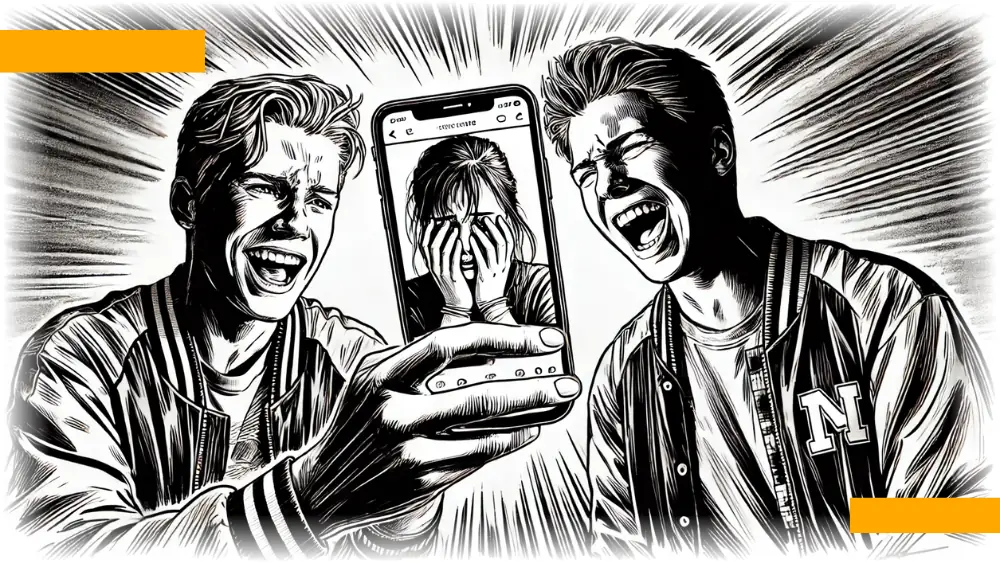 illustration: DALL-E
The report It’s just a joke: gender, sexuality and trivialisation in adolescent online violence such as cyberhate, cyberbullying, and online grooming by María Reneses, María Riberas-Gutiérrez, and Nereida Bueno-Guerra is the result of the European RAYUELA project. The study aimed to understand how gender and sexual orientation influence both experiencing and committing violence online. The findings are clear. The digital world, although seemingly democratic, is not free from inequality and stereotypes.
The authors conducted a two-step study. First, eight focus groups with 47 teenagers in five countries. Then representative surveys among youth in Madrid and Estonia. Both stages revealed a similar picture. Girls and non-heteronormative individuals are more often victims. Boys are more often perpetrators. These differences come from entrenched gender and social roles that the internet not only fails to break but often reinforces.
Boys attack girls suffer
The authors showed that gender largely determines who experiences and who inflicts online violence. Girls more often reported being targets of offensive comments, hate, and verbal harassment, especially about physical appearance. They were also more exposed to social exclusion and receiving unwanted sexual content.
Boys, on the other hand, dominated the group of perpetrators. They admitted more often than girls to sharing offensive memes, taking over accounts, or sending hurtful messages. In focus groups, it was often stated that boys’ aggression is masked as a “joke” and not taken seriously by peers or the perpetrators themselves.
| Role in violence | Boys more often | Girls more often |
|---|---|---|
| Perpetrators | v | |
| Victims | v | |
| Witnesses | v |
Although youth claim “anyone can be a victim” the narratives show clear links between violence and gender. Boys admit less often to being victims. Girls more often explain the violence as caused by their “lack of self-confidence.” This belief reinforces inequality and shifts the blame to those affected.
Most common forms of online violence
- Offensive messages on social media
- Exclusion from peer groups
- Receiving unwanted sexual images
- Sharing private photos or memes without consent
- Contact with adults with sexual undertones
The study also covered violence against LGBTQ+ individuals and people of different ethnic backgrounds. Respondents pointed to racism, homophobia, and sexism as common motives for attacks. Girls and non-heteronormative individuals repeatedly mentioned how hard it is to find understanding or support because hate against them is often justified by their lifestyle or appearance.
Ambiguous jokes and blaming victims
Trivializing violence through humor is one of the most dangerous phenomena described in the report. In focus groups, youth emphasized that many aggressive behaviors are justified as “jokes” or a way of communicating with peers. Boys in particular talked about “joking around” that might look like hate from the outside but is “normal” within the group.
At the same time, victims are often blamed for the violence. The narrative “if someone doesn’t care they won’t be attacked” was repeated often. This thinking reinforces stereotypes and the belief that weakness or sensitivity is the victim’s fault. Girls felt this especially strongly in situations related to appearance and clothing.
| Phenomenon | Girls | Boys |
|---|---|---|
| Receiving unwanted images | 17.2% | 6.4% |
| Peer group exclusion | 13.9% | 9.5% |
| Reporting cyberhate to adults | 21.6% | 11.3% |
| Witnessing violence | 41.2% | 27.8% |
| Admitting to cyberhate | 2.3% | 10.7% |
The data shows clear differences in both experiencing and committing violence. Particularly striking is the role of boys in cases of cyberhate driven by racism and homophobia. In Estonia, 27% of boys admitted insulting others because of their sexual orientation. Among girls, the figure was only 1.9%.
Who adds strangers who blocks
Conversations revealed clear differences in safety strategies. Girls are more cautious on social media. They add only friends or people recommended by others. They block strangers more often when they receive intrusive messages. Boys, on the other hand, showed more curiosity. They more often check the profile of a new contact before deciding to interact.
This behavior might explain why boys have more contact with adults pretending to be peers. But it is girls who more often face attempts by adults to establish relationships. One case told of a man who repeatedly created new accounts to contact a teenage girl despite her blocking him.
Normalization of grooming behaviors
Participants’ stories reveal how so-called grooming contacts have become normalized. Girls mentioned messages from adult men who suggested meetings or sent sexual photos. Some said these behaviors are everyday occurrences and “you just have to learn to ignore them.” Despite being aware of the danger, many downplayed these cases.
Do you trust AI-created news? You might have NO CHOICE 👇
Boys were less likely to admit being victims. But in three groups, it was pointed out that they more often play the role of perpetrators. This topic often caused discomfort and the statements were unclear. It can be assumed that there is strong social pressure discouraging boys from talking about such experiences.
Community hate circles and group sexism
In one Spanish focus group, the phenomenon of the “circle of homophobia” was described. Groups of boys fuel hate speech among themselves to build a sense of belonging and dominance. In private settings, they call each other slurs. Then they bring these practices to others at school or online. This group violence mechanism can be especially strong among young boys.
Although sexism online was rarely mentioned spontaneously, after researchers’ questions, youth admitted that women are often mocked in “funny” videos and comments. Girls not only experience such attacks more often but also face criticism from other women. Harsh judgments about “style” or “provocative photos” often come from peers.
**
The study was conducted under the RAYUELA project (EU, Horizon 2020) using a mixed method. Eight focus groups in five countries and a survey of 1,097 teenagers in Madrid and Estonia. Authors María Reneses, María Riberas-Gutiérrez, and Nereida Bueno-Guerra are researchers at Universidad Pontificia Comillas and Cardenal Cisneros University Centre. The findings were published in Humanities and Social Sciences Communications from the Nature group: https://doi.org/10.1057/s41599-025-04928-3


COMMERCIAL BREAK

New articles in section Media industry
Vulnerable to disinformation. Study of fake news in social media
KFi, azk/ bst/ amac/
As many as 58 percent of Generation Z individuals are unable to recognize fake news in social media. Among those over 65, this figure stands at 29 percent - according to a study published in Poland by NASK and the Praktycy.eu association.
Radio in Poland 2025. Analysis of listenership and listener behavior
Krzysztof Fiedorek
Radio attracts 17.3 million listeners in Poland every day, who spend over four hours with their receivers. Interestingly, as much as 86 percent of station time is listened to via traditional FM waves. Despite digitalization, the internet accounts for only 12.5 percent of the listenership share.
Tags, hashtags and links in video descriptions. Youtube SEO after Gemini AI update [ANALYSIS]
BARD
Once, positioning a video on Youtube was simple. It was enough to stuff the description with keywords and wait for results. Those days are not coming back. In 2026, the algorithm is no longer a simple search engine that connects dots. It is the powerful Gemini AI artificial intelligence that understands your video better than you do.
See articles on a similar topic:
Digital Newspapers in Poland
Bartłomiej Dwornik
The three largest distributors of digital press editions in Poland sell around 270,000 e-magazine copies monthly, according to Money.pl analysis. Digital press is mostly read by experienced internet users, managers, and emigrants.
Media in the Balkans and Turkey
Michał Kuźmiński
The Balkans have long been referred to as a “melting pot,” and for good reason. This region is highly diverse and quite unstable. Consequently, the media landscape here is varied as well. In some places, such as democratic Greece, a member of the European Union, the media market is stable and easy to navigate.
Automation of Disinformation. Global Risks Report 2025 and Media
Krzysztof Fiedorek
Disinformation and information manipulation have ranked first among global threats in both the two-year and ten-year perspectives. A particularly concerning factor is that social media algorithms often favor controversial or shocking content, further fueling disinformation.
Work in the media. We have more recruitment offers at Reporterzy.info [LINK]
AUTOPROMOCJA Reporterzy.info
Thanks to cooperation with the recruitment website Talent.com, the database of recruitment advertisements published in Reporterzy.info has been significantly enriched. We invite you to browse current job offers and internships in the media and advertising industry from the largest Polish cities.