 po polsku
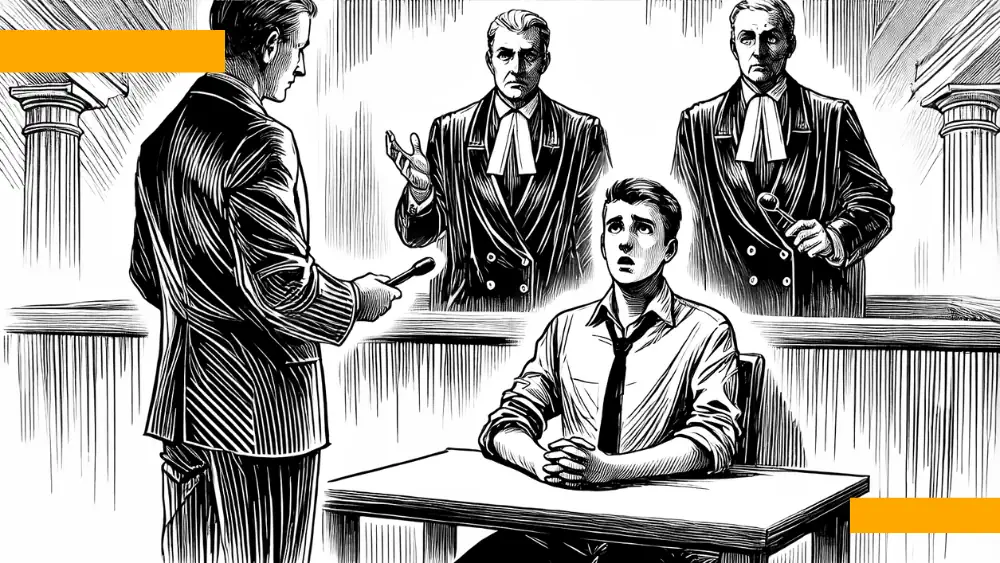 illustration: DALL-E
Translation supported by Google Gemini
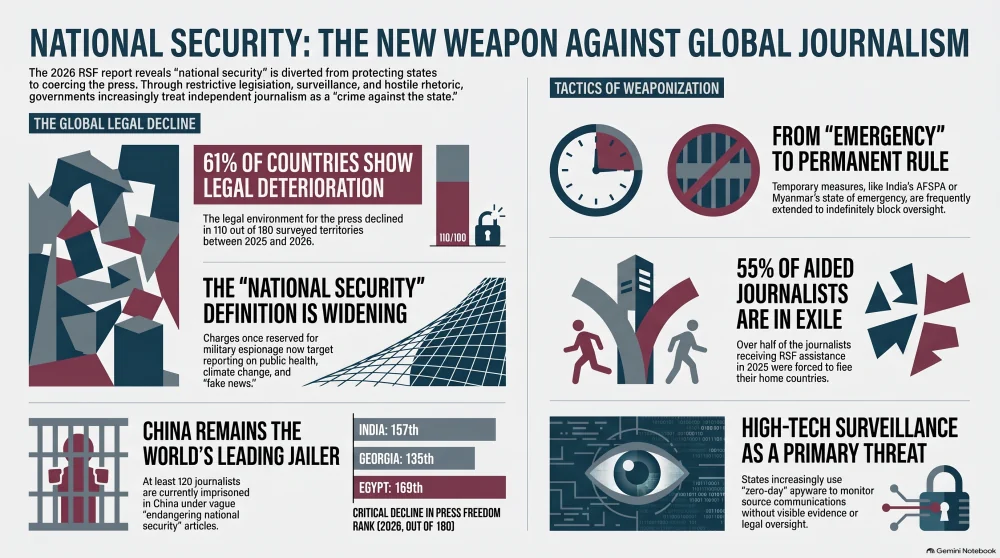
The authors show how states treat a free press as a deadly threat instead of protecting it as a core foundation of democracy. Journalism is not a crime against any state. Protecting it is an urgent need for us all. Every unfair criminal case against an ordinary journalist permanently damages the ability of citizens to understand the world around them.
Expanding definition of threats
State authorities willingly use words like spies, traitors, and common terrorists in their propaganda. They equate reporters with opposition groups or dangerous geopolitical enemies in this subtle way. Democracies do not lag behind in this trend. They also misuse state secret laws to suppress uncomfortable facts.
The document from Reporters Without Borders clearly proves that war and political instability create fertile ground for public fear. This gives governments a convenient excuse to increase control over independent media.
The case of Julian Assange remains the most prominent example of such actions. The United States pursued the WikiLeaks founder for fourteen years to bring him before an American court. The US government argued that he conspired to obtain secret military information, though it never proved this in court.
| Fact from Julian Assange`s case | Numerical value |
|---|---|
| Number of published secret documents | 250 000 |
| Potential sentence in years of imprisonment | 175 |
| Number of charges against the journalist | 18 |
| Days spent in harsh Belmarsh prison | 1 901 |
| Final sentence in months | 62 |
Figures in the table show the massive pressure exerted by a powerful state on an independent publisher. Assange left London prison on June 25, 2024, after pleading guilty to one charge, and moved to Australia. Reporters Without Borders had long called for a quick resolution to this situation. The team also runs a specialized lab that studies daily digital threats to investigative journalists. The Digital Security Lab helps newsrooms in concrete ways every day.
- It inspects physical devices for traces of compromise or hidden spyware.
- It analyzes dangerous phishing attempts and harmful online communication.
- It investigates suspicious account takeovers and unauthorized system access.
- It documents digital attacks to support efforts for legal accountability.
Lab actions save professional equipment and valuable data for many editors worldwide. Cyberattacks using advanced software exploit unknown security flaws. Journalist smartphones contain sensitive information, including private talks with confidential sources.
New laws and censorship in practice
The report "National security as A weapon against Journalism" details the hard situation in Cuba. The entry into force of a new social communication law in 2024 increased pressure on independent media. Police officers question journalists under fake charges of government propaganda and mercenary work. Authorities present independent articles as deliberate attempts to destabilize the socialist system. The Cuban legal system has banned private media since 1959.
Similar legal mechanisms operate in Tunisia. State Decree number 54 from 2022 bypasses the goal of fighting cybercrime. The law violates basic terms of the Budapest Convention on Cybercrime. Vague rules give authorities broad powers and threaten secret informants. Tunisian police often detain journalists under false pretexts of spreading fake news.
Digital surveillance of society
The military junta in Myanmar went a step further in its actions. In January 2025, military rulers adopted a new law on cybersecurity. Officially, these rules protect state sovereignty and ensure stability. However, the report from Reporters Without Borders shows that the rules give authorities huge powers to censor the internet.
| Country introducing changes | Year of new law | Main charge against free media |
|---|---|---|
| Cuba | 2024 | Propaganda against government policy |
| Tunisia | 2022 | Spreading fake news |
| Myanmar | 2025 | Distributing improper information |
In Myanmar, new rules ban citizens from using VPNs to bypass state blocks. Distributing improper information carries high fines or long prison terms. The reach of this law extends to citizens living abroad. Western tech experts call this model a classic Chinese variant. The system prioritizes state control over digital privacy.
Software company Geedge Networks supplies the junta with tools for deep surveillance. These tools allow state services to monitor user network traffic in real time. The company previously built systems for the Great Firewall of China.
The authors call on democratic governments to adopt a narrow definition of real threats. Politicians must avoid vague terms in laws, such as harm to state interests, to protect free journalism.
The full report "National security as A weapon against Journalism" is available for free on the Reporters Without Borders website.


COMMERCIAL BREAK

New articles in section Law in media
Blood in the world of media. The IFJ report on journalists killed in 2025
KFi
The International Federation of Journalists has published a shocking document titled 2025 Killed List Report. The increase in violence against media workers is visible all over the world. Last year, 128 people lost their lives. They die because of their courage in revealing facts that authorities try to hide.
Ai in disinformation. Operation Matryoshka and personalization of fakes
Anna Mikołajczyk-Kłębek
The increasing use of artificial intelligence to generate false content and profiled disinformation are trends that will shape the disinformation landscape in the coming years, according to Dr. Wojciech Kotowicz, an expert from the University of Warmia and Mazury (UWM) in Olsztyn, Poland.
Dietary supplement ads in Poland. Who keeps influencers in check?
Newseria, KFi
One in three Polish internet users considers influencer recommendations when deciding on medicines and dietary supplements. Although promotion of such products is regulated, there are still cases of advertising that skirt the law.
See articles on a similar topic:
How to Detect Pegasus on Your Phone and Protect Against Spying
RINF
The nature of spyware is to remain as hidden as possible, making it difficult to detect on a device. However, some mechanisms can help verify if a smartphone has been compromised.
SEO Poisoning. Hackers Use Search Engines to Target Businesses
Piotr Rozmiarek
Search engines help us quickly find information, but they can also be used by cybercriminals. SEO poisoning is a tactic where attackers manipulate search engine rankings to place harmful websites at the top of search results.
Deepfake. A Powerful New Weapon in The Information War
Krzysztof Fiedorek
One of the newest threats to the credibility of information is deepfake technology. Deepfake is a type of false video or audio material where the person in the recording appears to speak or behave in a way that does not align with reality.
Local Media in Poland - Corrections
Bartłomiej Dwornik
The regulations regarding corrections are perhaps the most frequently violated rule in Polish media. There is a clear division between those who never admit to mistakes and those who can humbly accept their faults.