
 po polsku

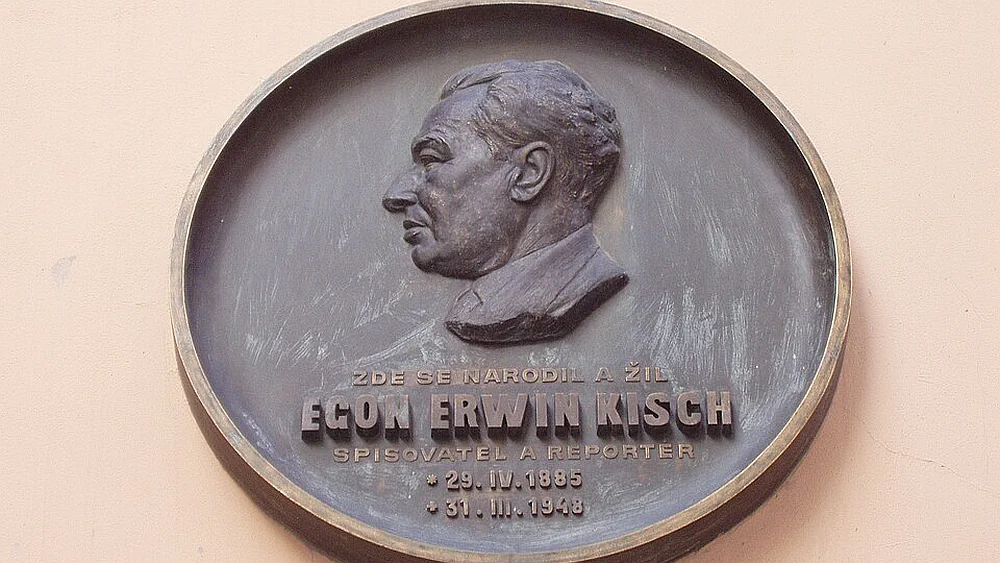 fot. Ladislav Faigl, wikimedia commons
In 1885, Prague, like all of Bohemia, belonged to Austria-Hungary and enjoyed both economic and cultural growth. In this increasingly wealthy city, on Melantrichova Street, the Kisch family lived in the townhouse "At the Two Golden Lions". Hermann was a merchant (he traded in cloth) and owned a shop located in the same building. Ernestine took care of the home and on April 29 gave birth to their second son. The boy was named Egon Erwin.
Both Egon and all of his brothers (three more boys were born after him) received a solid German-Jewish education:
- Seidel private school, 1891
- Piarist school, 1892
- Imperial-Royal First German State School (Realschule), 1895
Thanks to his father, a lover of German literature, Egon caught the prose bug at a young age. However, after finishing his basic schooling, he began studying at the Polytechnic in Prague in October 1903. He lasted one semester and transferred to the department of German literary history and medieval philosophy at the German-language Ferdinand University.
A fencing enthusiast with an anarchist label
As a student, he liked "political" duels, and not with words, but with sabers, fighting several of them. They resulted in a treatise on the Prague dueling system (Bohemia, 1906-11 and the book Aus Prager Gassen und Nächten, 1912).
In 1904, Kisch enlisted as a volunteer in the 11th Prague Home Regiment, but he did not like military life very much. His constant conflicts with superiors meant he spent most of his service in detention. As a result, he received no final promotion, only the nickname of an anarchist.
A love of literature, rooted by his father in young Egon`s life, made itself known back in his school days. In 1899, fourteen-year-old Kisch published his first poem in a Prague newspaper. He signed it with his middle name, Erwin, to avoid trouble at school, where the school heads banned such "practices". He repeated this move in 1905. With his mother`s financial support, he published his first book of poetry "Vom Blütenzweig der Jugend" (From the Blooming Branch of Youth).
That same year, he started new studies, this time in Berlin at the WREDE School of Journalism. Although he stayed there for only one semester, he managed to publish his second book, a collection of fairy tales titled "Der freche Franz und andere Geschichten" (Cheeky Franz and Other Stories, Berlin 1905). By March 1906, he was back in Prague, where he took a job at the German-language newspaper Prager Tagblatt.
Investigative reporter from poor neighborhoods
In April 1906, Kisch received a job offer as a reporter at the Prague daily Bohemia, which he eagerly accepted. Thus began his path in journalism, which he used to the best of his ability. He was 21 years old, had two books to his name, clear views, and Paul Wiegler, an experienced and well-known writer and journalist, as his mentor.
During his first year, the young journalism trainee honed his skills on the streets of Prague. He wrote mainly about life in the poorest neighborhoods of Prague, though he did not avoid crime cases either. He quickly became a skilled investigative reporter, which did not always please the "gentlemen in office". At first he wrote columns, then longer articles, and finally reportages. This last form of expression became closest to his heart.
Kisch did not sit behind a desk. He went out to people and took trips, such as the one in 1910, when he floated on a raft from Prague to Magdeburg to describe the work of Czech rafters (Floßfahrt, Bohemia, July 1, 1910).
Andreas Haase, the owner and publisher of Bohemia at the time, appreciated Kisch`s work and in August 1910 entrusted him with the column Prague Rambles (Prague Strolls). The first column in this series appeared on Sunday, August 7. On subsequent Sundays, readers eagerly awaited accounts of the reporter`s various investigations. A major sensation was the one from November 27, a report from a meat rendering plant (Bei "Antouschek", dem Wasenmaister, Bohemia, November 27, 1910). There were other sensational articles too, even though they had nothing to do with crime.
In September 1911, Kisch interviewed Thomas Alva Edison, who was passing through Prague. It was the first of his international interviews with such an important figure and echoed widely in the Czech press.
Ubiquitous correspondent, or the "raging reporter"
A year later, Erwin (he began using this name more often) started his career as a correspondent. Although he had already traveled outside Bohemia on behalf of the editorial office before, it was only in September 1912 that a series of reports from London cemented his position in this editorial section. That same year, his third book (From Prague Streets and Nights) came out, and another was already in preparation. In his reportages, columns, articles, and books, he often referred to his school years and time in the army, pointing out the flaws in those areas of life.
He was a man of many interests, and besides the underworld, he often visited Prague cafes, where he met various artists, writers, and cultural figures (Rainer Maria Rilke, Franz Kafka, Jaroslav Hašek). He used both those dark stories and the "high-brow" ones in his columns, and later in his books.
Kisch was known as a reporter who was everywhere. Whenever something interesting happened in Prague, he was there, watching, asking questions, and writing. It was in the newsroom of Bohemia that he received the nickname raging reporter, which stuck with him for the rest of his life.
Kisch parted ways with Bohemia in June 1913. He left for Berlin and began working with Berliner Tageblatt. Before leaving Prague, on May 28 he published an article in Bohemia about the suicide of Colonel Redl. His investigation exposed a spy affair that the authorities could not hide. He departed for Germany in glory and fame, with a huge success to his credit.
What can you buy for a penny?
In Berlin, Kisch worked as a reporter. One of his first reportages was "Wat koofe ick mir for een Groschen?", which meant in the Berlin dialect what can I buy for a penny (10 pfennigs). Egon often used the local dialect, winning the affection of Berliners. In the spring of 1914, he filled in for Gerhart Hauptmann as a dramaturge at the Berliner Künstlertheater (Berlin Artists` Theater), but this career, along with his entire stay in Berlin, was cut short by military conscription. In July, World War I broke out.
In August 1914, Corporal Kisch and his unit, the 11th Infantry Regiment, began fighting in the campaign against Serbia. The first years of the war were turbulent for the reporter. He took part in many battles, including:
- Cer (Jarad), August 16-24, 1914
- on the Drina, September 6-October 4, 1914
- Russian front, February 1915
- wounded on March 18, 1915
Throughout the fighting, he never parted with his notebook. He wrote down everything that happened, what troubled the soldiers, and the incompetence of superiors. His comrades from the regiment often repeated: Write this down, Kisch! He wrote it down, and in 1922 he published a book about this campaign under that very title.
Although he was declared unfit for active duty, from 1916 he worked as a censor. A year later, holding the rank of lieutenant, he was assigned to the War Press Headquarters in Vienna, the press staff of the Supreme Commander of the Austro-Hungarian Army. Here he began working for an illegal council of workers and soldiers. He was one of the founders of the Red Guard (a military organization), becoming its commander on November 1, 1918. However, on November 18, under government pressure, he resigned from this post and became editor of Der Freie Arbeiter (The Free Worker), which was founded on November 28. Starting with the second issue, a supplement called Die Rote Garde (The Red Guard), edited by Kisch, appeared. Here too, the editor regularly published his texts.
Expelled from Austria. Through Prague to Berlin
His views did not appeal to the authorities, who launched a campaign against him. Disappointed, he quit his job at The Worker and moved to the Viennese paper Der Neue Tag. At the same time, he joined the ranks of the Communist Party of German-Austria (KPDÖ). His criticism of the political situation and the newly formed state led to his expulsion from Austria.
Kisch returned to Prague in the summer of 1920. He published his next book, Die Abenteuer in Prag (Adventures in Prague) , resumed cooperation with Prager Tagblatt, visited Slovakia and France, and returned to Berlin in the autumn of 1921. This time, his "Berlin affair" lasted for 12 years, until 1933. During this period, he held no full-time staff job, but worked with over a dozen newspapers, including:
- Berliner Tageblatt
- Die Rote Fahne
- Arbeiter-Illustrierte-Zeitung (AIZ)
- Weltbühne
- Neue Bücherschau
- Willi Münzenberg Konzern
Many of these titles were newspapers sympathetic to communism or even owned by communist parties. Kisch did not hide his left-wing views. He also frequently visited countries under that system. He went to the Soviet Union and China several times. He also visited Algeria and Tunisia and published reports from these trips in Berlin newspapers. In 1924, he collected them all and published them in print as a book titled Der rasende Reporter (The Raging Reporter). The nickname, which had been circulating in the journalism market for some time, now stuck with him permanently.
In 1922, he became the official Berlin correspondent for the Czech newspaper Lidove Noviny. While he raged across Europe, North Africa, and especially the Soviet Union, he also gathered material for his books. During his Berlin years, he published over 10 of them, including:
- Klassischer Journalismus (Classical Journalism) 1923
- Zaren, Popen, Bolschewiken (Tsars, Priests, Bolsheviks) 1927
- Schreib das auf, Kisch! Ein Kriegstagebuch (Write This Down, Kisch! A War Diary) 1930.
- Die Reise um Europa in 365 Tagen. Eine groteske Begebenheit in 15 Bildern (A Journey Around Europe in 365 Days. A Grotesque Incident in 15 Pictures) 1930 written jointly with Jaroslav Hašek
- Egon Erwin Kisch beehrt sich darzubieten: Paradies Amerika (Egon Erwin Kisch Has the Honor to Present: Paradise America) 1930
- Asien gründlich verändert (Asia Thoroughly Changed) 1932.
- Egon Erwin Kisch berichtet: China geheim (Egon Erwin Kisch Reports: China Secret) 1933.
In 1924, he also published a book about the spy affair and death of Colonel Redl, a case that had brought him huge success in 1913 and cemented his standing as a journalist (Der Fall des Generalstabschefs Redl. 1924). He returned to more than just this issue. In his articles, he often touched on topics tied to his past: school, the hidden corners of Prague, or the war.
Master of participatory reportage
Yet what defined this period of his work most was a specific style of reportage never seen before. His travels yielded this very form of reporting. The books he published were mostly collections of his earlier work in this field. He reached its peak and was an irreplaceable master, a model for all journalists of his own generation and later ones. He explored themes of exploitation and processes of alienation in modern society.
When Kisch had his fill of Europe and Africa, he boarded a ship to America. On October 31, 1928, he stepped ashore in New York. For several months, he traveled between Baltimore, Los Angeles, Chicago, and Detroit on various ships, not always as a passenger, but as an ordinary sailor. He met with Charlie Chaplin and writer Upton Sinclair. Accounts of this journey appeared as a series of reportages in Welt am Abend and Die Rote Fahne.
After returning from the US, he visited France, and in November 1930 he went to Kharkiv. He served as a delegate to the World Conference of Revolutionary Writers. On November 15, he received a post as lecturer at the Faculty of Journalism of the Artem Communist University in Kharkiv. His lectures lasted until February 1931, after which he set off on a trip across Soviet Central Asia, ending it on September 15 with a meeting with Maxim Gorky in Bad Saarow, back on German soil.
He returned briefly to Berlin, and then in the spring of 1932 he set out for China and Japan. The raging reporter could not sit still.
Communist accused of treason
Kisch also worked to defend communist activists. He became a member of the Association for the Protection of German Writers (SDS, 1924) and the Communist Party of Germany (KPD, 1925), and he also co-founded the League of Proletarian-Revolutionary Writers" (BPRS, 1928).
His reportages and admiration for everything related to the USSR brought an end to his career in Germany. On February 28, 1933, at 5:00 a.m., Egon Ernest Kisch was arrested and charged with high treason. He spent nearly two weeks in Spandau Fortress. Following a protest by the Czech government (he was officially a Czech citizen), he was deported (with a signed receipt) to Prague, where in the pages of Arbeiter-Illustrierte Zeitung (Workers` Illustrated Newspaper), he described his time in prison.

A series of five reportages, In den Kasematten von Spandau (In the Casemates of Spandau), appeared in the April issues of the paper and exposed Nazi crimes. Kisch spared no one in them. He also spoke on this issue at the Anti-Fascist Workers` Congress of Europe, held in June 1933 in Paris. Kisch entered into a closer, five-year cooperation with Arbeiter-Illustrierte Zeitung.
Although he emigrated to Paris in 1934, his reportages continued to appear regularly in the Prague paper. He did not stop traveling either. Before the end of 1933, he visited France, Belgium, the Netherlands, and Spain, and his reports from Spain held special value. The political situation was grim, which Kisch documented thoroughly.
Threat to Australia
During his "Paris years" (1934-1939), Kisch worked with the French left-wing newspaper Regards. His reportages enjoyed great success and attracted new readers. Among the more "instructive" ones were:
- Borinage in the issue of May 11, 1934, in which Kisch described the situation of Belgian miners.
- Dans le Prado désaffecté from September 23, 1937, where he described the situation of the famous museum and its collections during the civil war.
He also worked with La Presse Nouvelle as well as the German-language Unsere Zeit. He published books. Some were collections of his reportages, such as Abenteuer in fünf Kontinenten (Adventures in Five Continents, 1936), while others contained short stories, like Geschichten aus sieben Ghettos (Stories from Seven Ghettos, 1934). In 1937, his book Landung in Australien (Landing in Australia) came out, in which he described his stay on that continent in greater detail than in his reportages. Admittedly, that landing was quite literal, except it was not from a plane, but into sea water.
In 1934, Kisch set off on a trip to Australia aboard a British ship. He held a valid passport and visa. He was sailing to Melbourne for the All-Australian Anti-War Congress. Australian authorities, knowing his communist views, deemed him a threat. They confiscated his passport and refused him permission to go ashore. Desperate, Kisch jumped from the six-meter railing straight into the ocean waves. He broke his leg.
After pulling him from the water, they put him back on the ship, and he sailed to Sydney. There he ended up at a police station, then before a court, which sentenced him to three months of hard labor for illegal border crossing. However, he did not serve the sentence, as he was released on bail. This story echoed loudly across the country. The Australian left organized strikes, protests, and demonstrations that came close to causing a government crisis. Authorities were accused of sympathizing with the Nazis. The ban on his stay was lifted, and Kisch set off on a tour of the country. It was the most famous expedition of the raging reporter, and perhaps the most reckless one.
Reportage is a form of struggle
In 1937, Kisch visited soldiers of the International Brigades on various fronts of the Spanish Civil War. Naturally, he sent reports to the newspapers he worked with, and the result of these interviews was two brochures published by the Brigades themselves in 1938: Die drei Kühe (Three Cows) and Soldaten am Meeresstrand, (Soldiers on the Seashore).
Feeling himself a communist, Kisch was heavily involved in politics. He took part in congresses, debates, and ordinary meetings. Everywhere he went, he presented his point of view. He argued that reportage is not only an art of writing, but also a form of struggle, Reportage als Kunstform und Kampfform (First International Congress of Writers for the Defense of Culture, Paris 1934). French authorities were deeply alarmed by his activity. In September 1939, they forced him to move to the provinces, placing him under house arrest, and in December he was sent to Ellis Island.
He was rescued from this predicament by American immigration authorities. They granted him a transit visa. Back in 1936, Kisch had signed a contract with the New York publishing house of Alfred A. Knopf to write his biography. By January 1940, the reporter was greeting American supporters. Unfortunately, America was not Europe. Knopf broke the contract under the pretext of political pressure. Yet Kisch did not give up. He gathered material about the life of Jews in the USA, and at the end of the year he left for Mexico.
Crawling in the inky river
Meanwhile, war broke out in Europe. Being far from home proved beneficial for the reporter, because as a Jew his life was in danger (one of his brothers died in the concentration camp in Łódź, and another in Terezín). He did not feel safe in America either, hence his departure for Mexico.
The war in Europe and the treatment of the Jewish people by the Germans convinced Kisch of his decision to live overseas. He chose Mexico. Here he began working with the newspaper Freies Deutschland (Free Germany) and co-founded the emigrant organization Heinrich-Heine-Klub. He became its vice president on November 10, 1941. At the same time, however, his biography was published in the USA, though under a changed title. It was supposed to be Crawling in the Inky River (Crawling in the Inky River) and instead became Sensation Fair (Sensation Fair), in English of course. A year later, the Mexicans fixed this mistake. Although they slightly changed the title to Marktplatz Fair (Marketplace Fair), the book was at least in the original German language.
Kisch would not be himself if he had to sit behind a desk. He set out in search of topics about life in Mexico and printed his reportages in Freies Deutschland. One of the first was from December 1941, titled Das Rätsel der Jüdischen Indianer (The Riddle of the Jewish Indians). This reportage also appeared in the Chilean magazine Jewish Weekly Review - Semana Israelita, in 1942, and in 1945 in the book Entdeckungen in Mexiko (Discoveries in Mexico).
Besides Freies Deutschland, where he was a full-time editor, Kisch also worked at Demokratische Post, a German-language emigrant newspaper. He also collaborated on films as a co-writer of screenplays. In 1943, he was a member of the Spanish crew for the documentary film in progress El Libro Negro del Terror Nazi en Europa" ("The Black Book of Nazi Terror in Europe").
How is Prague? Is it still standing?
Five years of war spent in exile did not shake Kisch`s communist views. On the contrary, he became a Stalinist, which caused the breakup of many friendships and acquaintances. However, he did not speak on this subject. He did not deny the decisions of others, did not condemn, and simply kept silent. He did what he considered right in his life.
The end of the war found him in Mexico, and he wanted to return home to Prague, to which he always felt strongly attached. On February 17, 1946, he began his return journey via New York and London. When he landed at the Prague airport on March 21, his first words to his friend Vincenc Nečas were reportedly: How is Prague? Is it still standing?
After returning, he lived as before. He worked for Czech communism (he gave a speech at the VIII Congress of the Communist Party of Czechoslovakia), gathered materials for a book about Czechoslovakia, and traveled (Yugoslavia). He began working on several reportages at once (Karl Marx, a meeting with poet Petr Bezruč). Unfortunately, he finished none of them. In September 1947, he was admitted to a cardiology clinic, and in November he suffered a stroke. On March 24, 1948, he had a second stroke, and on March 31 at 1:45 PM his heart stopped. There was no saving him.
Egon Erwin Kisch was cremated and buried on April 5. On September 30, 1948, his ashes were moved to the urn grove at Strašnice Cemetery in Prague.
Such in brief was the life of the raging reporter. He left behind over a dozen books and hundreds of reportages of a specific form and style. He was a master for subsequent generations of journalists. He mastered to perfection the art of combining documentary fact with poetic storytelling. He never renounced his love for Prague and Judaism, though he was not religious. He considered himself a citizen of the world. He used to say: I am a German. I am a Czech. I am a Jew. I come from a good family. I am a communist. Something out of that always helps me.
Timeline of Egon Erwin Kisch
- 1885, April 29 - birth of Egon Erwin Kisch
- 1891-1903 - Kisch studied at prestigious Prague schools
- 1899 - first writing attempts in newspapers
- 1903, October - beginning of his student years
- 1904 - Kisch joins the army
- 1905 - first published book, "Vom Blütenzweig der Jugend" (poetry collection)
- 1905 - studies at the Berlin School of Journalism "Wrede"
- 1906, March - work at Prager Tagblatt
- 1906, April - full-time job at the daily Bohemia
- 1907 - first travels in pursuit of a story (Piraeus, Constantinople, Naples)
- 1910, August 7 - first broadcast of reportages under the column Prague Rambles
- 1911, September - interview with Thomas Alva Edison (first interview in the reporter`s career)
- 1912, September - Kisch as a correspondent (London)
- 1913, June - departure for Berlin and start of cooperation with Berliner Tageblatt
- 1914, August - Kisch, holding the rank of corporal, takes part in the campaign against Serbia
- 1916 - work as a censor during military service
- 1917 - editor at the War Press Headquarters in Vienna
- 1918, November 1 - Kisch co-founds the military organization Red Guard
- 1918, November 28 - becomes editor of Der Freie Arbeiter
- 1919, March - move to Vienna and work for Der Neue Tag
- 1920, spring - deportation from Austria
- 1921 - 1933 - years spent in Berlin
- 1922 - work as Berlin correspondent for the Czech daily "Lidove Noviny"
- 1924 - publication of the book "Der rasende Reporter", published by Erich Reiss, Berlin.
- 1928, October 31 - start of travels across the USA
- 1930, November - Kisch becomes lecturer at the Faculty of Journalism of the Artem Communist University in Kharkiv
- 1933, February 28 - arrest of the reporter
- 1933, March 11 - deportation from Germany to Prague
- 1934 - emigration to Paris
- 1934 - 1939 - Parisian period
- 1934 - trip to Australia
- 1937 - Kisch on the fronts of the Spanish Civil War
- 1939, September - French government places Kisch under house arrest
- 1939, December - stay on Ellis Island
- 1940 - second stay in the USA
- 1941- 1946 - Kisch in Mexico
- 1941, November 10 - founding of the emigrant organization Heinrich-Heine-Klub, Kisch becomes vice president
- 1941, December - full-time job at Freies Deutschland
- 1946, March 21 - return to Prague
- 1947, November - first stroke
- 1948, March 31 - death of Egon Erwin Kisch
Sources:
- https://www.egon-erwin-kisch.de/bio.htm
- https://www.hagalil.com/austria/gemeinde/kisch.htm
- https://pm20.zbw.eu/mirador/
- https://de.wikipedia.org/wiki/Egon_Erwin_Kisch
- https://www.egon-erwin-kisch.de/
- https://katalogi.bn.org.pl/discovery/fulldisplay?vid=48OMNIS_NLOP:48OMNIS_NLOP&docid=alma991011613499705066&context=L
- https://wolnelektury.pl/katalog/autor/egon-erwin-kisch/
- https://www.deutsche-biographie.de/gnd118562533.html?language=en&utm_source=chatgpt.com#ndbcontent
- https://encyclopedia.yivo.org/article/1031
- https://adb.anu.edu.au/biography/kisch-egon-erwin-10755?utm_source=chatgpt.com
- https://www.dhm.de/lemo/biografie/egon-erwin-kisch?utm_source=chatgpt.com
- https://kalliope-verbund.info/de/query?q=ead.creator.gnd%3D%3D%22118562533%22&utm_source=chatgpt.com
- https://ruj.uj.edu.pl/server/api/core/bitstreams/3c9d003c-2a07-41d8-bdbe-5667490b76a6/content
- https://d-nb.info/931462568/04


COMMERCIAL BREAK

New articles in section History of the media
Havas. The history of the world's first news agency
Małgorzata Dwornik
The idea of two bankrupt Frenchmen in 1835 turned out to be brilliant: use information as a commodity. Along with translators, messengers, and correspondents, they hired a flock of carrier pigeons. These birds carried news from London to Paris in a single day. The product of L'Bureau Havas quickly became popular far beyond Europe.
România Liberă. 150 years of history of the Romanian press
Małgorzata Dwornik
On May 14, 1877, Romania officially declared independence from the Ottoman Empire, and just one day later, the newspaper România Liberă (Free Romania) appeared on the Bucharest market. Its founder, first director, and journalist was Dimitrie August Laurian, strongly supported by Professor Ştefan Mihăilescu.
El Mercurio de Valparaiso from Chile. The oldest Spanish language newspaper in the world
Małgorzata Dwornik
The first issue started a revolution in South America. It survived 200 years of turbulent history: headquarters fires, editorial office looting, economic crises, and dictatorship. Today, El Mercurio de Valparaiso holds a unique status in the Chilean media market. And the title of a UNESCO World Heritage site.
See articles on a similar topic:
Népszava. The history of Hungary's oldest newspaper
Małgorzata Dwornik
The first editor used a pseudonym. The paper was printed in both Hungarian and German. The military destroyed the newsroom. Journalists died in the Danube’s currents. Népszava survived monarchy, dictatorships, and revolution. And it still exists.
Jamal Khashoggi. A media trap, illusion of freedom, and price of free speech
Małgorzata Dwornik
He knew Osama bin Laden personally and advised Saudi kings, only to eventually become their greatest critic. Jamal Khashoggi entered the consulate in Istanbul and vanished without a trace, shocking world public opinion. This is the story of a man who traveled the path from palace salons to exile, paying the ultimate price for the fight for freedom of speech.
Haveeru Daily ހަވީރު. History of the longest-running newspaper in Maldives
Małgorzata Dwornik
Since its inception, the newspaper has faced unexpected challenges. From having to print on manual presses, to legal battles over title rights, to occupation strikes at the publishing house, arrests of journalists, and even arson at its headquarters. In 2024, the editorial team (once again) won the right to publish the paper in court. Readers hope that this time, it’s here to stay.
History of Public Relations. From Ancient Times to a Field of Study
Małgorzata Dwornik
Public Relations - two words we come across several times daily. We hear them on TV and radio, and read them in newspapers. PR - two letters that can sometimes cause quite a stir.